
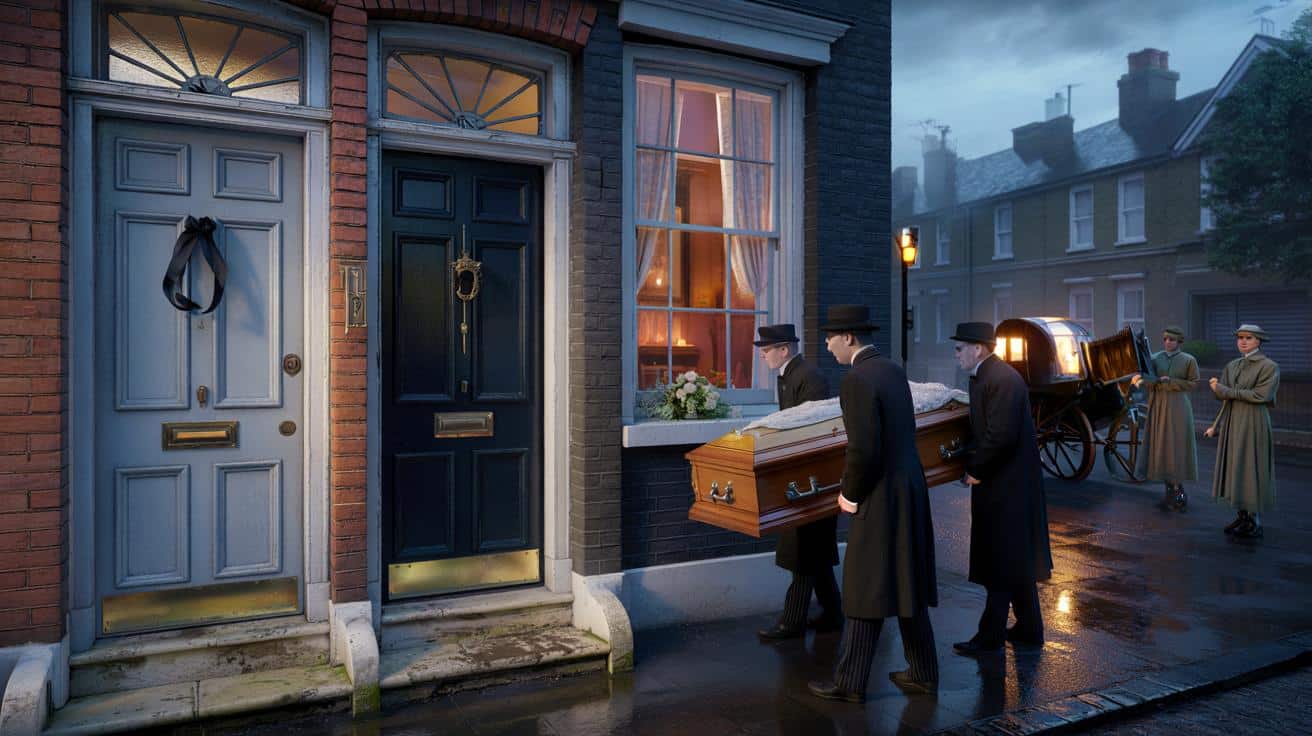
A second door, painted shut, hidden in plain sight on so many Victorian terraces. Not for neighbours or milkmen. Not for Christmas callers. It was a door for the one visit every house expected, handled quietly, watched by curtains that barely moved.
One carried scuffs and a brass letterbox polished by years of post. The other sat too clean, almost stage-like, its threshold pristine, its knocker missing, as if waiting for an entrance that never came. A neighbour told me his gran called it “the death door” and shrugged like this was as ordinary as a Sunday roast.
The hallway felt like a held breath.
A memory surfaced: black crepe tied to a knocker in an old family photo, faces fixed and formal in a front room. The door was a route taken once, maybe twice in a lifetime, a path for undertakers and quiet footsteps. The dead had their own way out.
The door no one used — until they had to
Walk a street of Victorian houses and you’ll spot it: a second front door that opens straight into the “best room,” the parlour. This wasn’t the family’s daily entrance. It was a threshold reserved for ceremony, especially when a loved one died at home and was laid out by the window for neighbours to pay respects. **Victorian families expected death to visit the house.** And they built for that moment with a calm, practical kind of love.
Picture Nottingham, 1893. A lace worker slips away late on a winter night, the doctor having come and gone, the clock still ticking in the parlour. By morning, women of the street have washed and dressed the body, a white cloth folded at the chin, candles softening the room. The undertaker arrives in a black coat and quiet shoes, and the neighbours wait on the pavement. The coffin is carried feet-first through the extra door, a straight line to the cart, no awkward turn on the stairs, no crush of furniture. Black ribbon on the knocker. Silence follows, then life shuffles back inside.
There’s a practical story here as much as a superstitious one. Coffins are heavy, and Victorian staircases were narrow with sharp corners that could snag a pallbearer’s shoulder. Joiners even shaped “coffin corners” into some landings to make tight turns. People also believed you should carry the dead feet-first so they didn’t “look back” at the house, a way to keep the spirit from returning. A second door solved all of it in one clean line: dignity, space, and a route that felt right.
How to spot one — and what not to misread
Start by reading the facade like a map. Look for a pair of front doors side by side, with one aligned to the parlour window and lacking a letterbox, bell, or the scuffs of everyday use. The paint on that door might be fresher, the limestone step barely worn, the fanlight more decorous than practical. We’ve all had that moment when a building suddenly “makes sense,” and you see the plan behind the brick. If one door now opens into a cupboard or is permanently locked, that’s your clue.
Don’t confuse a parlour door with a tradesmen’s entrance or a service alley. In some terraces, the second door led to a passage running to the back yard; those were for deliveries, not funerals. Symmetry can fool you too: some villas had twin doors simply for style, both in daily use. Look for absence rather than presence — missing hardware, an unmarked doorstep, a letter slot that never was. Ask the local archive for old plans or peek at 1890s maps online. Let’s be honest: nobody actually does that every day. Even a chat with an older neighbour can unlock a century.
A “death door” didn’t belong to legend alone; it belonged to routine. **A so-called death door wasn’t a portal to doom — it was good planning.**
“The death door is a story about logistics and love,” says a heritage officer in Salford. “It let people do the hardest thing with grace.”
- Spot the signs: no letterbox, no bell, barely worn step, direct line to the parlour.
- Check period photos: mourning crepe on one knocker, not the other.
- Read the room: surviving cornices and a deep window bay mark a “best parlour.”
- Look for later changes: doors bricked up post‑1910 as wakes moved away from home.
- Follow the floor: scuff marks and patched boards can show where a coffin once passed.
What a sealed doorway reveals about us
By the early 20th century, medicine moved death from the parlour to the ward. Funeral parlours replaced front parlours, and a nation quietly retuned its rooms. Builders began to brick up the extra door or turn it into a window, and the “living room” took its new name, an almost defiant rebrand. **The door is a mirror, not a monster.** It reflects what we believe a home should do: protect, host, heal — and, once, say goodbye without a fuss.
Stand on a Victorian pavement and try the thought on for size. A family built that second threshold to make one terrible day a little easier. It spared the stairs. It spared the neighbours a chokepoint. It spared the living a lingering fear that the dead would turn and head back in. The bones of the culture are still in the brick, even when we have forgotten the words. A sealed door can be a message from people who planned for the unplannable.
| Key point | Detail | Interest for the reader |
|---|---|---|
| Parlour doors were practical | Direct route from street to the “best room” for wakes and departures | Reframes the house as a tool for dignity, not superstition |
| Design tells a quiet story | Missing letterbox, untouched step, aligned fanlight, no wear | Gives you a checklist to spot hidden history on your street |
| Custom faded with hospitals | By mid‑20th century, deaths moved to wards and funeral homes | Explains why some doors vanished or were bricked up |
FAQ :
- What exactly is a “death door”?A second front door on many Victorian houses that opened straight into the parlour, used on formal occasions — especially to take a coffin out feet‑first without negotiating narrow halls and stairs.
- Did every Victorian home have one?No. You tend to see them on certain terraces and townhouses in Britain and in some North American homes where similar “coffin doors” or “parlour doors” existed. Plenty of cottages and later semis never had them.
- Was it all superstition?Not all. There was a ritual logic — feet‑first to stop the dead “looking back” — and a very practical one. Tight staircases and heavy coffins are a bad mix. The extra door delivered space and calm when the street gathered to pay respects.
- How can I tell if my house had one?Look for a bricked‑up doorway line, a mismatched fanlight, an untouched threshold, or a parlour that seems over‑formal for daily life. Old deeds, insurance maps, and photographs can clinch it, as can small clues like paint ghosts or hinge scars.
- Can I reopen or remove a sealed door?You’ll need to check planning rules, conservation status, and structural needs with your local authority. A listed facade has its own rules. Many owners choose to keep the feature as a talking point — a thread connecting the house to its first story.





I grew up on a terrace with two front doors and never really payed attention to the ‘quiet’ one. Your checklist—no letterbox, barely worn step, straight line to the parlour—suddenly made the whole facade click. Love how you frame it as logistics and love, not just spooky lore. Thanks for giving me a new way to read my own street.
Cool story, but do you have citations beyond oral history? City plans, 1890s insurance maps, undertakers’ ledgers? Would be great to see sources to back the ‘feet‑first’ bit—could be regional. I might check the local archieves myself.