
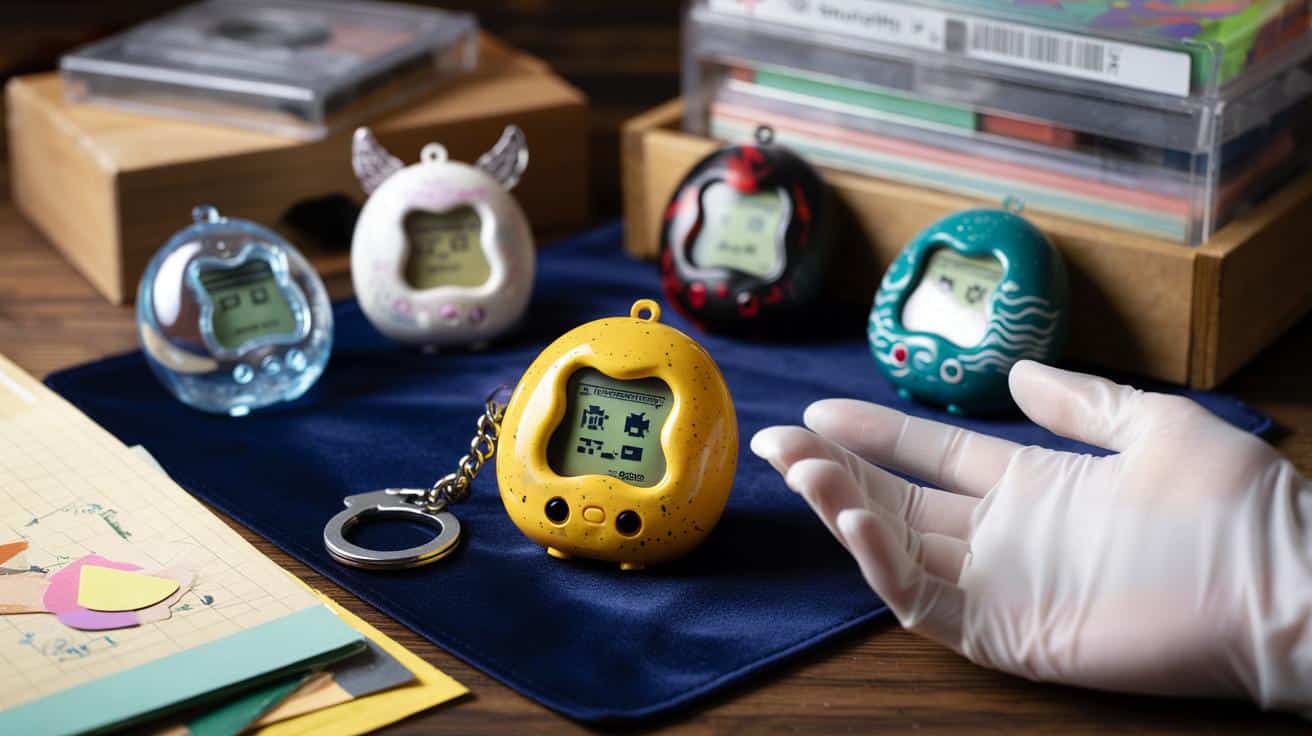
Not jewellery, not a forgotten watch. A plastic egg with three buttons, bought with pocket money and confiscated by more than one teacher.
The loft smelled like old paperbacks and cold dust, the sort of air that makes your shoulders rise without thinking. I cracked open a shoebox of school relics and there it was: an egg-shaped keyring in a faded speckle shell, its little screen clouded by a dozen playground scrapes. My thumb found the A button by muscle memory. For a second nothing, then a faint beep and a pixelated creature blinked awake, as if it had simply been napping since Year 7. We’ve all had that moment when time folds in on itself and you’re back in a classroom, sneaking feeds behind a maths textbook. The past nudges you in the ribs. And here’s the twist.
The 90s pocket pet that’s quietly turned into money
That pixel pet is a Tamagotchi, and the earliest runs are now trading for real cash. We’re talking first-wave Bandai releases from 1996–1997, the **first-generation Tamagotchi** known as P1 and its sibling P2. Not the 2000s “Connection” models with infrared, but the originals that lived and died by a CR2032 coin cell and your attention span. The nostalgia cycle has rolled round, and collectors have moved from posters to hardware. Prices reflect it.
Recent sales tell the story better than a headline. At the time of writing, a UK P1 in yellow with black splatter and a tidy screen went for around £620 after bids. A sealed Japanese Angelgotchi, still tabbed, hit roughly £1,450 on a specialist auction site. A near-mint Devilgotchi — notorious and scarce — slipped past £2,000 with fees factored in. Not every listing flies, and condition decides the ceiling. But the ceiling keeps rising.
Why the spike? Scarcity met sentiment, and both found a louder stage. Many original units were played hard, dropped in playgrounds, or lost to a leaky drawer battery, so clean survivors are thin on the ground. Millennials now have spending power and a soft spot for pixel pets. Short-form video made hatchings viral again. There’s also the tech charm: an 8-bit LCD that still boots, a chirp you can hear across the flat, a toy you can actually fix with a soft cloth and patience. *It’s the kind of vintage tech that still works in the palm of your hand.*
How to check yours — and make it worth more
Start with the ID. Flip it over and look for the moulded stamp on the back: “BANDAI 1996/1997” is what you want on a true early egg. Count the icons across the bottom of the screen; P1 and P2 have distinct menus and slightly different sprites. Original shells came in speckles, marbles, pastels and clear variants, and some patterns are prized. Pulling the battery tab lowers value, so photograph it before any test runs. If you do power it, use a fresh CR2032, then shoot the boot screen, pixel clarity, and any box or papers next to it in daylight.
Clean with restraint. A microfiber cloth on the shell, a puff of air for the screen edge, and that’s your lot. Alcohol wipes can fog the display layer, and polishing compounds strip the factory sheen that collectors look for. Keep any blister packaging, even if it’s crumpled. Don’t swap screws, don’t touch the PCB, and don’t write on the box. Let’s be honest: nobody does that every day. The idea is to preserve the story, not rewrite it.
Buyers care about provenance almost as much as pixels. Photograph the front, back, screen on, screen off, and any scuffs in close-up. Show a coin for scale. Mention if the **battery tab intact** is still present, or if it ever got the dreaded drawer-battery leak. If you’re not sure whether it’s P1 or P2, say so plainly and show the icon strip.
“Tabbed is king, boxed is queen, and clean screws are the crown,” says a London retro-toy dealer who moves half their stock in the run-up to Christmas. “Collectors pay for time travel that still bleep-bloops on cue.”
- Check stamp: Bandai 1996/1997, country of manufacture.
- Identify model: P1 vs P2 vs themed spin-offs (Angel, Devil, Ocean/Morino).
- Document condition: shell, screen, buttons, speaker beep.
- Box and inserts: blister, manual, paper slip, tie.
- Photos in daylight, no filters, file names that match the listing.
Where to sell, when to hold — and who’s buying
There’s a rhythm to this niche. General marketplaces like eBay give reach and fast bids, while specialist houses — Vectis in the UK, Catawiki in Europe, and US outfits that shuttle globally — bring curated eyes and sometimes gentler postage routes. List around paydays and the last weeks before December if you want the impulse audience. Prices swell when nostalgia trends spike on TikTok and whenever a journalist finds theirs in a shoebox and writes a piece like this. If your unit is entry-level and well-loved, a fan group might be friendlier. If it’s **mint-in-box** and variant-rare, wait for an auction calendar with a dedicated vintage tech slot. A plastic egg is still a story; you’re choosing the room to tell it in.
You might be reading this on your phone while standing over that very drawer. The idea of selling feels a bit like giving away a tiny part of your old room, the one with the glow-in-the-dark stickers and the CD rack that rattled. That’s alright. Keep it if the beep still makes you smile. Or photograph it properly and test the water with a Buy It Now and offers. Someone out there wants exactly your shell pattern, exactly your patience marks, exactly your clumsy early feeds. Value lives in pixels and memory, and it’s negotiable — which is to say, human.
| Key point | Detail | Interest for the reader |
|---|---|---|
| Model and variant | P1/P2, Angelgotchi, Devilgotchi, Ocean/Morino, shell patterns | Spot if yours is the high-value run |
| Condition and completeness | Screen clarity, shell gloss, **battery tab intact**, box and inserts | Understand what adds hundreds to the price |
| Where and when to sell | eBay for reach, specialist auctions for top-end; time around holidays | Maximise demand and minimise fees |
FAQ :
- How do I tell a P1 from a P2?P1 and P2 share the same shell shape, but the icon strip and sprites differ. P2 adds a “Duck” icon and tweaked games. Compare your icon row to reference images and check the back stamp year.
- Does a pulled tab ruin the value?Not ruin, but it lowers the ceiling. A never-activated unit with its pull-tab is a grail for some collectors. A clean, lightly used example still sells well.
- What’s a fair price for a used original?Working, tidy P1/P2 without box often sits between £120 and £350. Desirable shells, clear screens and honest photos push it higher. Rare themed lines can leap past £800.
- Should I replace the screen or shell?No. Swaps and repro parts put off serious buyers. Clean gently and document flaws instead. Honesty sells, and originality sells for more.
- How do I ship it safely?Power it off, wrap in soft tissue, then bubble wrap, then a snug box with void fill. Include a note with your contact. Tracked post and a photo of the parcel help if anything goes sideways.








Brb raiding my parents’ loft—if I find that speckled egg, drinks on me.