
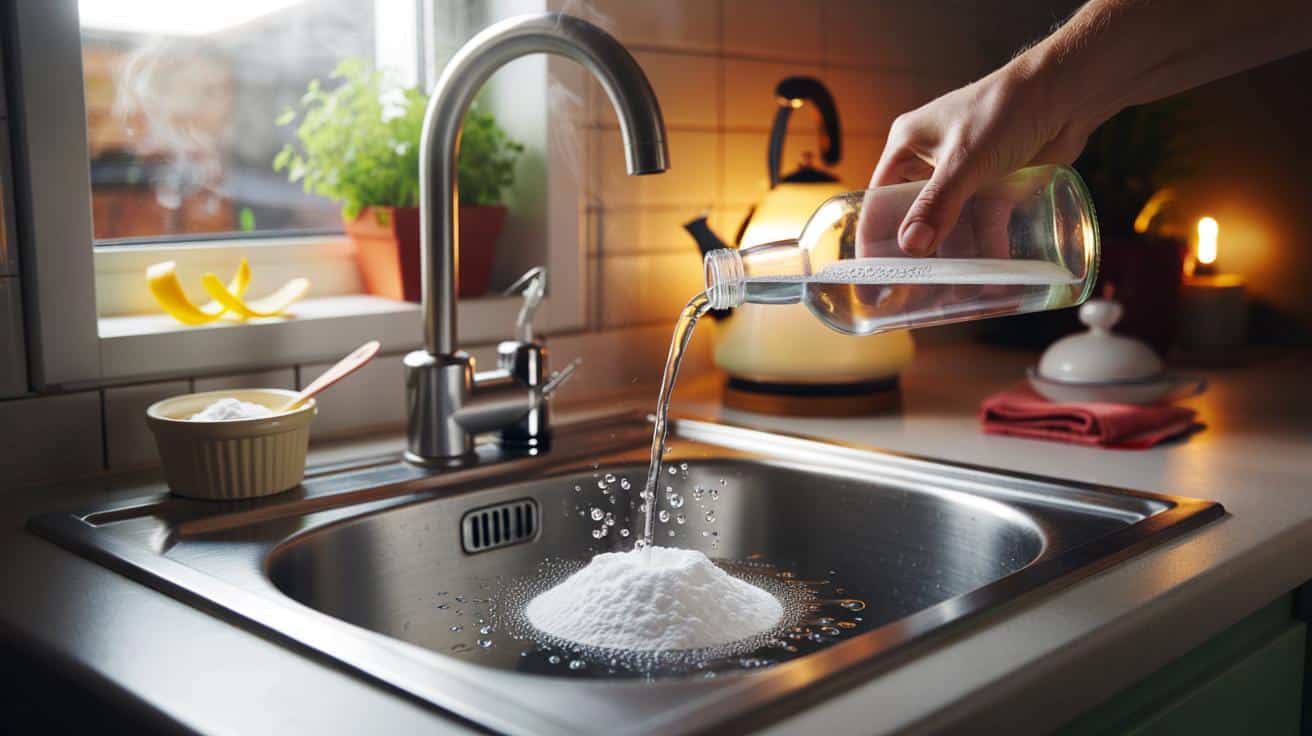
Plates stack, foam turns grey, and the smell begins to flirt with embarrassment. We’ve all been there: staring at a plughole as if it might apologise and sort itself out. Somewhere between calling a pricey emergency plumber and pretending it’ll fix itself lies a simple, fizzy trick hiding in your cupboard.
It happened on a Sunday night in a small, steamed-up kitchen in Hackney. A roast had come and gone, the wine glasses were gently clouded, and the sink bowl filled like a slow pond. I could hear the distant whirr of a neighbour’s washing machine, the domestic soundtrack of a city that never really settles. The sink wasn’t just slow—it had given up.
On the table sat a humble tub of bicarbonate of soda, the overlooked hero of baking days and smelly trainers. I poured. I waited. The air changed, very slightly, like a page about to turn. Then the fizz began.
What’s really blocking your sink
Most blockages aren’t dramatic; they’re tiny treaties between grease, soap scum, coffee grounds and shed hair. Day by day, a narrow pipe becomes a sticky tunnel. The film builds, the flow slows, and the smell shows up before the water does.
Gunk loves company. A splash of oil from a pan, a curl of pasta, a sliver of lemon peel—all harmless alone. Together, under your plughole, they settle into a sort of damp truce. It’s not malicious. It’s just how kitchens live.
In a terrace house in Leeds, Ellie found this out the expensive way. She nearly paid a Sunday call-out fee that would’ve swallowed her grocery budget. Instead she tried a cup of bicarbonate of soda and warm vinegar, waited ten minutes, and watched the water vanish as if someone had tugged a secret lever. The cost? Pennies. The relief? Audible.
There’s a reason the trick works. Bicarbonate of soda is a gentle alkali; fats trapped in the pipe are, in part, acidic. When the two meet—especially with the lift of vinegar—the fizzing carbon dioxide bubbles help nudge, loosen and break apart grimy bonds. Think of it as a tiny, friendly storm where you need it most.
It’s not just the reaction. The grains of bicarb mildly abrade slime, and the follow-up rush of hot water softens and sends the loosened mess down the line. That’s why timing matters: give the fizz a moment to do its dance, then bring the heat.
Plumbing shapes the story too. Your P-trap under the sink holds water to block smells, but it’s also where sludge likes to lounge. The trick agitates that bend. If the clog sits deeper, you might need a plunger or a simple drain snake. Most everyday clogs live close to home.
The baking soda trick, step by step
Start by removing any standing water with a jug or mug. Boil a kettle, then let it sit for a minute so it’s hot, not raging. Pour half down the drain to warm the pipe and soften grease. Add 120 ml (about half a cup) of bicarbonate of soda directly into the plughole, nudging it in with a spoon.
Now pour 250 ml to 300 ml of warm white vinegar over the bicarb and cover the hole with a mug or the plug to keep the action under the surface. Wait 10–15 minutes while it fizzes and mutters away. Finish with the rest of the hot water to flush. If the water’s still slow, a few plunges often deliver the final push.
Bicarbonate of soda is the quiet hero of the cleaning cupboard. It doesn’t shout, but it shows up when you need it, and it won’t bully your pipes. That’s the charm.
Common slips are easy to dodge. Don’t tip boiling water straight into plastic (PVC) pipes; give it a beat off the boil. Clear out puddled water first so the fizz meets the clog, not the basin. Never mix this trick with bleach-based cleaners. If you’ve recently used a chemical drain product, wait a day or two before playing chemist at home.
Another pitfall is impatience. Give the fizz its full minute on stage. If the drain is truly stubborn, repeat once rather than dumping in half the tub. And if you have a disposal, run it briefly before the treatment to clear scraps and switch it off. Let’s be honest: nobody does this every week.
When you want reassurance, hear it from someone who deals with mess for a living.
“Nine out of ten slow kitchen drains I see would have moved with heat, bicarb and a bit of patience,” says Tom, a South London plumber. “Save your call-out for the ones that smell like the street or back up across rooms.”
- If water backs up into the bath or another sink, the blockage is deeper—call a pro.
- If you smell sewage, stop and get help—this isn’t a DIY moment.
- If the pipe is leaking at the joints, fix that before any flush.
- If the sink stays full after two tries, try a plunger or a drain snake next.
A tiny ritual with outsized calm
There’s a small power in having a response ready when the house misbehaves. The fizzing sound is part science, part therapy, a reminder that not every domestic hiccup needs a heroic invoice. You wait, you listen, and the kitchen exhales.
The trick scales with life. Students in shared flats, new parents sleepwalking through bottle washes, elderly couples protecting old pipes—it gives each a way to nudge chaos back into order. The environmental bonus isn’t nothing: fewer caustic cleaners, less plastic, less stress.
Sometimes the simplest fixes feel like a tiny rebellion against the idea that everything must be complicated. Share it with a neighbour. Teach it to a teenager heading off to their first place. Tell the friend who always reaches for the harsh gel. You don’t need to be handy to win back your sink—just ready to let the fizz do its work.
| Key point | Detail | Interest for the reader |
|---|---|---|
| The method | Warm the pipe, add ½ cup bicarb, pour 1 cup warm vinegar, wait 10–15 minutes, flush with hot water | Clear, repeatable steps that work in minutes |
| Why it works | Mild alkali + acid reaction loosens grease and scum; bubbles agitate the clog | Confidence in the science, not just a meme |
| Safety boundaries | Avoid boiling water in PVC, never mix with bleach or recent chemical cleaners | Protects pipes, wallet and lungs |
FAQ :
- Does baking soda really clear a clogged sink?For most everyday kitchen slowdowns caused by grease and soap scum, yes. The fizz and mild alkalinity loosen buildup so hot water can flush it away.
- How much should I use—and how long do I wait?About 120 ml (½ cup) of bicarbonate of soda, followed by 250–300 ml (1 cup) of warm vinegar. Wait 10–15 minutes before the hot-water flush.
- Is it safe for all pipes?It’s gentle on metal and PVC. Use hot—not boiling—water on plastic pipes, and don’t do this if you’ve just used a chemical drain cleaner.
- Can I try this with a garbage disposal?Yes. Switch the disposal off, scatter bicarb into the drain, add warm vinegar, wait, then flush with hot water. Run the disposal briefly after the flush to clear loosened bits.
- When should I call a plumber?If water backs up into other fixtures, you smell sewage, the sink doesn’t change after two rounds and plunging, or you spot leaks at joints. That’s a deeper issue.








Worked in minutes—sink cleared, no chemical stink. Thanks!