
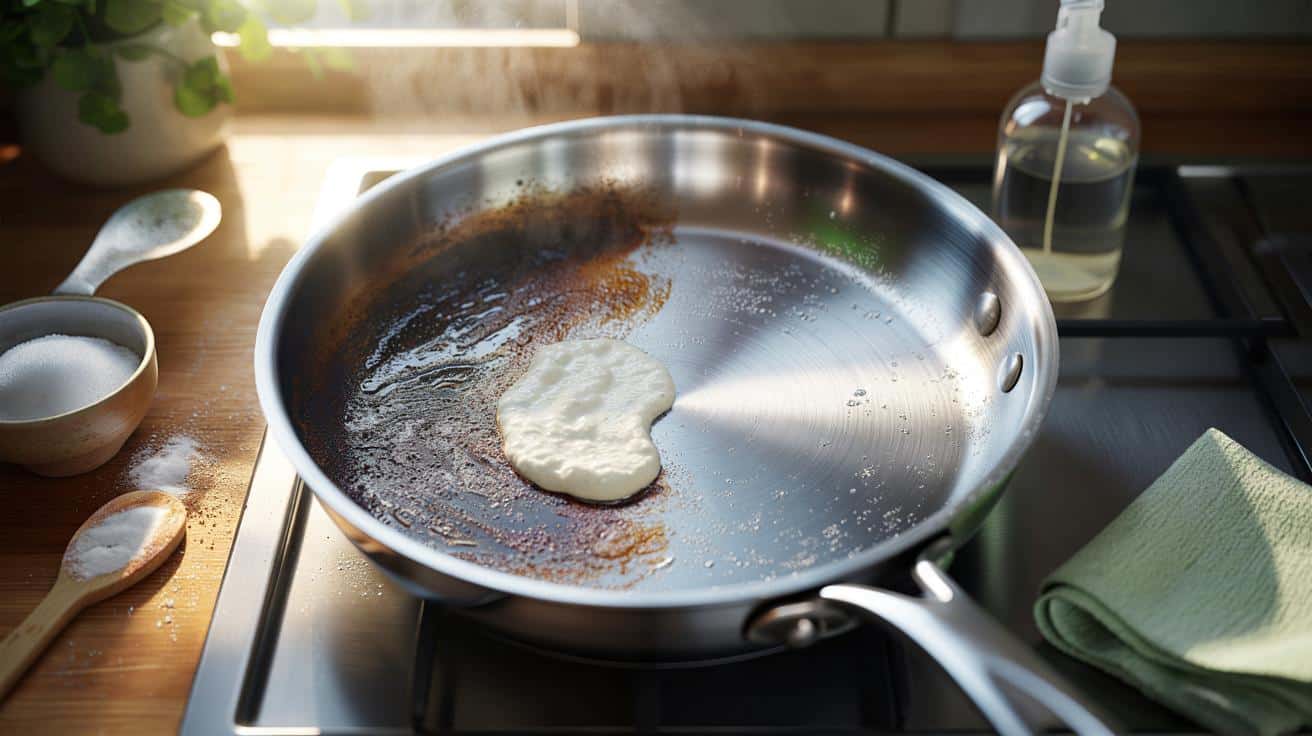
Burn marks welded to the bottom of a favourite pan can turn a simple meal into a small domestic drama. The fix isn’t fancy, and it doesn’t come in a designer bottle. It costs five cents.
A tomato sauce had caught just enough to lace itself into the stainless steel, and every pass of the sponge made the pan grimmer, not cleaner. I stood there in the cool light of the extractor fan, hands wrinkled from hot water, weighing up whether to keep scrubbing or quietly move this pan to the back of the cupboard like a guilty secret. Then a friend’s grandmother’s voice popped into my head—something about a powder in the baking aisle, something about patience and heat. I filled the kettle, reached for the tiny cardboard box most of us ignore, and thought: what have I got to lose.
Then came a five‑cent idea.
The quiet chemistry behind burnt pans and the cupboard cure
There’s a reason some stains laugh at soap. When oil, starch and protein meet high heat, they don’t just brown; they cross‑link into a stubborn, plastic‑like film that clings to metal. That bronzed ring on your stainless skillet or the tar‑black map on your enamel casserole is more than “dirt”. It’s polymerised food, baked onto microscopic scratches, locked in by heat and time.
We’ve all had that moment when a quick sear turns into a slow, smoky saga—and the washing‑up morphs from tidy ritual to trench war. Ask any weekend cook and they’ll tell you the same thing: soaking helps, but only up to a point. Online searches for “burnt pan cleaning” spike late on Sundays, just when stews and roasts have had their say and reality arrives at the sink.
Here’s where the 5‑cent hero plays its part: baking soda, also known as sodium bicarbonate. It’s alkaline, so it nudges that burnt layer to let go, softening the bonds and neutralising lingering acids from tomatoes or wine. It’s also a fine, gentle abrasive, so when you swirl it into a paste it scours without gouging. On stainless and enamel it’s a small miracle; on non‑stick, used softly, it’s the grown‑up alternative to tears.
The 5‑cent method that brings a pan back from the brink
Start simple. Cover the bottom of the pan with a finger’s depth of hot water, then sprinkle in a tablespoon of baking soda per 20 cm of pan, and add one drop of washing‑up liquid. Bring it to a lazy simmer for 8–10 minutes, nudging stuck bits with a wooden spatula as they loosen. Turn off the heat, let it sit for two minutes, pour most of the liquid away, then scatter a little more baking soda and swirl into a thick paste; leave that to rest for 10 minutes before wiping with a non‑scratch pad along the grain.
Work with the pan, not against it. On stainless, a final splash of hot water followed by a quick spritz of white vinegar lifts the faint cloudy film and brings back the shine. For enamel, keep the simmer gentle and skip any metal tools. On non‑stick, avoid scouring pads entirely—use a soft sponge and patience. Let’s be honest: nobody does this every day. But when disaster strikes, ten calm minutes beats an hour of red‑faced scrubbing.
Ten minutes of gentle simmering beats an hour of furious scrubbing. Common missteps? People mix vinegar and baking soda at the same time, which just makes a fizzy show and cancels the cleaning power. Others boil the living daylights out of the pan, then shock it under cold water and warp the base. One more note: cast iron can be rescued with a quick baking‑soda simmer, but keep it brief, dry it over heat, and rub in a dot of oil to re‑season.
“I was ready to bin that pan,” says Lara, a café cook in Bristol. “A teaspoon of bicarb, a little simmer, and it looked like it forgave me.”
- What you need: baking soda, hot water, a wooden scraper, a soft sponge, a microfibre cloth, and a few spare minutes.
- What to avoid: steel wool on non‑stick, mixing acid and alkali together, and panic.
- Optional finish: a tiny splash of vinegar on stainless for sparkle.
Why this tiny trick sticks—and where it doesn’t
There’s a deeper pleasure here than a shiny pan. It’s the sense that small, ordinary things still work, that a quiet bit of chemistry and a five‑cent habit can reverse a kitchen mistake without shame or landfill. You spend almost nothing, you keep a tool in service, and you get to cook the next meal without remembering the last one every time the light hits the steel.
Respect the edges, though. Aluminium pans clean well with baking soda, but simmer gently and rinse promptly to dodge dulling. Copper wants a different song—lemon and salt for polish, not a long alkaline bath. If a non‑stick surface is flaking, no powder will un‑flake it; that’s a parting of ways. This trick costs less than a bus fare and feels like wizardry. And yes, the same paste revives roasting trays, oven racks and grill pans that look like they’ve seen a bonfire.
Baking soda is the 5‑cent hero hiding in your cupboard. The best part is how forgiving it feels. You don’t need perfect timing or a laboratory’s precision, just the choice to pause, simmer, and wipe. Maybe that’s why this hack keeps travelling through families, taped to fridge doors and passed along in crowded group chats: it’s cheap, it’s kind to your hands, and it works when you’ve already tried everything else.
A small rescue that changes how we cook tonight
What stays with you after the pan is clean isn’t just the gleam, it’s the quiet relief. You keep a favourite tool in the rotation, you save a few quid, and you bring a little ease back to the stove. Tell someone else who’s eyeing a blackened skillet and thinking it’s beyond hope. Share the photo, share the trick, share the sense that domestic life doesn’t need to be a grind to be honest. There will be more meals, more experiments, more moments where you look away at the exact wrong time. There will also be five cents’ worth of powder in the cupboard, waiting to put it right.
| Key point | Detail | Interest for the reader |
|---|---|---|
| Simmer, then paste | Hot water + baking soda simmer for 8–10 minutes, then a 10‑minute paste rest | Short, reliable routine that lifts burnt residue with less effort |
| Pan‑by‑pan tweaks | Stainless loves a vinegar spritz; non‑stick needs a soft sponge; cast iron wants a quick re‑season | Protects cookware while getting results |
| What not to do | Don’t combine vinegar and baking soda at once, don’t shock hot pans, don’t use steel wool on coatings | Prevents damage and wasted time |
FAQ :
- Is baking soda safe on all pans?It’s great on stainless and enamel and fine on aluminium with a gentle simmer and quick rinse. For non‑stick, use only a soft sponge and no abrasive force. Cast iron is okay for a short treatment, then dry over heat and oil to re‑season.
- What’s the exact ratio to use?About 1 tablespoon of baking soda per 20 cm of pan base is a useful guide. You want a mild alkaline bath, not a slurry so thick it cakes before the heat can work.
- Can I swap vinegar for baking soda?Vinegar shines as a finishing rinse on stainless to clear cloudy film, but it won’t soften burnt‑on grease the way baking soda does. Don’t use them together at the same time, or they neutralise each other.
- Will this remove rainbow stains on stainless?Those heat‑tint colours fade with a quick vinegar spritz or a little diluted lemon juice. The baking‑soda simmer is for stuck‑on food; acids handle discolouration from heat.
- What if the burn is really severe?Repeat the cycle once. For inch‑thick carbon, carefully scrape first with a wooden or plastic scraper, then do the simmer‑and‑paste again. If the metal is pitted or warped, it’s a structural issue, not a cleaning one.








Tried this tonight on my stainless skillet—baking soda simmer + paste—and it legit saved me from binning it. Truley a five‑cent miracle.
Will this actually work on a well‑seasoned cast iron without wrecking the seasonning? The article says “quick simmer then re‑oil,” but I’m still nervous.