
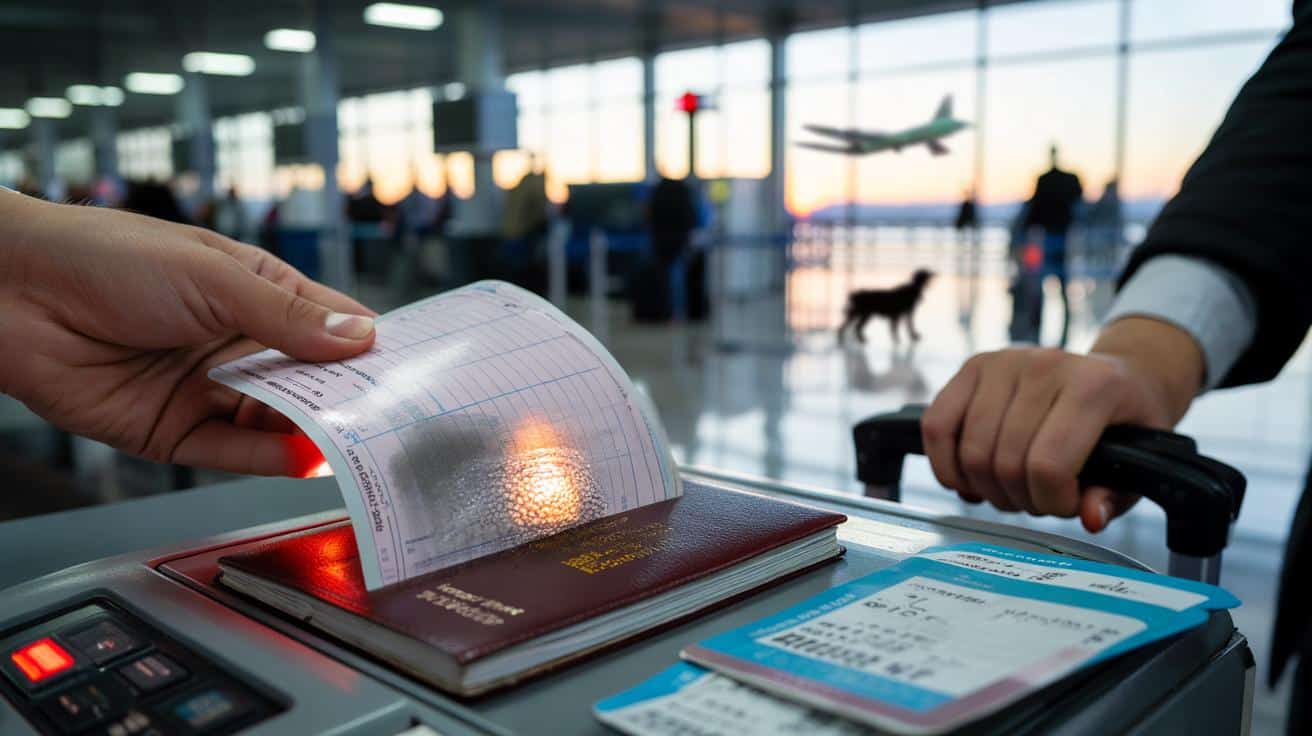
You breeze through packing, print your boarding pass, and stroll to the airport with that smug “I’m early” glow. Then the agent flips your passport, pauses, and calls a supervisor. A tiny lift on the photo page. A hairline nick by the code at the bottom. One microscopic flaw that means you’re not going anywhere today.
It’s early morning at Gatwick, coffees steaming, trolleys clacking, holiday faces bright with expectation. A woman in a linen jacket is chatting about Santorini when the check‑in agent goes quiet. The passport’s photo page has a tiny bubble under the laminate. Barely a grain of rice. The agent tries the scanner twice, calls for a second look, and tilts the document under the fluorescent light.
The line watches in sympathetic silence as facts replace hope. No airline wants a passenger refused at the border. The woman’s voice stays calm, then cracks. Someone offers a tissue. Security swings past with a training dog as a new flight closes for boarding. A manager arrives with a gentle shake of the head.
A bubble did it.
The tiny detail that gets you grounded
The smallest flaw on the photo page can trigger a firm “no”. We’re talking about the laminated data page at the front, not the visa pages. A lifted corner, a ripple from a spill, a hairline scratch crossing the **machine‑readable zone**. It looks like nothing in your kitchen light. Under an airline lamp, it reads like “tampering risk”.
Airlines take this seriously because the risk is theirs. If a border officer refuses you on arrival, the carrier pays for the return and can face penalties. The easy choice is to stop problems at the gate. That’s why a 2mm lift by your photo, a smudge across the MRZ, or a warped page can end a holiday before it begins.
I met a teacher from Leeds who was turned away for a 3mm lift on the laminate near her chin. She’d flown with that passport for years without drama. At Easter, a new scanner refused to read the code, the supervisor ran a fingertip along the edge, and that was that. She rebooked a day later with an emergency document and lost two nights of her trip. One tiny peel cost her £480.
Another traveller showed me a passport with a faint watermark ripple on the data page from an ancient lip balm spill. The booklet looked “lived in”, not destroyed. It still bounced at check‑in. The reason was simple: a ripple can hide a cut, and a lifted laminate can mean the photo was swapped. When anything suggests tampering, airline staff default to safety.
There’s logic behind the rigidity. Border systems rely on the **data page** being perfectly intact. The MRZ at the bottom is designed to be read by machines at speed. If even a single character is unreadable or the laminate is compromised, the system flags it. The chip in modern UK passports helps, but if the page itself looks altered, that’s a no‑go. Airlines are taught to spot “micro‑damage” because a mistaken green light lands on their desk, not yours.
Then there’s the practical side. A manual inspection takes time, and a packed queue leaves little room for debate. Staff don’t get to arbitrate your optimism against the rules of six different borders. They have to make a clean call. And that call often hinges on a detail you could miss with the naked eye.
How to check your passport like an airline
Start with bright light. Hold the passport at an angle and tilt the photo page slowly. Look for ripples, bubbles, or edges that lift when you bend it gently. Run a clean, dry finger along the laminate and the bottom code lines. If anything catches, that’s a red flag. Try reading the chip with a reputable NFC passport app on your phone. If it fails, don’t panic, but do test twice.
Next, check the **machine‑readable zone** for breaks, ink smears, or dents. That’s the two lines of code at the bottom of the photo page. Make sure there’s no tape, no stickers, no residue. Confirm your details match your ticket: full name, spelling, hyphens, and middle names. If you’ve changed your name or your look has changed drastically, bring supporting docs or an old ID photo. It sounds fussy because it is.
Let’s talk bad habits. Don’t keep your passport in a damp washbag. Don’t shove it in a back pocket. Don’t let a toddler “play airport” with it on the carpet. Never “fix” a lifted corner with glue or tape; you’ve just created evidence of tampering. And don’t assume a passport that survived one trip will pass the next—different scanners, different staff, different day. Let’s be honest: nobody does that every day.
There’s also the timing. If your passport looks borderline and you fly in a week, get a rapid appointment or consider postponing. An emergency travel document can save a trip, but it doesn’t work for all destinations or returns. Think of it as a brittle Plan B, not a safety net.
“If the laminate lifts or the MRZ is marked, we stop the process,” a UK check‑in supervisor told me. “It’s not personal. Once the scanner says no, the border will say no louder.”
- Lifted or bubbling laminate on the photo page
- Any line, dent or stain running through the MRZ
- Water damage or waves on the data page
- Loose binding, missing pieces, or cuts at the edges
- Holes or punch marks not applied by authorities
- Chip fails repeatedly and the page shows physical damage
- Name on ticket doesn’t match the passport, including hyphens or order
- Not enough validity for your route or transit
Other small details that still wreck trips
Expiry dates aren’t the only clock. Many countries want at least six months’ validity from your arrival date, and some require two blank visa pages facing each other. Schengen has a twist for UK travellers: your passport must have been issued within the last ten years on the day you enter, and it needs three months’ validity beyond the day you leave. That **10‑year rule** and the “three months after exit” rule catch people all the time.
Names are another tripwire. A hyphen dropped by a booking system, an accent stripped out, a middle name missing—each can trigger extra checks or a flat refusal. Airlines often can amend minor mistakes for a fee, but not at the last second in a busy queue. If your name has changed after marriage or deed poll, carry the paper trail. *It looks fine at home; at a counter it’s flagged in seconds.*
Appearance matters too. If your passport photo doesn’t obviously look like you—new beard, dramatic haircut, major weight change—expect a longer look. That’s not judgement, just process. Bring a backup ID or an older photo on your phone to show continuity. If the chip has failed but your passport is otherwise pristine, many borders will still admit you; the risk is that airline staff can’t take that gamble when time is tight and signs of damage are visible.
We’ve all had that moment where our stomach drops at a check‑in desk. The goal isn’t to scare you from travelling; it’s to give you a 60‑second ritual that saves a holiday. A passport is a surprisingly delicate object doing a very tough job. Treat it like a fragile key that opens expensive doors.
One last nuance: transit rules. Flying via a country you’re not entering can still trigger their passport requirements. Nightmarish outcomes happen when a harmless layover becomes the strictest gate in your journey. Read your routing like a lawyer would read a contract and you’ll avoid ugly surprises.
What this all adds up to
Your passport isn’t just your identity—it’s a piece of security tech. The page you barely notice is the page everyone else is trained to scrutinise. If a corner lifts, a code blurs, or a name smudges across booking systems, the chain breaks. And once it breaks at a check‑in desk, putting it back together in time for boarding is rare.
None of this asks you to become a forensic examiner. It asks you to slow down for one minute and look at the exact things a trained agent looks at: the laminate, the code, the name, the dates. Those checks turn panic into planning. They also make awkward conversations shorter, kinder, and less expensive.
Travel is meant to be messy in the best way—crumbs of croissant on a train table, not adhesive on your passport page. The tiny detail that can ban you from a flight is often hiding in plain sight. Spot it before someone else does and you keep hold of your holiday, your money, and your morning.
| Key point | Detail | Interest for the reader |
|---|---|---|
| Micro‑damage matters | Lifted laminate or a mark across the MRZ can trigger a denial | Prevents a surprise refusal at the gate |
| Validity traps | Six‑month rules, blank pages, and the 10‑year/Schengen exit window | Stops last‑minute cancellations and fines |
| Name accuracy | Hyphens, middle names, and order must match the ticket | Avoids reissue fees and boarding delays |
FAQ :
- What kind of damage will definitely get me refused?A lifted or bubbling laminate on the photo page, a tear or stain crossing the MRZ, or any sign the photo page has been altered. Those are hard stops for most airlines.
- My chip doesn’t read on my phone—am I grounded?Not automatically. Some phones and apps are finicky. Test again, then inspect the page. If the data page looks perfect, many borders still admit you, but airline staff may be cautious if there’s visible damage.
- Do tiny scratches or worn covers matter?Scuffs on the cover or visa pages are usually fine. The data page is sacred. Any damage there needs attention before you fly.
- How long do I need on my passport for Europe?For Schengen, your passport must be issued within the last 10 years on the day you enter, and valid for at least three months after the day you leave. Separate from that, some non‑EU countries want six months from arrival.
- Can I tape or glue a lifted corner?No. That looks like tampering and makes refusal more likely. Book a replacement or seek an emergency travel document if your trip is close.







Wow, had no idea a 2mm lift could ruin a trip. Adding a light‑and‑tilt check to my preflight routine.
Is this realy airline policy everywhere, or just UK carriers being extra cautious? Any sources beyond anecdotes or training manuals?