
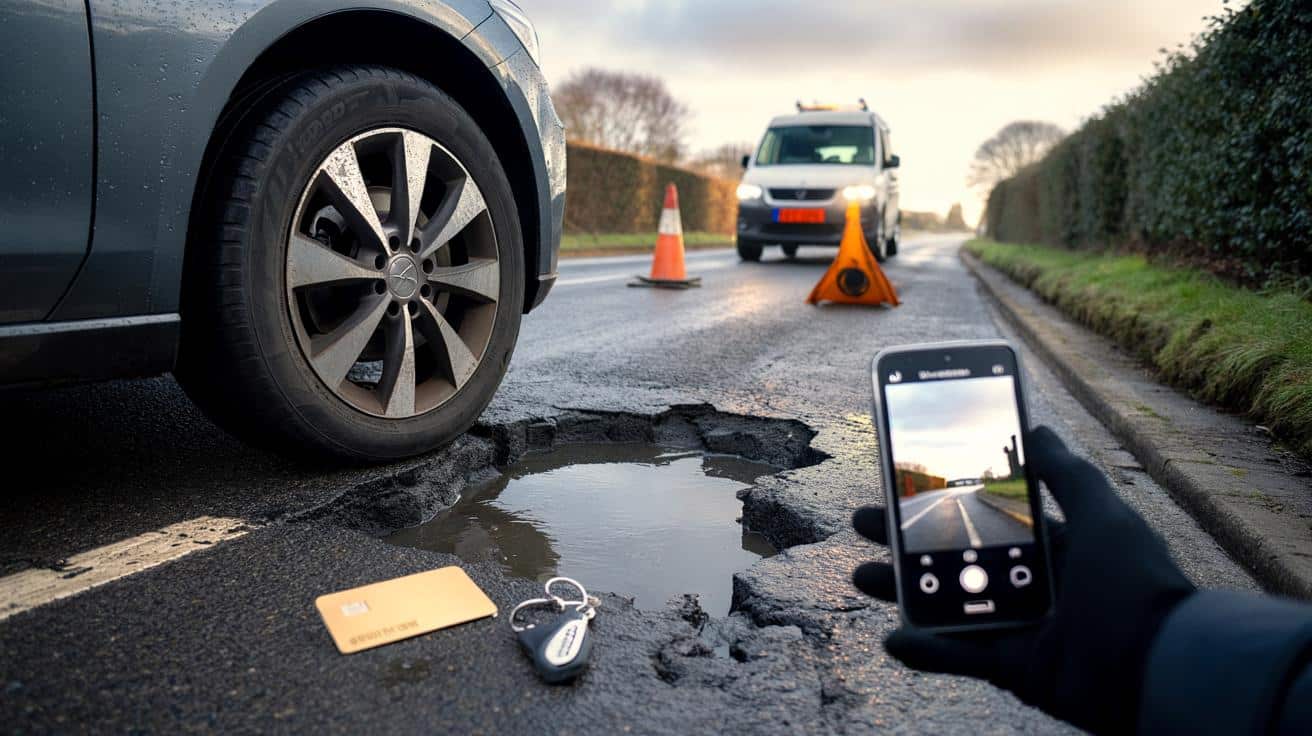
The alloy is bent, the tyre’s gashed, and your day is ruined. Potholes aren’t a quirky British annoyance anymore — they’re a quiet tax on anyone who needs to get to work, pick up kids, or just get home in one piece. This isn’t just bad luck. In many cases, it’s a bill your local council should pay.
It was a bleary February morning in Derbyshire when I heard that bang. Coffee sloshed over my coat. I pulled into a lay-by, fingers shaking, and stared at a tyre that looked like it had been chewed. A driver in a van rolled down his window and said, “That crater’s been there for weeks, mate.” He wasn’t angry, just tired. We’ve all had that moment when the road feels like it’s fighting back. There’s a way through this, though — and it’s simpler than you think.
Why councils pay — and why they refuse
Local authorities have a duty to maintain roads under the Highways Act 1980. If your car is damaged by a hole they knew about, or should have found on routine inspections, they can be on the hook. That’s the heart of it. Claims don’t hinge on sympathy; they’re about whether the council took “reasonable care” to keep that stretch safe.
One reader told me how she won £412 from her council after a wheel was buckled by a crater on a busy B-road. She found a trail of earlier complaints on FixMyStreet, and an old warning cone in a hedge. Once she put those pages alongside her repair invoice, the insurer handling claims for the council caved. It wasn’t luck. It was proof.
Councils use the Section 58 defence: if they can show a proper inspection schedule and prompt repairs, they’ll push back. Urban routes might be inspected monthly, quiet rural lanes less often. If the hole appeared that morning, your claim will likely fail. If it’s been festering between inspections, or it fell outside the council’s own repair standards, your odds rise fast.
The 3-step claim that actually works
Step 1 is evidence. Photograph the pothole from different angles, include the road in frame, and add something for scale — a key, a bank card, a shoe. Take a close-up of the depth and edges, and a wider shot that shows signs or landmarks. Note the time, date, weather, and exact location. Then document the damage: tyre, alloy, suspension, undertray. Keep the broken parts if replaced. Get a written diagnosis from a garage and at least one repair quote. Let your images tell a clean, simple story.
Step 2 is linking that hole to council knowledge. Report the pothole online and keep the reference number. Check if it was reported before — look at your council’s map, FixMyStreet, local Facebook groups. Ask for the inspection and maintenance history for that section in the weeks before your incident; you can do this in your claim or via a quick Freedom of Information request. Let’s be honest: nobody keeps a tape measure in the glovebox. Use what you have, then follow up with what the council should already hold.
Step 3 is the claim itself. File through the council’s “damage or compensation” page, or write directly to their claims handler. State what happened, why the road was unsafe, and what you’re claiming. This is where many claims are won or lost. Use plain English. Demand a reply within 28 days and be clear you’re seeking a **Full refund** of reasonable repair costs, plus towing or transport if you had them.
“On [date] at [time], my vehicle sustained damage caused by a pothole at [exact location]. The defect measured approximately [depth/width] and has been previously reported under reference [if any]. Under the Highways Act 1980, please confirm the inspection regime and repair records for this location. I enclose my repair invoice(s) and photographs. I am seeking reimbursement of £[amount].”
- Attach: photos (scene and damage), repair invoice(s), quotes, report reference, map pin/screenshot, any witness note.
- Keep originals; send copies.
- If the road is a red route or motorway, claim from TfL or National Highways, not the council.
What happens next — and how to keep your costs down
Claims usually pass to an insurer who may test you with a stock rejection. Don’t flinch. Read their reason. If they rely on Section 58, ask for proof of inspections and response times, not just assertions. If they say the pothole wasn’t hazardous, point to your photos and any prior reports. If they argue “wear and tear,” remind them a blowout from a sharp-edged defect isn’t normal aging.
There are pitfalls you can dodge. Don’t inflate costs with premium upgrades; councils don’t pay for betterment. Don’t claim for pre-existing wear or unrelated damage. Don’t skip an alignment report if you felt a pull after the hit. If you replaced two tyres when one was damaged, explain why (same axle) and accept a proportionate settlement. And if your no-claims bonus is precious, think twice before involving your own insurer; self-claiming against the council keeps control with you.
Speed helps, but accuracy wins. If you get nowhere after a robust reply, consider the small claims track; under £10,000 is common, and many councils settle before a hearing. You can also complain to the Local Government Ombudsman about process delays — not liability — which sometimes nudges an overdue response. If you’re hit by a defect on a trunk road, switch target to National Highways. And remember, a clean paper trail beats emotion every time.
Some readers tell me they hit a pothole once and forget it by lunchtime. Others keep the hubcap in the boot as a reminder. The real shift happens when you turn that jolt into a paper trail. Take two photos now and you cut hours later. Share your claim reference in the group chat and someone will send you a prior report you didn’t know existed. One person’s bad morning becomes another person’s winning exhibit. Roads only change when bad holes cost money.
| Key point | Detail | Interest for the reader |
|---|---|---|
| Evidence is king | Photos, timestamps, repair invoices, prior reports | Builds a claim that’s hard to knock back |
| Know the law | Council duty under Highways Act; Section 58 defence | Frames your argument like a pro |
| Target the right body | Council for local roads; TfL for red routes; National Highways for motorways | Sends your claim to the payer with the cheque book |
FAQ :
- Can I claim if I’ve already repaired my tyre?Yes. Keep the damaged tyre if possible, but clear photos and a dated invoice are usually enough. Two quotes can help if the cost is high.
- Do I need to measure the pothole?No, but it helps. A key or bank card for scale works. Councils have their own thresholds; photos showing sharp edges and depth tell the story.
- What if the council says the hole was inspected recently?Ask for the inspection log and repair timescale for that location. If prior reports exist or the defect exceeded their own criteria, push back.
- How long will a claim take?Four to eight weeks is common. If you hear nothing after 28 days, chase in writing. You can then consider a small claim if the evidence is strong.
- Can I claim for extra costs like towing or taxis?Yes, if they’re reasonable and linked to the incident. Keep receipts. Avoid upgrades or convenience add-ons you’d struggle to justify to a judge.








I just went through this in Surrey: hit a sharp-edged pothole, blew a near-new tyre, and bent the alloy. Your Step 2 was key—I pulled prior reports from FixMyStreet and asked for the inspeciton logs. Their insurer tried a stock rejection, I replied with photos + invoice, and they settled £312 within 6 weeks. Wish I’d known to keep the damaged parts in the boot. Great write‑up, super practical 🙂