
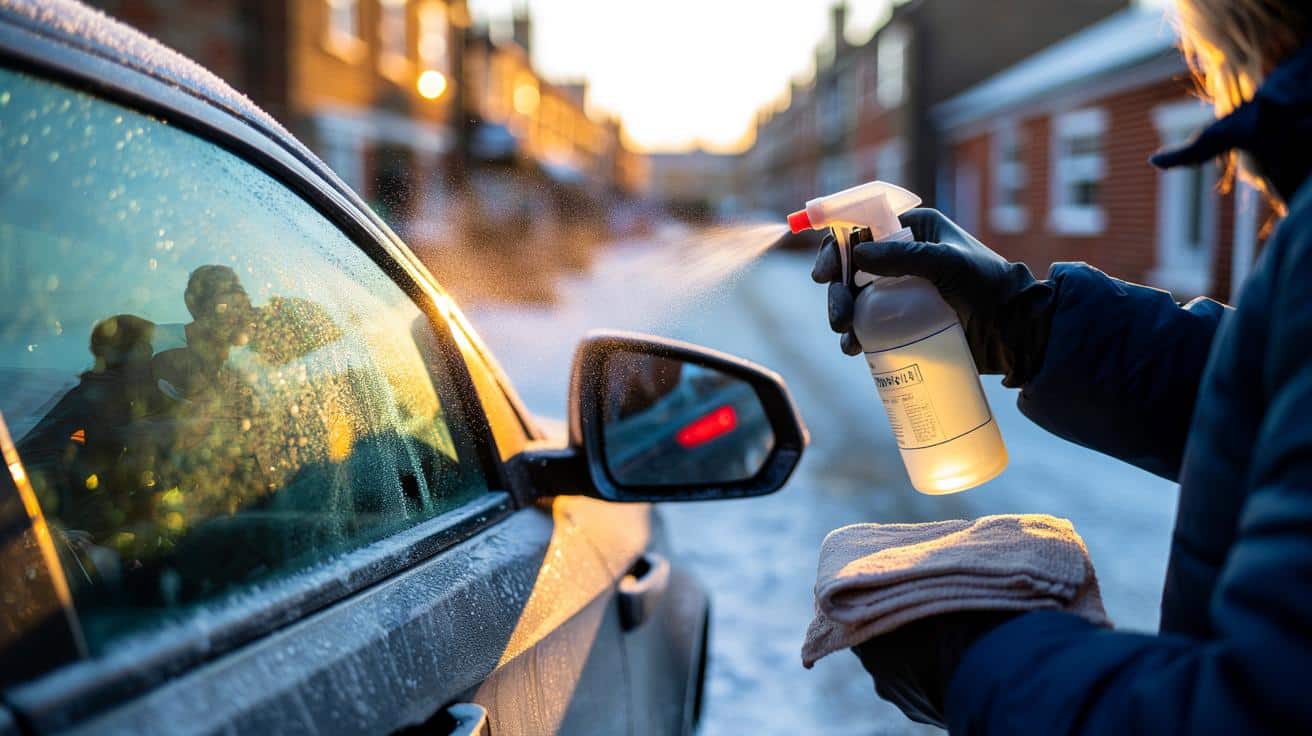
Frosted mirrors cost minutes and patience on cold mornings. There’s a cheap, oddly satisfying fix hiding in your kitchen that can change the start of your day.
40am on a tight terraced street, breath turning to mist as keys fumble and a kettle clicks off in two different houses. A driver in a navy parka scrapes at a stubborn rind of ice on his wing mirror, glancing at the bus timetable in the reflection like it might pity him. Two doors down, someone else does something different: a quick spritz, a wipe with a soft cloth, and they’re rolling away before you can say “defrost”. Vinegar, from the same bottle that bathes chips.
Vinegar, of all things.
Why a vinegar-water spritz works on icy mirrors
Here’s the simple truth: a diluted vinegar spray can stop a light film of ice from forming on your car mirrors overnight. The acetic acid lowers the freezing point of the thin layer of water sitting on the glass, so frost finds it harder to grip. It’s not wizardry. It’s chemistry you can smell.
We’ve all been there: a first frost catches you out, and five minutes becomes fifteen. One reader from Leeds told me she mixed a small bottle with white vinegar and water, misted both mirrors at dusk, and woke to clear glass while neighbours scraped. No drama, no white knuckles. The only giveaway was a faint tang in the air.
Think of frost like a film that needs a foothold. The vinegar mix interrupts that film and keeps it slippy, especially on smooth, small surfaces like mirrors. On milder freezing nights, a single pass can be enough to prevent any build-up at all. On sharper nights, it won’t make you invincible, yet it will make any frost that does form thin, fragile, and easy to sweep away with a sleeve.
How to mix it, when to spray, what to avoid
Grab a clean trigger bottle, white distilled vinegar, and tap water. Mix 3 parts vinegar to 1 part water for prevention, give it a quick shake, then spritz a fine mist over each mirror at dusk. Aim for the glass, not the casing. A quick wipe with a microfibre cloth spreads the film evenly and stops drips, and you’re done. It takes less than a minute, and you can do it with your coat still on.
A few friendly warnings save headaches. Use white vinegar, not malt vinegar from the cupboard next to the crisps, unless you want brown stains and a chip-shop perfume that lingers. Keep the spray light; a puddle will streak and may wander onto paint. Avoid blasting cameras or sensors around the mirror housing. If your mirrors are heated, this tip still helps before the heat kicks in, it just means they’ll clear even faster.
“I tell customers this works for mirrors and light frost, not for an ice storm,” says Tom, a Leeds mechanic who sees the annual winter rush. “It’s a smart little edge, but it won’t beat -10°C on its own.”
“Vinegar buys you time on the school run. Just don’t expect miracles in a deep freeze.”
- Stick to white distilled vinegar at supermarket strength (around 5% acetic acid).
- Shield paintwork with a card or cloth if you’re worried about overspray.
- Rinse the mirrors with plain water every few days to keep rubber trims happy.
- For heavy frost, pair the spray with a proper ice scraper or a mirror cover.
A small winter ritual with a big payoff
There’s something quietly pleasing about claiming back a slice of morning calm with a tiny, repeatable hack. A bottle by the back door, a spritz at dusk, and your mirrors stop holding your day hostage. The ritual asks for almost nothing and returns a clean view of the road, which is all you wanted at 6.40am anyway. Share it with a neighbour and watch the street move a little faster.
| Key point | Detail | Interest for the reader |
|---|---|---|
| Mix and timing | Use a 3:1 vinegar-to-water mix and spray at dusk on dry mirrors | Quick, cheap routine that prevents light frost from forming |
| Scope and limits | Great for mirrors and mild freezes; pair with covers or de-icer in deep cold | Realistic results, fewer delays, safer morning visibility |
| Paint and parts care | Keep spray off paint and rubber trims; wipe drips; rinse occasionally | Protects your car while enjoying the hack’s benefits |
FAQ :
- Will vinegar damage my car’s paint?A light, targeted mist on the glass is fine, and any stray droplets should be wiped straight away. Repeated soaking of painted surfaces isn’t wise, so keep the spray on the mirror glass and give the area a quick rinse now and then.
- What ratio works best for prevention?For overnight protection on mirrors, 3 parts white vinegar to 1 part water is a sweet spot. For breaking thin frost in the morning, you can go 2:1, then wipe and dry.
- Can I use this on the windscreen?It can work, yet it’s not ideal for wiper blades or certain coatings. If you try it, keep it off the blades and trims, and consider a commercial de-icer for the screen instead. Let’s be honest: nobody really does that every day.
- Does it work in very low temperatures?It helps with light-to-moderate frost. In harsher cold, combine it with a cover or a proper de-icing spray. Heated mirrors make the combo even better.
- Will my car smell like a chip shop?A faint whiff is normal and fades quickly, especially with white distilled vinegar. Keep the spray small and focused, and it won’t linger. If it does, a quick wipe with plain water removes the scent.




Just tried this on my driveway in Leeds—3:1 white vinegar to water, light spritz at dusk—and the mirrors were crystal this morning. No scraping, no drama, just a faint tang that faded quick. Definitley keeping a bottle by the back door. Thanks! 🙂