
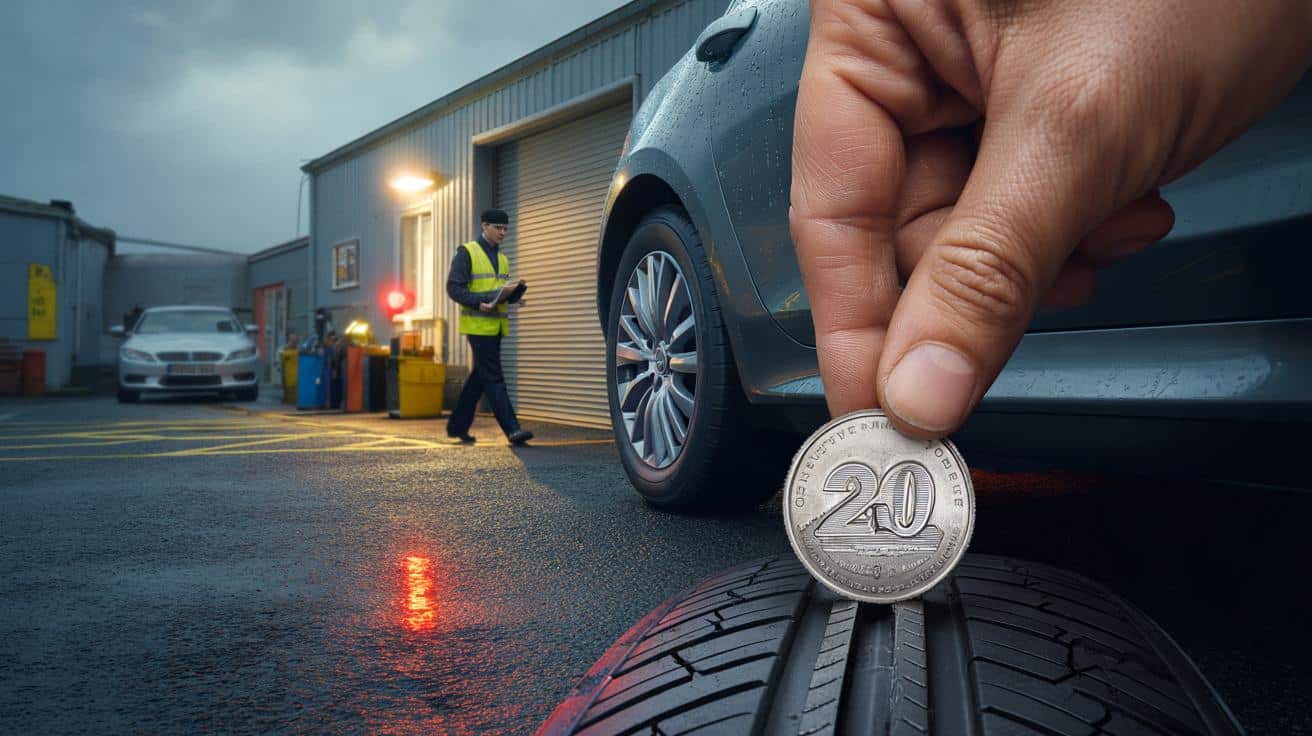
A simple 20p coin can tell you if you’re heading for a pass… or a cold walk home with an advisory sheet. I tried it the morning of my test, and it changed everything.
It was a grey Tuesday outside a small industrial estate, the kind of place where the kettle never quite boils and the roller shutters echo your thoughts. Three cars ahead, a tester with a clipboard paced between brake checks and headlight aim. My car idled with that faint vibration you only notice when you’re nervous. I’d cleaned the windscreen. Topped up fluid. But tyres? I hadn’t looked properly in months.
We’ve all had that moment when a small doubt turns into a big worry. I remembered a friend’s tip and dug a 20p out of the coin tray, fingers cold and ridiculous. I pressed it into a groove and watched. The outer rim disappeared. Then I checked again, at an angle, heartbeat steadying. My pocket changed the result.
The tiny check that dodges a big MOT headache
Tyres are where your whole car, your whole family, touches the road. The legal line for tread depth in the UK is 1.6 mm across the central three-quarters of the tyre, all the way around. That sounds abstract until you imagine standing in rain on a painted zebra crossing. Grip matters in the moments that count. A 20p coin turns that number into something you can see with your own eyes.
My neighbour Sophie almost learned this the hard way. She rolled up for an MOT last autumn, thinking the rattly heat shield would be the villain. The tester pointed to the front nearside and didn’t smile. She borrowed a 20p from the receptionist and tried the check there and then. Outer band visible. She nipped round the corner for two new tyres, came back, and passed. Ten minutes. A different day.
Here’s why that coin is such a decent proxy. The wide outer band of a 20p coin is roughly the same height as the minimum legal depth. Push it into the main tread groove. If you can see the band, your tread may be below 1.6 mm. If the band disappears, you’re likely safe — at least in that spot. Water clears through those grooves; when they’re shallow, your contact patch skates rather than bites. Illegal tread isn’t a maybe — it’s points on your licence and a fat fine.
How to do the 20p coin test the right way
Do the test in good light. Take a 20p and place it in the main grooves across the centre of the tyre. Check in at least three places across the width, then repeat at four points around the circumference. Fronts wear faster, so start there. If the outer band is visible at any point, treat that tyre as at risk and get it measured properly. It took less than a minute, yet it changed my whole morning.
Tyres don’t wear evenly, especially if pressures are off or your car spends its life nudging the same kerb. That’s why you rotate the wheel a little and test again, instead of trusting a single dip. Do it on all four tyres. Don’t forget the inside edge on fronts if your alignment’s been questionable lately. Let’s be honest: nobody does that every day.
If you’re hesitating between “probably fine” and “hmm”, listen to that voice and get a gauge or a quick check at a tyre place. They’ll measure to a tenth. Mine popped to 2.3 mm at the lowest point, which meant I had a choice: risk a borderline fail, or replace now and stop thinking about it.
“Bring me a coin and five minutes, I’ll tell you if you’re on the edge,” said Mark, a veteran MOT tester who’s seen every kind of bald tyre under a different story.
- Check when tyres are cool and clean of stones or mud.
- Compare across the tyre, not just one groove.
- If you’re near the limit before winter, change early for wet grip.
The bigger picture: cost, calm, and a pocket habit
The coin trick is more than a hack. It’s control in a world that throws bills at you when you least expect them. Tyres at 2 mm might scrape a pass today, yet they’ll feel different in heavy rain. The stopping distance grows, the steering gets doughy, and you’ll tense up on the motorway puddles. I saved myself an instant MOT fail with a 20p coin. That’s the headline, sure, but the real win was not having to explain to a boss or a partner why I’d lost a day and a chunk of cash to something I could have checked with spare change.
There’s a simple rhythm worth borrowing. Keep a 20p in the door pocket. Once a month, or when you fill up, do a quick loop around the car. While you’re there, glance at pressures on the dash or a forecourt gauge. Worn tread accelerates when tyres run soft, and soft tyres burn fuel. That’s a spiral you can pause with one small habit and a coin that’s already in your life. A 20p coin in your pocket can be the most useful tool you own.
| Key point | Detail | Interest for the reader |
|---|---|---|
| Use a 20p coin | If the outer band is visible in the tread, you may be under 1.6 mm | Instant, free check before your MOT |
| Check multiple spots | Test across the width and around the tyre’s circumference | Avoid borderline fails from uneven wear |
| Know the stakes | Illegal tyres risk fines up to £2,500 per tyre and points | Safety and money saved with one minute of effort |
FAQ :
- How does the 20p test actually work?The wide outer rim on a 20p aligns closely with the legal minimum tread depth. If you can see that band when the coin sits in the main groove, your tread may be below 1.6 mm and needs a professional check.
- Is the 20p test “official” for MOTs?No. It’s a quick consumer check. MOT testers use calibrated gauges, but the 20p is a smart way to catch a likely fail before you arrive.
- Which tyres should I test first?Fronts, then rears, then all again at another point around the tyre. Fronts often wear faster on front‑wheel‑drive cars, especially on inner edges if alignment is out.
- Can I pass an MOT with 2 mm of tread?Yes, because the legal minimum is 1.6 mm across the central three‑quarters. That said, wet‑weather grip drops fast as you approach the limit, so many drivers change at 3 mm.
- What if I see the band in just one place?That suggests uneven wear. You might still fail if any part of the central three‑quarters is under 1.6 mm. Replace the tyre and get alignment checked to prevent a repeat.








Is the 20p rim actually 1.6 mm? I’ve seen people quote 2 mm—does it vary by mint year or am I overthinking this?
Read this at the petrol station, did the test, outer band visible on my fronts. Nipped to the tyre place and avoided a likely fail. Cheers for the clear steps.