
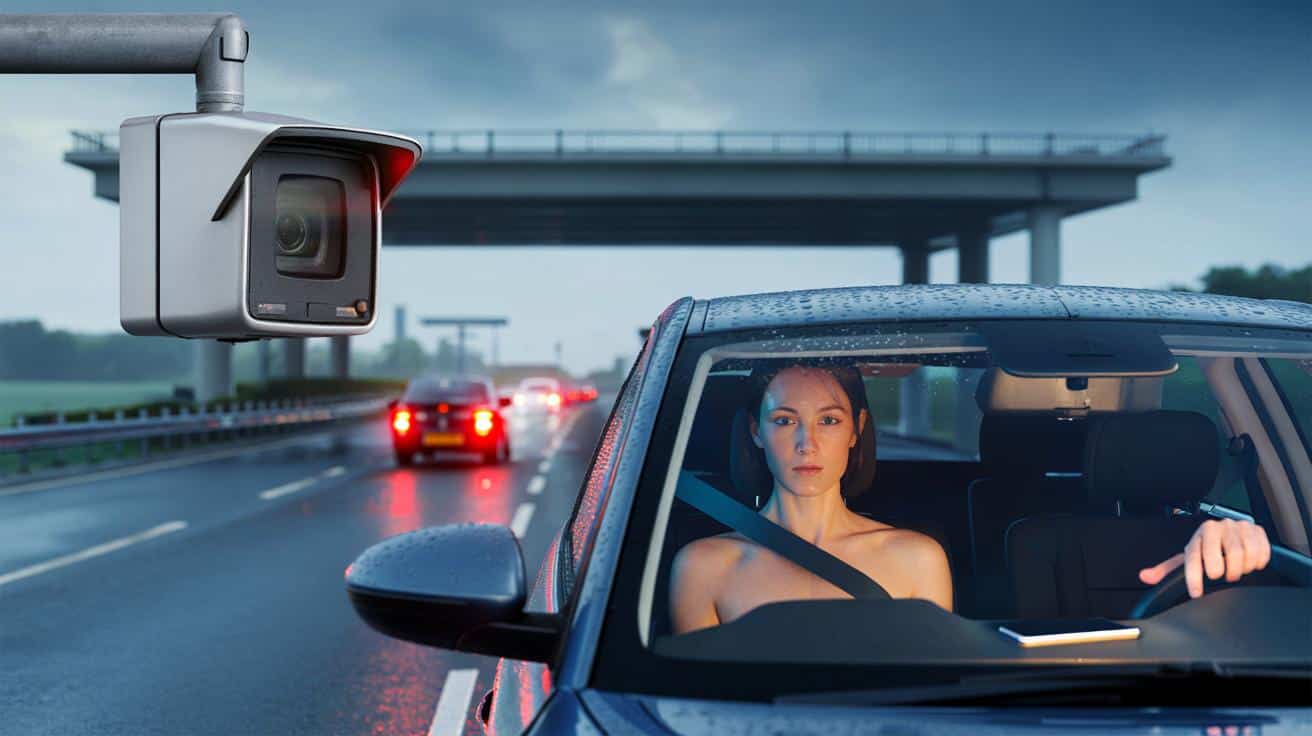
The cameras did. In 2026, those discreet grey boxes on poles and gantries won’t just clock your speed; they can also see if a seatbelt is clipped, who’s scrolling on a phone, and what’s happening in that split second you thought no one noticed.
It’s early, damp, and the wipers tap a lazy rhythm. A small grey box sits above the dual carriageway, almost blending into the sky. No bright yellow warning, no obvious flash, just a quiet watcher. A week later, an envelope lands on the mat, and with it a new truth about driving: the camera didn’t care about your playlist, it cared about your seatbelt. *It felt like the rules had quietly changed overnight.*
They’re not just watching your speed anymore.
Meet the grey boxes: smarter, smaller, stricter
They look like street furniture. That’s the point. These “hidden” grey boxes are compact, weatherproof, and built to blend in. They don’t shout like the old yellow Gatsos. They perch quietly on a gantry, sit on a verge, or tuck into a lay-by, glancing down at cars with clinical patience.
Inside, the tech has moved on. High-resolution lenses, infrared lighting to see through sun glare and drizzle, and machine-learning software trained to spot a shoulder strap. Not magic. Just clever optics and pattern recognition. The result is simple and a bit unnerving: a camera you might not clock can clock you.
You can feel it most on familiar roads. One parent on the school run told me she only noticed the unit after a neighbour mentioned “the grey thing on the A-road”. She thought it was for speed. Then a Notice of Intended Prosecution arrived, with a clear image that showed her belt looped under her arm. That eight-minute drive suddenly felt expensive.
In trials across England, these systems logged hundreds of seatbelt and phone offences in days, not months. Some forces sent warning letters at first, then moved to fines as the tech proved its reliability. The pattern was blunt: where the boxes went up, compliance went up too. A nudge with teeth.
Here’s how it actually works. The camera captures images as vehicles pass, often from an overhead angle to see across dashboards and torso lines. Software flags suspected offences—no belt across the shoulder, a phone glowing in a hand—and then a trained operator reviews the record. Only then does a case proceed.
If it sticks, a Notice of Intended Prosecution follows. For seatbelts, the standard penalty is a £100 fixed fine, or up to £500 if it reaches court. In England and Wales, it’s typically no points for adults right now, though that’s been under review in policy circles. Balance that with the blunt stats: wearing a belt cuts the risk of fatal injury dramatically. The camera is simply betting that you’ll pick the safer option next time.
How not to get snared (and stay safer doing it)
Start with a ritual. Belt on before the engine turns. Click, tug, go. Ask passengers to buckle up, back seats included. Set your route and playlist while parked, then tuck the phone away—glovebox, bag, or a fixed cradle that keeps your fingers off the screen. Small habits, big wins.
Fit matters. Heavy coats can trick you into wearing the shoulder strap under the arm, which cameras—and crash physics—treat the same as not wearing it at all. Adjust the belt height so it crosses the middle of your shoulder, not your neck. Check the buckle isn’t twisted. We’ve all had that moment where we nudge off for “just a minute” unbelted. Let’s be honest: nobody checks every tiny adjustment every single day.
Phone use is where good intentions crumble. A quick glance becomes a long stare, and that’s when the grey box takes a crisp, time-stamped look at your lap. Leave the device out of reach if temptation bites. Use voice commands for the essentials, then let the notifications stack up until you stop. The message isn’t puritanical; it’s practical: you can’t be in two places at once—on the road and inside your screen.
“We’re not hunting for gotchas,” a roads policing sergeant told me. “We’re hunting for that one decision that stops an ambulance run. The aim is compliance, not tickets.”
- Two-second check before rolling: belt clicked, strap flat, phone away.
- Passengers count: remind everyone, every time.
- Rain, glare, twilight: if the camera can see, it can see your habits too.
- The goal is to prevent crashes, not to empty wallets.
The bigger picture: privacy, trust, and a culture shift
This is more than a new gadget on a pole. It’s a shift in what enforcement looks like—and where the line sits between public safety and personal space. The tech is powerful. It also needs guardrails: human review, transparent processes, clear data rules.
Drivers adapt when they understand the rules of the game. Signage helps, even if the law doesn’t demand it. Plain language helps too: what’s monitored, how evidence is checked, how long images live, where the appeals window sits. Culture moves on tiny hinges; trust is one of them.
By 2026, expect more of these grey boxes on fast A-roads, around average-speed corridors, and on busy approaches where risk peaks—school runs, commuting arteries, motorway merges. You’ll start recognising them even when they don’t shout their presence. And you might feel something else, quietly, as you click the belt and roll out. A new normal settling in.
| Key point | Detail | Interest for the reader |
|---|---|---|
| AI-enabled cameras now spot seatbelts and phone use | High-res optics, infrared lighting, and software analyse shoulder straps and hand positions | Know what behaviour gets flagged, not just your speed |
| Evidence is reviewed by a human before action | Operators confirm images; NIP typically arrives within 14 days | Helps avoid false positives and explains the timeline |
| Penalties and rollout in 2026 | £100 fixed fine for adults not wearing a seatbelt, up to £500 in court; expanding across more forces | Plan your habits now to dodge fines and keep trips stress-free |
FAQ :
- Can these cameras really fine me for not wearing a seatbelt?Yes. Trials have become live enforcement in several areas, with human-reviewed images used to issue penalties for seatbelt offences.
- Do passengers get fined too?Adult passengers can be penalised for not wearing a belt. For children, responsibility sits with the driver to use the correct child seat or restraint.
- Are warning signs required before these cameras?No. While many routes display safety camera signs, the law doesn’t require a warning for enforcement to be valid.
- What if I have tinted windows or it’s raining?Infrared lighting and camera angles are designed to cope with glare, drizzle, and typical tints. If the image is unclear, it won’t pass human review.
- How much is the fine, and will I get points in 2026?The standard seatbelt penalty is a £100 fixed fine, up to £500 in court. In England and Wales, points are not usually applied for adults, though policy can change.







Powerful tech or creeping surveillance? I get the safety angle, but who stores these images, for how long, and can they be used for anything else later? Moving from trials to fines is a big step—please be crystal-clear about data retention and audit trails. Also, what’s the false-positive rate in rain or glare, and how many get overturned on review? Transparency builds trust; vague reassurances dont.