
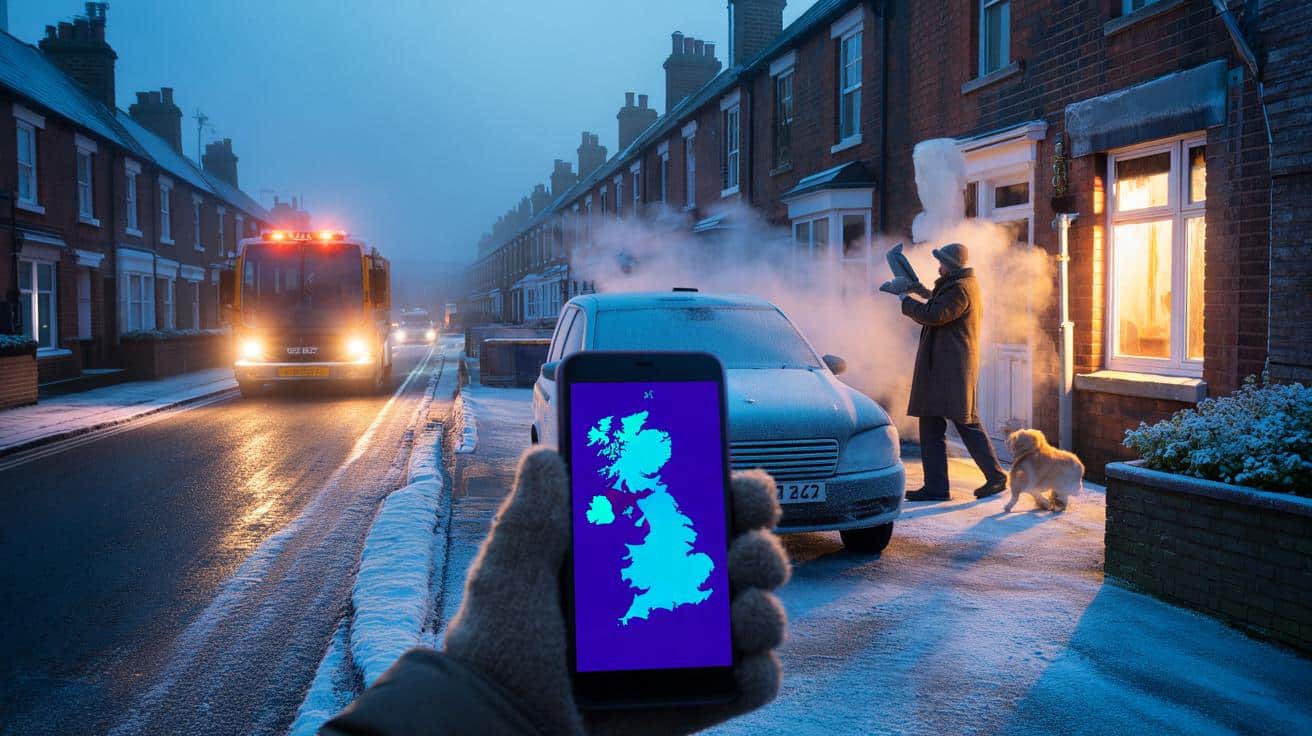
Arctic air is lining up for another swipe at Britain, with overnight lows dipping to -6C in the coldest pockets and a brittle frost pushing across the morning commute. Gritters are being prepped, school runs will be crunchier, and the nation is quietly hunting for its warmest hat.
At 6.10am a terrace street holds its breath. You can hear the scrape of a credit card on a windscreen, the soft clink of a gate, the rough sigh of a bus brake. A dog’s breath hangs white in the glow from a kitchen window. Someone checks their phone and those familiar snow maps bloom blue and purple, little islands of cold gathering over Scotland, leaking down past the Pennines, pooling in valley floors.
Neighbours nod, collars up, each doing the same little dance of keys, gloves, bag, breath. The cold isn’t dramatic, but it’s right there on your knuckles. **Snow maps now show Arctic air sliding back, with -6C pockets lighting up the coldest corners of the UK.** A single thought moves faster than the traffic.
Again.
The blue fade creeps south
Look at the maps and you can almost feel it arriving. A wash of polar air sags south from the top of the chart, colouring the Highlands deep blue and clearing the sky to a starry, brittle night. From there it drifts across northern England, nibbling at the North York Moors, brushing the Peak District, frosting the Midlands by dawn.
That -6C shows up in the most sheltered spots: Highland glens, rural Northumberland, parts of Cumbria where the wind loses interest. On high ground, exposed faces will feel sharper again, windchill scraping an extra two or three degrees off what your skin thinks is true. Urban cores run warmer by a notch or two, yet pavements on the edges still glaze like toffee.
On a Monday last winter, a Doncaster lorry driver left at 4.30am and counted three gritters before the A1. He told me the verges looked “sugared”, the way fields do when the first light catches. That’s the kind of morning this pattern makes—margins, microclimates, little wins for those who set off early. Across the country, temperatures are running a few degrees below the seasonal norm, the kind of deficit you feel in your fingers before your phone confirms it.
Those blue swathes don’t just happen. A stubborn dome of high pressure to the northwest can block the milder Atlantic train, steering air straight down from higher latitudes. Cold seas feed the chill, and the North Sea adds texture—short, snappy showers that pop along exposed coasts, turning lanes crunchy in minutes. Radiative cooling at night then does its quiet work, nudging rural lows down to -6C while city centres cling to a degree or two above that.
It looks simple on a map; it never feels simple on your street.
Small moves that make cold mornings easier
Here’s a seven-minute routine that pays for itself. Before bed, cover the windscreen and put your scraper and de-icer on the passenger seat, not in the boot under the frost. Top up screenwash to a winter mix and place a towel by the front step so you don’t skate out of your own doorway at 6am.
Set a gentle preheat on the boiler for an hour before you wake rather than cranking it in a panic. Leave a flask by the kettle and fill it when you switch on the porch light. Park nose-east if you can; morning sun buys you a minute. Never pour boiling water on glass; it can craze and refreeze in a heartbeat.
We’ve all had that moment when the lock won’t turn and your breath fogs your specs. Don’t force it. Warm the key in your glove and try again. **Black ice is invisible, but it isn’t imaginary.** Short steps, soft hands on the wheel, no hero moves. If your path is shaded, a sprinkle of grit the night before turns a stumble into a shrug.
Cotton is treacherous in the cold—go for wool or synthetics next to your skin, then a wind-stopping layer on top. Keep gloves in your coat sleeves, not on a distant shelf by the door. Use your phone torch at ground level to spot that shy film of frost hiding on the first and last step.
Let’s be honest: nobody really does that every day. You grab what you can and hope muscle memory carries the rest. So build small habits you don’t have to remember. De-icer by the door. Charger in the car. A message the night before in the family chat: “Frost likely, five minutes early?” Little notes help when everyone is bleary and blunt.
The trick is not to be heroic, just boringly ready. Your future self in the dark will thank you for anything that removes friction. You don’t need a survivalist kit; you need a warm hat, a steady plan and five calm breaths at the first slip.
“Cold isn’t the enemy. Surprise is.”
- Car: scraper, de-icer, winter screenwash, foldable shovel, torch, phone charger, blanket.
- Travel: check rail updates before you dress; leave 10 minutes earlier; keep a Plan B route.
- Home: draught excluders down, curtains closed at dusk, doors shut on unused rooms.
- Body: warm layers next to skin, spare socks in bag, flask in hand; slow breaths if you shiver.
- Care: quick text to a neighbour, pets’ water bowls unfrozen, doorstep gritted at bedtime.
What this snap says about the week ahead
On paper, this spell looks neat: a short, sharp return to Arctic air with rural lows down to -6C, wintry showers hugging coasts, and a slow thaw as winds veer and milder pulses nose back in. In reality, it’s a patchwork—street by street, hill by hill, a handful of minutes that either save you grief or cost you a boot full of slush.
What matters is the rhythm. Early starts, quiet roads, the hush you only get when the air is held together by cold. Kids on the lookout for a usable slope. Elderly neighbours who’d welcome a knock. A thousand porches lit five minutes earlier than usual.
**Cold snaps pass; the small rituals we build around them tend to stay.** There’s a comfort to that. Share a tip that helped. Send a photo of the first flurry. Say where the pavement bites or where the sun first reaches. The maps guide us, but the stories carry us.
| Key point | Detail | Interest for the reader |
|---|---|---|
| Arctic chill returning | Model maps show a fresh push of polar air, with rural lows near -6C | Know when and where mornings will be most difficult |
| Where snow is likeliest | Coastal showers along North Sea and Irish Sea coasts; higher ground favoured | Plan commutes and school runs with realistic expectations |
| Practical wins | Night-before prep, safer driving habits, small home tweaks | Reduce stress, stay warmer, avoid avoidable slips and delays |
FAQ :
- Will everyone see -6C?Not at all. The coldest values are most likely in sheltered rural spots—Highland glens, parts of northern England and the Borders. Towns and city centres usually sit a couple of degrees higher.
- Is London getting snow?Flurries are possible if a streamer sets up down the Thames or if showers drift far enough inland, yet it’s more likely to be dry and frosty. Bridges, flyovers and untreated corners can still turn slick.
- How long will this cold snap last?Brief, then changeable. A few days of colder-than-average air before a nudge back toward milder Atlantic conditions, though fresh pulses of chill can follow. Keep an eye on updated forecasts.
- What’s the safest way to drive on black ice?Slow everything down. Gentle steering, no sudden braking, higher gear when pulling away, leave extra space. If you feel a slide, ease off and let the tyres find grip; don’t fight the wheel.
- How can I stay warm without blowing the bills?Layer smart—thermal base, mid-layer, windstopper. Block draughts, close curtains at dusk, heat the room you’re in, use a hot-water bottle, drink warm fluids. Small changes stack up.



Thanks for the practical tips—putting de‑icer by the door and setting a gentle preheat saved me last winter. Quick Q: will those -6C pockets reach rural Northumberland mid‑week, or is it more a one‑night dip? Trying to decide wether to leave 10 mins earlier for the school run.