
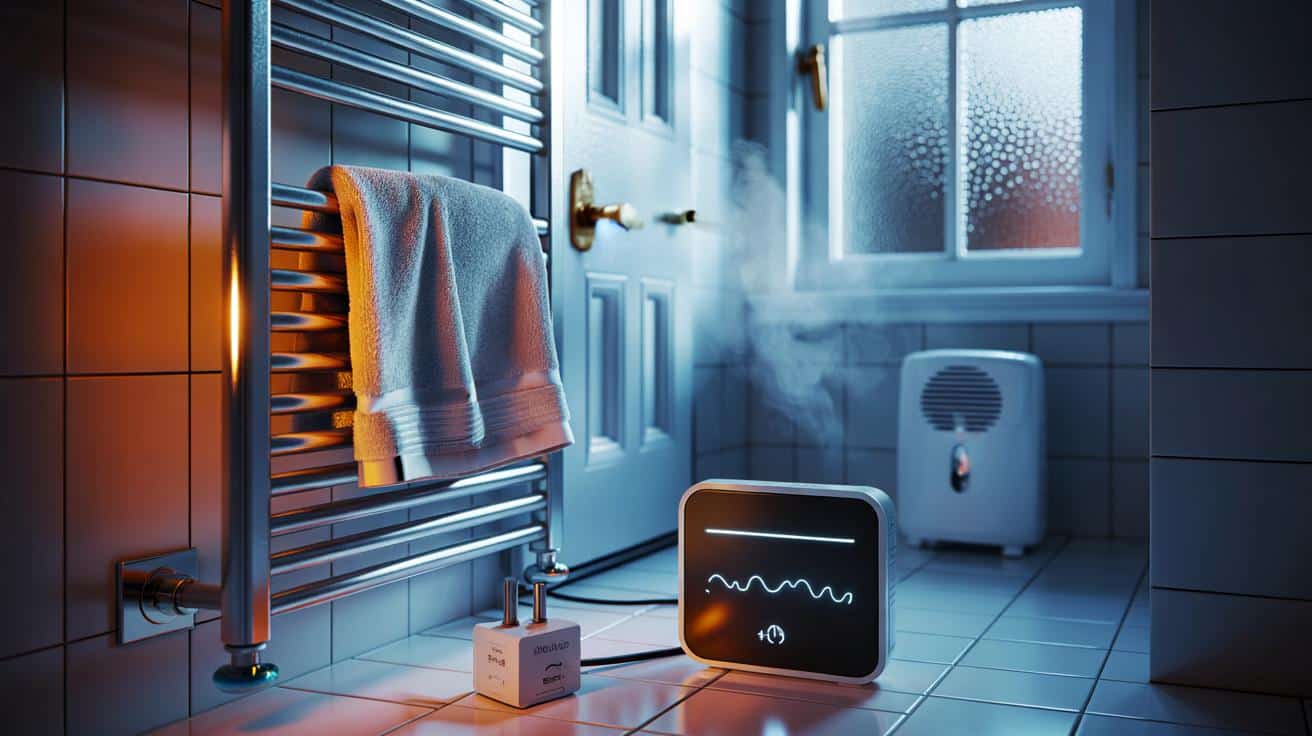
Yet there’s a smaller, friendlier‑looking culprit that hums along in the background. It doesn’t roar. It doesn’t glow. It just sips power all day until the total stings.
I noticed it on a Tuesday, the kind of grey morning where the sky feels low and the tiles bite your feet. The kettle clicked, the kids yelled for PE kits, and my smart meter graph suddenly grew a quiet little plateau. The boiler was idle. The oven was off. The washing machine blinked in standby as innocent as a cat on a radiator. We’ve all had that moment when the house seems still, yet the numbers won’t stop climbing. I followed the warm trail to the bathroom and laid a hand on the chrome bars. The towel was toasty, yes. The energy draw was toastier. The culprit sits behind the bathroom door.
The winter energy hog hiding in plain sight
That humble chrome ladder you brush past every morning can be a stealthy energy sponge. I’m talking about the heated towel rail, especially the electric kind with a simple on/off switch. It looks dainty. It rarely feels hot-hot. Yet that steady glow can run for hours, even days, because it becomes part of the bathroom’s background.
Here’s the shape of it. A typical electric rail draws 150 to 400 watts; many sit around 200 to 250. Left on around the clock, 200 watts becomes 4.8 kWh per day. At roughly 28p per kWh, that’s about £1.34 every day, or £40 a month for warm towels. One family in Leeds told me they thought their rail “couldn’t be costing much,” then discovered it was running 24/7 out of habit. The laundry didn’t change. The rail did. Their bill noticed first.
The trick is time. A kettle gulps power but only for minutes; a towel rail sips for hours and wins by endurance. Many rails don’t have thermostats that track room temperature, just a basic element that keeps pushing heat. Bathrooms are often the coldest spaces with the most hard surfaces, so heat leaks away faster. Electric rails work independently of your boiler, which sounds flexible, but it also means they can quietly do their own thing long after the towels are dry. That “low, always-on” setting? It adds up.
How to keep the towels warm without the bill shock
The smartest move is a schedule. Use a timer or a smart plug to run the rail in short bursts when you actually need dry towels: an hour before the morning rush, then a shorter burst in the evening. Two windows—say 6.30–8.00am and 6.00–7.00pm—usually keep towels dry and cosy without heating empty hours. If your rail accepts one, fit a thermostatic controller and dial it to a modest setpoint rather than full blast.
Common trap: people think “low” means cheap and leave the rail on all day, every day. The maths doesn’t care about the label; it cares about watts and time. Don’t smother the bars with a thick pile of towels either, which traps heat and wastes energy while still leaving the top layer damp. Open the window after showers for ten minutes to let humidity escape, then close it again—moist air is harder to heat and slower to dry. Let’s be honest: nobody really does that every day.
As one energy adviser told me,
“Heat for the moment you need—don’t bankroll the empty hours.”
A few quick wins help you do just that:
- Put the rail on a smart timer with two daily slots, then forget about it.
- Choose a lower-wattage element if you’re replacing the unit, or add a thermostat kit.
- Hang towels with space between them; rotate once after showers for faster drying.
- Use a short dehumidifier burst after a family shower to speed up drying, then switch it off.
Beyond the towel rail: the winter ripple effect
Once you spot one quiet load, others become visible. A small dehumidifier at 150–300 watts can be brilliant after steamy showers or for a damp spare room, yet it can turn into a daily background hum if it never gets switched off. An oil-filled radiator makes a lovely room feel snug, then lingers on for hours because it feels gentle. A heated throw costs pennies per hour, but not if it’s running in three rooms all weekend with nobody under them.
*The cheapest warmth is the warmth you actually notice.* This is the strange arithmetic of winter: little things grow large over time. Watch for the flat lines on your smart meter—the plateaus that say “constant draw”—and ask what they are. It might be the garage freezer frosting up more than it should, or a towel rail that never got the memo. Share what you find with your neighbours; swap the small fixes that stick. That’s how bills lighten without the house feeling cold.
| Key point | Detail | Interest for the reader |
|---|---|---|
| Heated towel rails can quietly cost £1 a day | At ~200W left on 24/7, they use ~4.8 kWh daily | Translates a “low” setting into real money you can save |
| Timing beats constant heat | Two short bursts align heat with use and drying | Warm towels, lower bills, no daily micro‑management |
| Find the flat lines | Smart meters reveal steady background loads | Quick path to cutting costs without sacrificing comfort |
FAQ :
- Are heated towel rails expensive to run in winter?Individually they’re low power, yet hours make them add up; 200–250W running all day can beat the cost of a single tumble-dry cycle.
- Should I leave a towel rail on all the time?No—short, scheduled bursts dry towels just as well and can trim usage by 50–80% across a week.
- Is a plumbed towel rail cheaper than an electric one?Plumbed rails piggyback on your central heating; electric rails draw separately. Which is cheaper depends on your boiler efficiency and tariff, but electric always-on habits are the common money drain.
- Can I use a smart plug with a towel rail safely?Yes if the plug is rated above the rail’s wattage and suitable for the bathroom zone; stick to reputable brands and follow fitting guidance or use a timer designed for heated rails.
- What other winter items quietly add to bills?Dehumidifiers left on, oil-filled radiators in spare rooms, always-on underfloor heating in bathrooms, and outdoor freezers in very cold garages all deserve a second look.






Isn’t 200W fairly small? At 28p/kWh, are we sure about £1.34/day unless it’s on 24/7? I’d love a quick calc for different tarrifs and wattages.
Great piece—never realised the “low” glow can still be a steady 200–250W. I’m setting a timer for 6:30–8:00 and 18:00–19:00; defintely going to watch for those smart‑meter flatlines. We had a similar “mystery plateau” and assumed the boiler—turns out it was the rail. Aligning heat with use makes sense, and the Leeds example hit home. Curious how much impact a thermostatic controller adds versus just tighter schedules.