
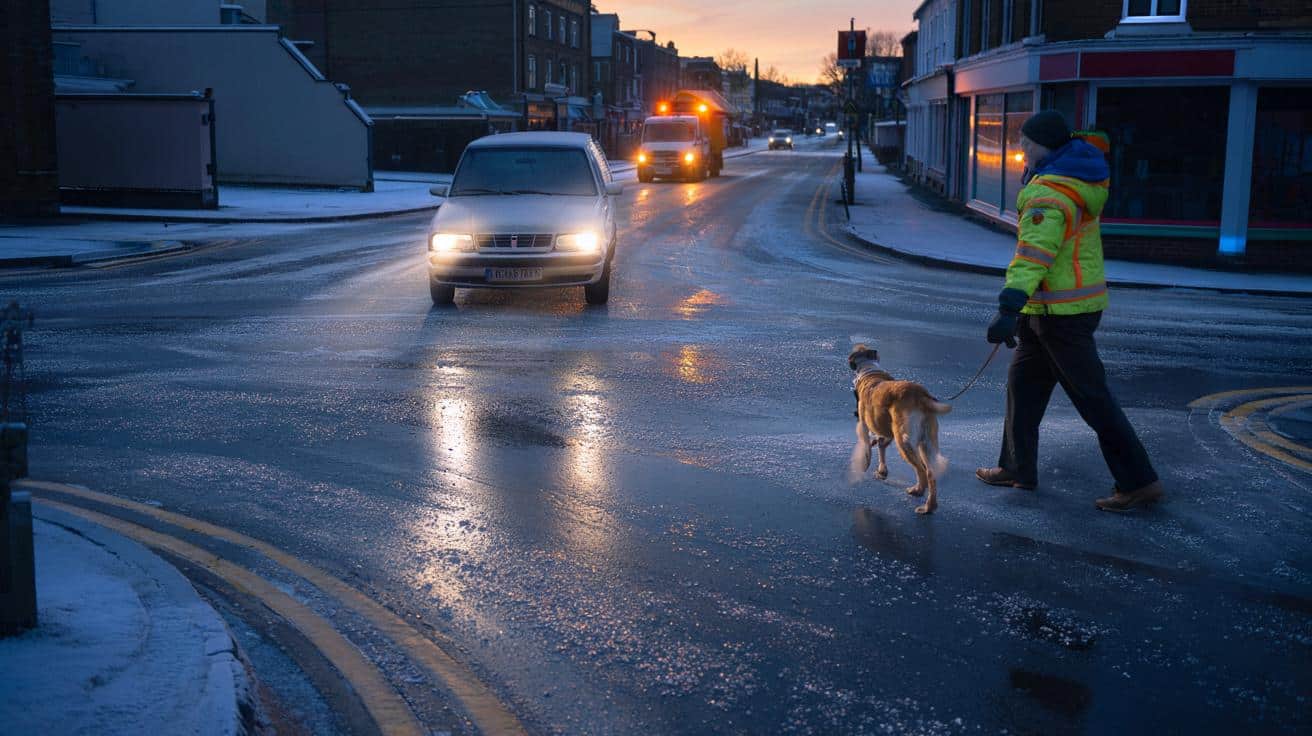
Icy patches are spreading across roads and pavements as temperatures plunge after sunset, catching late commuters and early risers off guard. Forecasters are warning of a sharp freeze, with black ice forming quietly where yesterday’s rain still lingers. The message is simple: slow down, look twice, and think ahead.
Not a crunch, exactly—more a dry whisper under the tyres as the estate car rolled onto the junction at 5:47am. Headlights picked out a glint on the tarmac you wouldn’t notice at noon. Breath hung in front of faces, dogs tugged at leads, and the town felt paused, like someone had turned the volume down.
A white van drifted a foot sideways, then caught itself. No horn. No drama. That’s the thing about ice: it does its work quietly. It felt like the road had turned against us. Somewhere in the distance a gritter rattled past, orange flash bouncing off shopfronts. One corner stayed darker than the rest. A trap waiting for dawn.
By sunrise, social feeds were full of near-misses and spinning wheels. School bags zipped. Kettles clicked. A cold snap isn’t unusual in January. What’s new is how fast it landed last night—and how long it might hold.
Tonight’s freeze, tomorrow’s risk
Road temperatures are falling faster than the air, and that’s where the trouble starts. Bridges, shaded bends, and untreated cul‑de‑sacs become slick well before high streets. Gritters hit priority routes first, leaving side roads to fend for themselves. The risk isn’t the big frozen puddle you can see. It’s the glossy film on an otherwise ordinary stretch.
We’ve all had that moment when the pavement looks fine until your foot slides a little. A nurse walking to an early shift described “skating across the zebra crossing” even though her street looked dry under the lamp. On the ring road, drivers reported a faint shimmer halfway up a ramp. No frost on the windscreen, yet the roundabout felt like glass. That mismatch throws people off.
Here’s the mechanics in plain English. Rain falls, drains slowly, and settles in micro‑dips. After dark, surfaces radiate heat into a clear sky and cool below zero. The water films freeze first because they’re thin. Salt helps, but its punch weakens in deeper cold, and traffic must grind it in to work. **Black ice often looks like ordinary wet tarmac.** That’s why confidence can be your worst enemy on a familiar road.
Small changes that make a big difference
Treat your first ten minutes outside like you’re walking into a theatre—slow, deliberate, eyes scanning. Short steps, flat footfall, and a hand free for balance. On the road, think in soft motions: gentle throttle, gentle steering, gentle braking. Keep the car in a higher gear than usual to reduce wheelspin. **Leave ten times the usual stopping distance.** It feels absurd on an empty road. It’s not.
Plan B beats bravado. Choose gritted routes even if they’re longer. Use the warmest glove you own rather than two thin ones that slip. Clear every pane of glass, not just a peephole in front of your face. Let’s be honest: nobody does that every day. Do it today. Warm the cabin slowly, and crack a window to clear fog faster. If you’re cycling, drop the tyre pressure slightly and pick steel over painted cycle paths, which can be treacherous in a freeze.
Think of gear as insurance. A torch, phone charger, and a small bag of cat litter or sand for traction can turn a bad morning into a story you laugh about. A hi‑vis vest isn’t overkill if you break down before dawn. **Never pour hot water on a frozen windscreen.** It can crack, and the re‑freeze is worse.
“I’d rather get a hundred photos of grit lines on my feed than one call from a driver in a ditch,” says a highways supervisor in the North West. “Treat dry‑looking roads with suspicion before 9am.”
- What to keep in the car: scraper and de‑icer spray; gloves; small shovel; sand or cat litter; torch; blanket; water; basic first aid; spare phone power bank.
- Before you go: check the council gritting map, tyre tread and pressure, wiper fluid, and your route’s shaded spots.
- If you slip: lift off the throttle, steer gently where you want to go, and let the car settle.
The freeze is local—and that matters
Two streets apart can be two seasons. A hill in shade stays frozen after school pick‑up while a sunny lane thaws by mid‑morning. Cities hold heat longer; rural lanes keep their frost. That patchwork is why blanket advice feels woolly. Your commute isn’t a headline—it’s a map of tiny microclimates. Share what you see. Tell your neighbour about the slick bit by the post box. Watch for meltwater refreezing at dusk. The cold won’t last forever. The habits you build tonight might.
| Key point | Detail | Interest for the reader |
|---|---|---|
| Black ice hides in plain sight | Looks like wet tarmac, forms where water films freeze first | Spot danger earlier and avoid sudden moves |
| Gentle inputs win | Soft steering, higher gears, long gaps, steady pace | Fewer scares, more control, less wear on brakes and tyres |
| Local cues beat national forecasts | Shade, bridges, and side roads freeze first and thaw last | Choose safer routes and times for your exact journey |
FAQ :
- How do I spot black ice before it’s too late?Watch for a subtle sheen under streetlights and a “quiet” feel through the steering. If the road looks oddly dark and the car feels light, you’re likely on it—slow everything down.
- Should I use cruise control on icy mornings?No. Cruise can add throttle at the wrong moment. Keep manual control so you can react smoothly to changing grip.
- Do winter tyres really make a difference in the UK?Yes. They stay grippier below 7°C and bite into slush and cold, wet roads. All‑season tyres are a decent compromise if you can’t swap sets.
- Is it safer to drive very early or wait?Waiting for daylight helps, and mid‑morning often brings a thaw on busy routes. If you must go early, favour main roads and keep your speed modest.
- What’s the best way to defrost my car?Start the engine, set ventilation to the windscreen, and use a scraper and de‑icer spray. Avoid hot water and don’t drive with tiny vision slots—clear every window before you move.



Isn’t this just Janurary being January? Feels a bit alarmist tbh.