
What they didn’t expect was the sound a wall makes when it lies. Renovation is meant to reveal problems. Sometimes it reveals people.
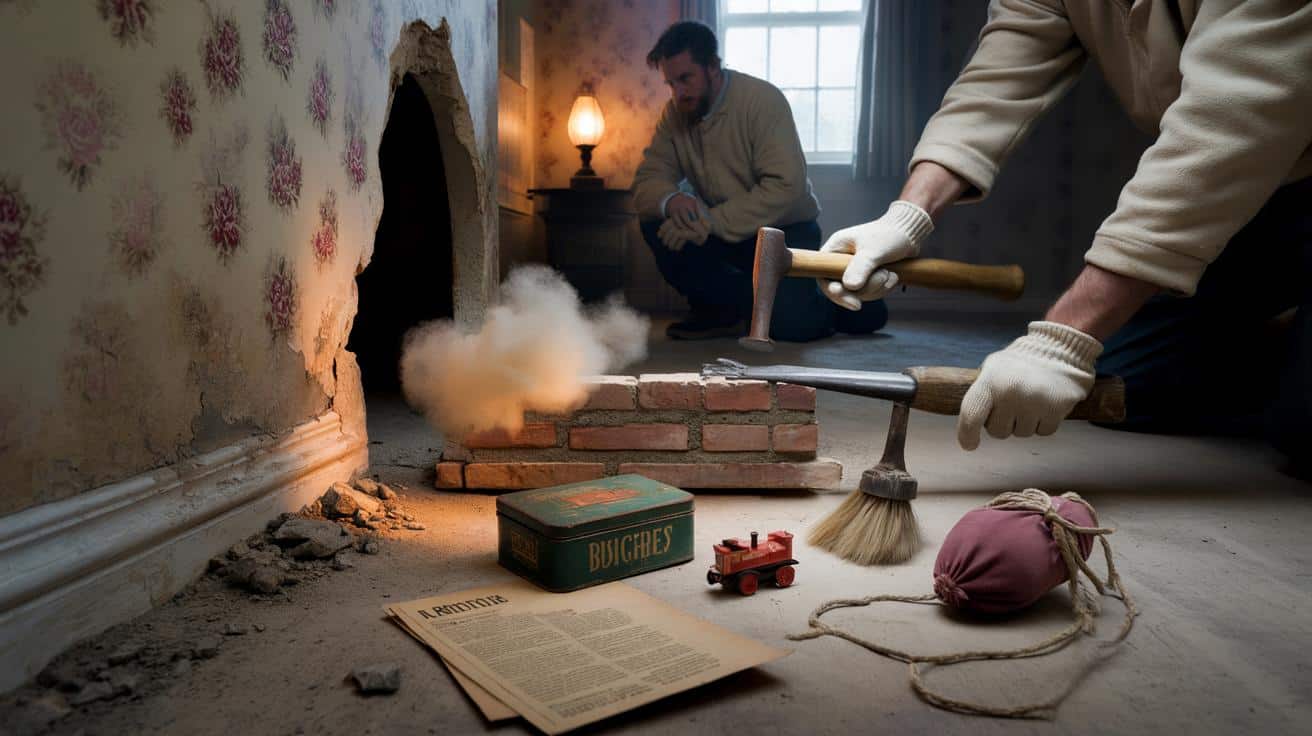
The dust had a sweet chalky scent, the kind that coats your tongue and makes tea taste like plaster. On a dank Saturday in March, a couple in fleeces worked in parallel – one steaming off a century of wallpaper roses, the other prising skirting gently, like pulling a bandage. The radio muttered football scores. Then came the hollow thud. Not the solid knock of brick, nor the crunchy give of lathe. A different note, like a drum you didn’t know was there. They froze, exchanged a grin that felt both mischievous and slightly scared. A torch went on. Fingers traced a hairline seam at knee height. The crowbar slid in with almost polite resistance. Brick dust sighed, something shifted, and the gap exhaled a pocket of air that smelled of lavender and old fires. They weren’t alone in the room anymore. The wall breathed.
Between plaster and time: the hidden room nobody planned
Old houses are like palimpsests. You live in the present, but you brush up against other people’s choices with every nail you pull. The couple’s “void” turned out to be a bricked-over alcove, no bigger than a suitcase, framed by a low arch. Inside sat a tin biscuit box, mottled green with rust, a ration book, a child’s chipped toy train, and a tiny velvet bag knotted with thread. Nothing sparkled. Everything vibrated. They didn’t rush it. They took photos with dusty hands, whispering without meaning to, aware they’d crossed a line between maintenance and memory.
Across the UK, millions of homes were built before the First World War. Every so often, someone taps a wall and finds more than bad plaster. A friend of mine lifted carpet in a Leeds terrace and found a mid-century terrazzo floor hiding under plywood. Social media flows with small dramas: an air-raid shelter tucked beneath a garden, stained glass painted over in the ’70s, a coin hoard wedged behind a hearth tile and forgotten in the rush of a move. None of it is grand, exactly. All of it feels like a handshake across time.
Why do these finds happen? Houses get layered. Fashions change, families grow, regulations shift. A priest hole gets bricked up because it’s not polite dinner talk anymore. A war starts, valuables slip into a cavity with a promise to retrieve them, then the owner never comes back. Builders make a shortcut, leave their mark in a cavity, seal it, and the secret becomes a feature. The physics is prosaic: hollows reverberate, surface temperatures differ slightly, skirting shifts when the timber behind shrinks. The psychology is the magic. You walk past the same spot for months, then one day your hammer sends back a different story.
If you hit a hollow: how to do this without turning a find into a fiasco
Stop. Not forever. Just long enough to slow your heart and tidy your thinking. Snap wide shots before you touch anything, then close-ups of where elements sit. Lay a clean sheet on the floor and move each item onto it in the order you found them. Label with masking tape. Ventilate the room. Wear gloves, not because treasure is fragile, but because mould and soot can be unfriendly. A cheap borescope camera can peek deeper without ripping half the wall. If the house is listed, call your local conservation officer before you remove masonry. Pause the sledgehammer; pick up the soft brush.
People rush. It’s normal. The adrenaline of discovery makes you want to yank and whoop. That’s the moment errors creep in. Don’t clean coins in lemon juice. Don’t vacuum paper. Don’t announce your find in a public Facebook group until you’ve thought about security and privacy. We’ve all had that moment when curiosity sprints ahead of caution. If anything looks like asbestos, back away and get a professional. Lead paint flakes? Bag them, wipe down, wash your hands. Let’s be honest: no one does that every day. Today is different.
What about the law, the ethics, the “what now”? If the find could be archaeological or you suspect it’s linked to the property’s fabric, speak to your council’s heritage team. If it’s modern memorabilia, consider the family history angle.
“The most meaningful discoveries aren’t always valuable,” says Helen Browne, a building conservation officer. “They’re evidence of ordinary lives. Record it well, treat it kindly, and you’ll add a new layer of care to the house.”
- Photograph items in situ before moving them.
- Note dates, names, addresses on paper items without unfolding aggressively.
- Store finds in breathable containers, not sealed plastic bags.
- Inform your insurer if structural work pauses due to discovery.
- If you think it’s treasure or human remains, contact the police or your local Finds Liaison Officer.
The pull of a hidden story
Part of what makes a discovery like this stick in your throat is how small it is. A button still threaded to a sleeve scrap. A key with no lock. These things say, quietly, “Someone stood here too.” You rearrange your sense of the house. The draught in the hallway, the scuff on the stair, the way the floorboard sings near the front room door – it all belongs to a story that now has your name scribbled in the margin. You were meant to find this, or at least that’s how it feels.
Objects don’t shout. They hum. When the couple sat on the dusty floor and opened the velvet pouch, they didn’t pull out jewels. They found three worn coins and a note in tidy cursive: “For luck, if ever needed.” That’s not monetary value. That’s a tiny ceremony. Maybe the house had a bad winter. Maybe a man was called up. Maybe a child hid a secret stash and then grew up and forgot. You can’t know it all, so you perform a small act of respect: you keep the note. You slip the coins into a frame with a photo of the house as you found it. A hidden find changes how you feel about your own rooms.
There’s no need to romanticise damp or pretend woodworm is charming. Real life renovation is mess and invoices and aching arms. Still, the moments when a wall offers up a whisper are a gift. They remind you that homes aren’t just assets. They’re containers of time. Share the story with the next owner one day. Put a letter back, with a date and a promise. In fifty years, another pair of hands might tap that same place and smile. The line continues.
| Key point | Detail | Interest for the reader |
|---|---|---|
| How to handle a find | Pause work, document in situ, use gentle tools, ventilate, and call heritage officers if the property is listed | Actionable steps to protect both the discovery and the renovation timeline |
| Why homes hide things | Layers of fashion, war-time habits, quick fixes, and deliberate concealment create voids and memory pockets | Makes sense of the surprise and adds meaning to everyday DIY |
| Common mistakes | Rushing, over-cleaning, posting publicly too soon, ignoring health hazards like asbestos or lead | Prevents damage, legal headaches, and health risks |
FAQ :
- Is it legal to keep what I find in my walls?If it’s part of the building’s fabric or classed as treasure, different rules apply. Everyday memorabilia usually stays with the homeowner. When in doubt, call your local council or Finds Liaison Officer.
- What if I think the house is listed?Stop intrusive work around the area and speak to your conservation officer. Alterations to listed fabric can require consent, even inside.
- How do I tell if there’s asbestos?You can’t by sight alone. Ages and materials can hint, but only lab testing confirms. If you suspect it, don’t disturb it; bring in a licensed contractor.
- Should I try to restore paper items I find?Keep them flat, dry, and out of sun. Avoid tape and household cleaners. A paper conservator can stabilise fragile items without making things worse.
- What if I find human remains or weapons?Stop immediately and call the police. Safety and legal procedure come first, even in a private home.







The wall breathed—what a line! Makes me want to tap every skirting board in my 1920s semi 🙂 Did you end up keeping the coins framed, or log them with a heritage officer first?