
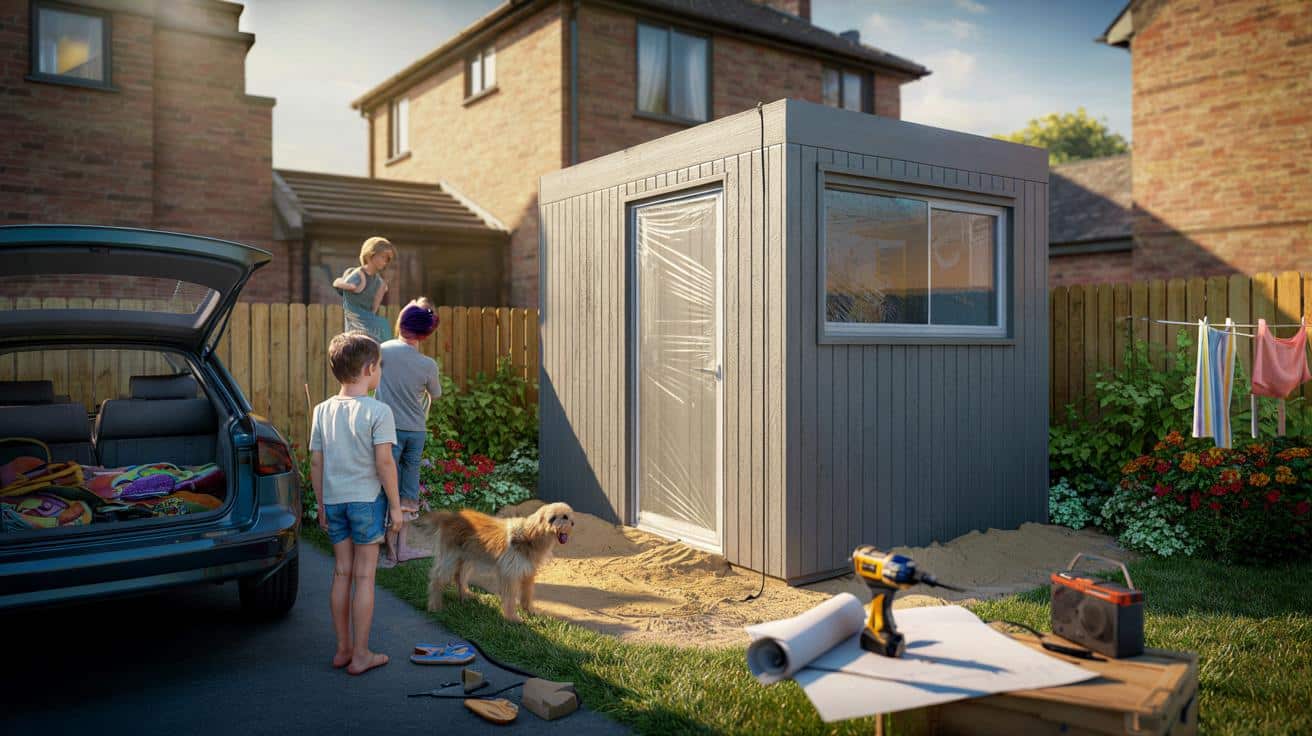
Not a scaffold or a tarpaulin — a finished wall, windows sealed, a door covered in protective film. We’ve all had that moment when the place you know suddenly feels unfamiliar. What happens next carries the weight of law, neighbourliness, and the thin line between progress and intrusion.
We pulled up as the last of the Sunday sun slid across the brickwork. The kids were arguing about crisps, the dog was impatient, and the boot was a mess of towels and flip‑flops. Then I saw it — a grey cube at the fence line, higher than the shed, taller than our kitchen extension, casting a long new shadow across the flowerbed.
The smell of fresh cement drifted over. A radio murmured somewhere, a drill coughed and went quiet. The neighbour’s curtain twitched, then stilled. I felt that odd mix of curiosity and alarm that sits like a stone in your stomach. Then the drilling started.
When a new wall appears overnight
Modern building moves fast. A prefab panel here, a flat‑pack garden room there, and a crew can raise a shell in a weekend. From the street, it can feel like someone has clicked and dragged the horizon, nudging it closer to your washing line.
Speed is exciting when it’s your project, and terrifying when it’s someone else’s. A family in Derby told me they left for half‑term and returned to a cedar‑clad outbuilding that seemed to sprout while they were on the M1. It wasn’t a fantasy TV reveal. It was just quiet, legal work making itself felt in real life.
Much of this happens under the umbrella of permitted development. In plain terms, that’s a set of rules that let homeowners build certain things without a full planning application. Height and placement matter, so does whether you’re in a conservation area. Building regulations are separate again, dealing with safety, structure and insulation. It’s a maze that looks simple until it’s on your doorstep.
What you can see versus what’s allowed
The shape you see isn’t the whole story. Some garden rooms, annexes and extensions are fine if they stay under specific height limits and keep a respectful distance from boundaries. Roof shapes change the math, and so does where the door faces. Two meters can be the difference between ordinary and actionable.
Local councils handle thousands of planning queries and enforcement complaints each year. Many turn out to be misunderstandings — a permitted outbuilding mistaken for a rogue annexe, or a temporary scaffold misread as a permanent wall. Neighbour disputes often begin with assumptions. They ease when facts arrive.
If the new wall touches a shared structure, the Party Wall notice enters the chat. It’s not planning law; it’s a framework to protect both sides when building near or on a boundary. Rights to light are different again, and often a civil matter rather than something the council polices. These distinctions are dry on paper. They’re electric on a Sunday evening when your kitchen goes dim.
What to do in the first 48 hours
Start with calm evidence. Take date‑stamped photos from fixed points — the end of the garden, the back door, the upstairs window. Save screenshots of the neighbour’s address on the council’s planning portal. If you knock, be polite: ask what’s being built, who the builder is, and which rules they’re working under. Keep a diary. Let’s be honest: nobody does that every day. But it helps if you need to prove a pattern of noise or hours worked.
Next, check the basics. Is there an application on the council website? Are there site notices on the fence or lamp post? If nothing shows, write to the planning enforcement team with your photos and notes. If the structure involves a boundary, ask if a Party Wall notice should have been served. If a trench is close to your fence, ask about foundations and vibration. This is stressful, and your home is your safe place.
People get tripped up by shouting matches and Facebook rants. Speak to the site foreman before you escalate. Builders often want to avoid trouble. If they have permission, they’ll show it; if not, they may pause. If things feel unsafe or aggressively fast, the council can consider a stop notice, though it’s rare and reserved for clear harm. Progress is not the enemy. Silence is.
“Most neighbours don’t want a fight,” a planning officer told me. “They want to be heard, to understand what’s lawful, and to feel like the line is visible to everyone.”
- Look up the address on your council’s planning portal and search “applications” and “enforcements”.
- Measure from the ground to the highest point near your boundary; note roof shape.
- Check if you’re in a conservation area or if there are Article 4 directions removing rights.
- Keep a simple log of dates, noise times, and conversations.
- If a shared wall is involved, read up on the Party Wall etc. Act 1996.
A neighbourhood story that echoes
What’s at stake isn’t just a wall. It’s the idea of home as a place you understand without thinking. Garden studios are multiplying because working from home has redrawn the day. Families stretch space to help ageing parents or returning graduates. The city creeps into the suburbs one permitted ridge at a time.
Communities adapt by talking sooner and more plainly. Knock before you pour. Share drawings before you order. If you’re on the receiving end, keep an open mind until facts form. Privacy can be protected with screening or a higher fence; light can be balanced with design tweaks. The conversation is itself the safety net.
Somewhere between the return from a break and the first cup of tea, you make a choice. To escalate or to engage. To hold the line or redraw it together. The new building next door can be a flashpoint or a shared problem to solve. The difference lives in how quickly we replace shock with a plan.
Back on that quiet Sunday, the drilling stopped. The foreman wiped dust from his hands, saw us staring, and folded a set of drawings open on a toolbox. A conversation began that wasn’t on the schedule. Small courtesies, clear rules, and a little grace — they’re not glamourous, but they build better streets than concrete ever will.
| Key point | Detail | Interest for the reader |
|---|---|---|
| Check status fast | Search your council’s planning portal for the address and any live applications | Know in minutes whether you’re looking at permitted works or a potential breach |
| Document calmly | Date‑stamped photos, a simple log of noise and conversations, names of contractors | Creates a clear record that supports complaints or constructive talks |
| Talk early | Knock politely, ask for the scope, timing and drawings, propose practical tweaks | Reduces conflict and opens the door to quick fixes like screens or window changes |
FAQ :
- Is it legal to build something that fast next door?Speed isn’t the test — compliance is. If the project meets permitted development rules or has planning permission, rapid progress is fine.
- What exactly counts as permitted development?In England and Wales, certain sizes, heights and positions are allowed without full permission. Roof shape, distance to boundaries and overall height all matter.
- Who do I contact if I think there’s a breach?Your local council’s planning enforcement team. Send clear photos, dates and a brief description of the impact.
- Can I force them to stop immediately?Only the council can issue formal notices, and they do so sparingly. If there’s danger, call it in; otherwise, supply evidence and await guidance.
- What if my light or privacy is affected?Privacy can often be improved with design tweaks or screening. Rights to light can be a separate civil matter — a surveyor or solicitor can advise.








Came back to find a grey cube too? Guess the neigbour unlocked the “instant build” DLC 😅