
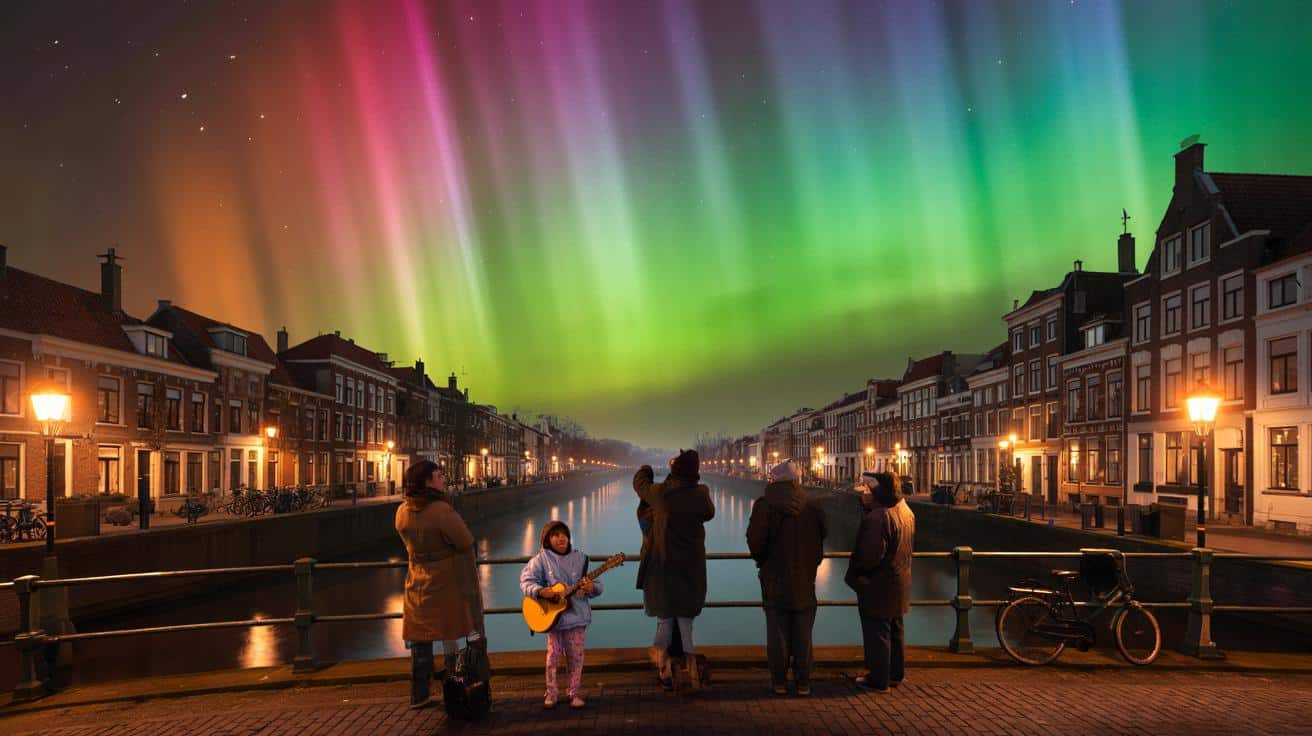
Rooftops and riverfronts glowed with soft pinks and eerie greens. Car parks turned into pop‑up observatories, and a thousand shaky phone videos tried to make sense of a sky that refused to stay still.
The message pinged just after 9pm: “Look north.” I took the stairs two at a time, pushed through the back door, and there it was — a quiet ripple above the houses, faint at first, then deepening like breath. A neighbour in slippers whispered, “Is that…?” The town fell into a hush usually reserved for first snow or last trains. A busker on the bridge stopped mid‑song and stared, capo dangling from his collar. Everyone looked up, phones forgotten, as if the street had been given a secret. Then the sky started to move.
A sky that shouldn’t look like this
Across parts of Europe, unfamiliar light stepped over familiar places. Curtains of aurora crept into view in Brittany and Lombardy, in the Low Countries and the north of Spain, painting long bars that quivered, faded, then flared again. Streetlamps carved silhouettes of chimneys against a blush that didn’t belong to them. *The night didn’t feel like night.* For a few hours, the horizon itself seemed to rise, thin and alive, as though the continent had tilted toward the Arctic without asking permission.
In Ghent, a couple woke their children and pulled coats over pyjamas, marching to the canal with a thermos and a grin. In Kraków, tram drivers slowed, passengers craning necks to catch a glimpse between wires. On timelines from Lisbon to Vilnius, a mosaic of shaky clips and raw wonder started to bloom. One space‑weather dashboard recorded Kp levels punching into storm territory, the kind of spike that pushes aurora well beyond usual latitudes. The numbers were cold; the glow felt anything but.
What pushed it south was the Sun’s own mischief. A surge of charged particles, thrown our way by a solar eruption, met Earth’s magnetic field and found the weaknesses, tugging at invisible threads that guide night lights toward polar caps. When the field lines bend and buckle, geomagnetic energy spills wider, and colours bloom further from the Arctic rim. Pink and crimson can appear where oxygen thins and nitrogen takes over, making city‑dwellers blink at a palette they thought belonged to postcards from Tromsø. **Europe looked north.** And north answered back.
How to catch it when it happens again
If the alerts start buzzing, keep it simple. Step away from the brightest street you know, face north if you can, and give your eyes a few quiet minutes to adjust. The best vantage is a clear, low horizon — a riverbank, a hill, a beach car park where sodium lights don’t roar. Check a reliable aurora map or a magnetometer read‑out, then pocket your phone and listen to the night. When the curtains appear, they’re often subtle at first — a grey smear that your camera reads as colour before you do.
Phone cameras can help, even the basic ones. Switch to night mode, lower the exposure compensation, and try a 3–10 second exposure with ISO between 800 and 1600. Brace against a wall or use a railing as a makeshift tripod, and tap to focus at infinity. Don’t blast your flash. It won’t “fill” the sky; it will bleach your friends and annoy strangers. We’ve all had that moment when the shot matters more than the view and then we miss the view. **Let the eyes win first.** Let’s be honest: nobody really does that every day.
Expectation is the trickiest part. Many people imagine neon ribbons like a screensaver; often you’ll see soft veils that build over minutes, then suddenly surge like surf.
“It felt like the sky had veins of light, humming above the roofs,” said a breathless sky‑watcher in Lille. “You don’t think Europe looks like this — until it does.”
A small checklist helps when the surprise arrives:
- Pick a dark, north‑facing spot with a low horizon.
- Give your eyes 10–15 minutes to adapt before filming.
- Use night mode, long exposure, and a steady surface.
- Watch for pillars, arcs and a rising arch near the horizon.
- Stay warm, stay patient, and keep headlights behind you.
Why this strange night matters
Rare sights have a way of re‑setting the dial on what we think our towns are for. A retail park becomes a viewing platform; a ring road lay‑by turns into a balcony on space weather. These moments tug a thread that runs from bus stops to magnetospheres, reminding us that our maps sit inside bigger, older currents. **No telescope required.** A sky like this lands right in the middle of errands, childcare, leftovers, bills — and still makes room.
There’s also the hush, the neighbourly grin, the brief suspension of small worries while everyone stares the same direction. The Sun’s cycle is climbing, which means these spills of light may show up again, sometimes where they don’t usually belong. That prospect is both practical and poetic. It pushes us to learn a compass point, to find a darker lane, to keep an eye on the quiet numbers that hint at a noisy sky. And it invites a simple question we don’t ask enough: what else are we missing when we don’t look up?
| Key point | Detail | Interest for the reader |
|---|---|---|
| Aurora slipped far south across Europe | Reports and images came from France, Belgium, northern Spain, Germany and Poland as Kp values spiked into storm territory. | Know that you don’t need to travel to the Arctic to witness a spectacle — sometimes it comes to you. |
| Driven by a geomagnetic storm | Charged particles from a solar eruption disturbed Earth’s magnetic field, widening the auroral oval and lighting lower latitudes. | Simple science you can picture: solar weather changes our night sky in very visible ways. |
| How to see and capture it | Find a dark, north‑facing horizon, let eyes adjust, use long exposures, keep expectations flexible. | Practical steps to turn a rare event into a memory — and a photograph you’ll actually love. |
FAQ :
- Was it really the aurora, or just city glow?City glow sits still and warms the sky orange; aurora shifts, pulses, and often shows green or pink in photos.
- Do I need special gear to see it?No. Your eyes are enough. A phone in night mode helps reveal colour your eye might read as grey.
- Which way should I look in Europe?North, toward the lowest, darkest slice of horizon you can find, away from strong streetlights and windows.
- What time is best?Anytime it’s dark with activity, often between 9pm and 2am local. Peaks can come in waves, so linger a little.
- Is it dangerous?For most of us on the ground, no. It’s a visual side‑effect of solar weather that satellites and grids monitor closely.


Watched from a riverbank near Ghent and it was definitly more than “city glow”—green veils that brightened and faded like breathing. Your tip to let eyes adjust for 10–15 mins worked. I almost forgot to take photos, then my phone in night mode pulled out pinks I couldn’t see yet. Magical.
Not to be a downer, but some clips looked like time‑lapse or cranked saturation. Any way to verify without trusting shaky vids? A magnetometer app shows Kp, sure, but locally it still felt like light pollution, tbh. Anyways, great read—just trying to sanity‑check.