
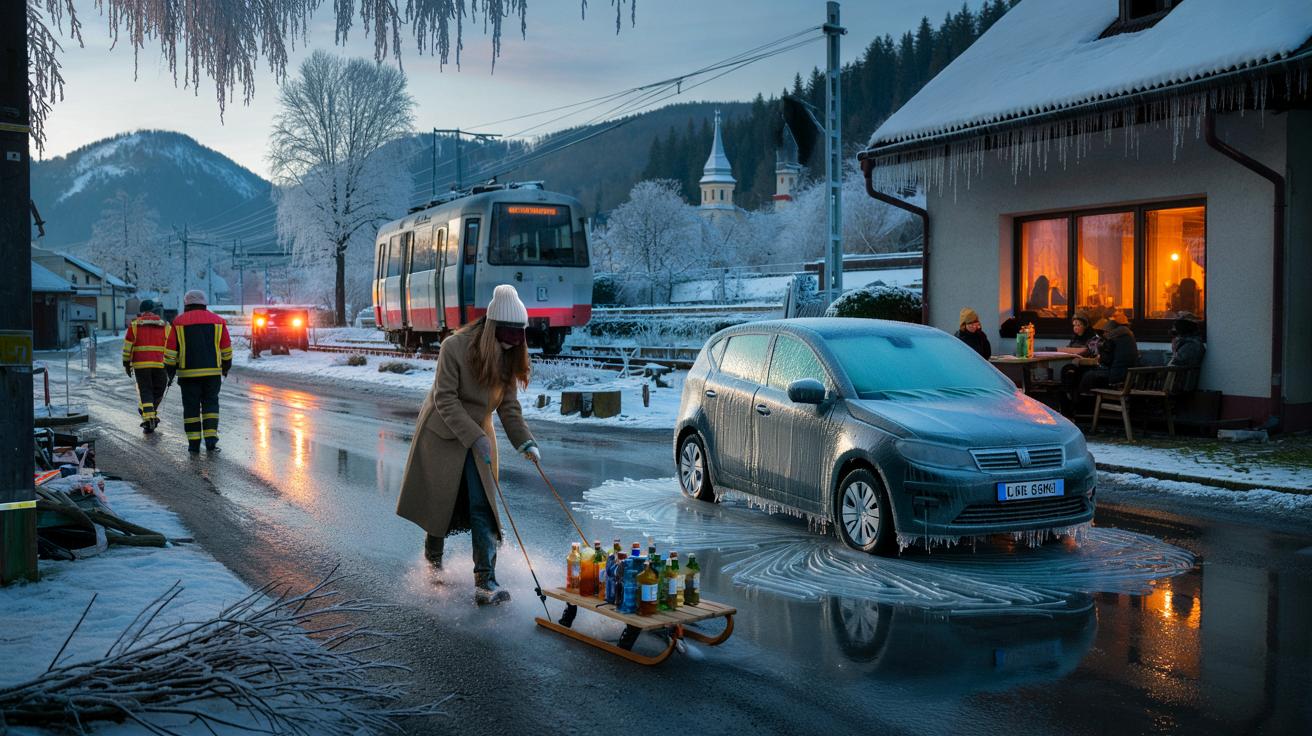
Slovenia has declared a state of emergency after a rare, stubborn band of freezing rain glazed valleys and highland towns, dropping power lines and halting rail in a crackle of ice. Engineers talk in metres of cable on the ground. Parents talk in torches and flasks.
I stepped out before sunrise and the air sounded like a forest of wind chimes breaking. Branches snapped with a soft gunshot pop, one after another, skidding across pavements already slick and treacherous. A woman in a wool coat dragged a small sled of bottled water back from a volunteer hub, smiling the way you do when there’s nothing else to do. It was beautiful until it hurt. We’ve all had that moment when the day looks ordinary and then quietly isn’t. Then the forest began to fall.
A country on pause as ice takes hold
By mid-morning the damage had a rhythm: crack, thud, hiss. Limbs fell, cables sagged, and the rail yard stood silent under a skin of clear ice, as if varnished. **This was not snow as you know it.** It was rain that had turned mid-fall, pinning doors shut and turning a Toyota into a sculpture. The emergency is not just official; you feel it in your boots.
In a village outside Postojna, a café opened by candlelight so neighbours could warm fingers around stovetop coffee. The owner, Pavel, handed out mugs while a teenager charged phones off a car battery snaked through a cracked window. **Small towns became islands overnight.** Volunteers went door to door, counting who needed insulin, who had a wood stove, who didn’t.
Freezing rain is a trickster. Warm air rides in above cold ground, raindrops fall liquid, then flash-freeze on contact. The result is weight—tonnes of it—spread leaf by leaf, wire by wire. The science is sober; the feeling is not. **The emergency is less about drama and more about days without basics.** No lift in the block, no fridge, no kettle. A country pauses, then reorganises itself in quieter ways.
What helps when winter turns strange
There’s a small ritual that works: think in layers, power, neighbours. Wear a base layer that wicks, a middle that traps heat, then a shell. Put your phone on low-power mode and stash a charged battery bank in an inside pocket so it stays warm. Map one warm room at home and seal the bottom of doors with towels to keep heat in. It’s not glamorous, but it buys hours.
Generators save lives when used right. Keep them outdoors, far from windows, and run them in short bursts to recharge, not to pretend the house is normal. Stock water, not just food; kettles don’t boil themselves in an outage. Let’s be honest: nobody actually does that every day. That’s fine. Start with three things tonight—candles, blankets, meds—and you’ll thank yourself later.
Think like a street, not a flat. Text your stairwell or WhatsApp group: who’s okay, who needs what, who has a gas hob. A winter emergency rewards coordination more than heroics.
“We lost the lights at four in the morning,” said Maja, a nurse I met queuing for a portable heater. “It went so quiet that I could hear branches snapping for hours. The loudest thing after that was neighbours knocking on doors.”
Here’s a tiny pack list that travels well when ice makes you slow:
- Head torch with spare batteries
- Power bank and short charging cable
- Wool hat, thin gloves inside thick gloves
- Two large bin liners (rainproof everything)
- Insulated bottle and a high-calorie snack
The deeper story behind a frozen week
What happened in Slovenia this week reads like a glitch, but it doesn’t live alone. Winters across Europe are getting stranger—milder on average, yet spiked with sharp, short cold snaps that make freezing rain more likely. Climate doesn’t hand you a single cause; it loads the dice. A warm layer aloft, a cold surface, a stubborn front that refuses to move—add topography carved by rivers, and you get a country set in ice.
There’s also the humbler truth of infrastructure built for a different rhythm. Lines that can handle snow can struggle with a clear glaze that triples their weight. Trees conditioned to sway under powder snap under invisible glass. Municipal plans written for ploughs now need chain saws, de-icers, community hubs. Most of the best fixes are boring. They don’t make television, but they keep elderly neighbours warm and traffic lights back online.
And still, the human part is the bit that lodges in your chest. The long walk for water. The quiet phone. The way a country learns, almost overnight, that resilience is a slow habit, not a hero moment. When the ice melts—and it will—the memory lingers in changed routines: extra blankets by the door, numbers taped to the fridge, a neighbour’s spare key on your hook. The future will ask for more days like that.
| Key point | Detail | Interest for the reader |
|---|---|---|
| Freezing rain, not snow | Liquid drops freeze on contact, building a clear, heavy glaze on trees, roads, and power lines | Explains why everything looked shiny yet became dangerous in minutes |
| The emergency unlocks capacity | Rapid funds, army engineering units, cross-border energy support, and simplified procurement | Shows what changes practically for services and how help arrives faster |
| Resilience is local | Warm rooms, neighbour check-ins, safe generator practice, small, repeatable routines | Gives readers a simple playbook they can copy tonight |
FAQ :
- What exactly happened?A band of warm air above sub-zero ground produced freezing rain. That rain coated everything in ice, bringing down trees and power lines and prompting a national state of emergency in Slovenia.
- Which areas are most affected?Lowland valleys and foothill towns where cold air pools, plus forested regions with mature trees. Urban centres saw transport disruption and power cuts, too.
- How long could the emergency last?Ice can cling for days if temperatures hover around zero. The physical clean-up—trees, lines, rails—takes longer, often measured in weeks.
- Is this linked to climate change?One event has many ingredients. Warmer winters with sharper cold snaps can increase the odds of freezing rain. Scientists say the dice are being loaded.
- What can travellers do?Check local transport feeds, carry warm layers and a power bank, and keep travel plans flexible. If you don’t need to move, wait a day—roads improve fast once ice breaks.



Thanks for the clear explainer—freezing rain isn’t ‘just snow’ after all. Wishing folks in Slovenia a quick recovery and steady power. Neighbors checking on neighbors is the real headline here 🙂