
Ice baths crop up in garden buckets, lidos fill at dawn, and cold showers trend under breathless hashtags. Scientists have been paying attention too — not to the bravado, but to what the cold is whispering to our cells.
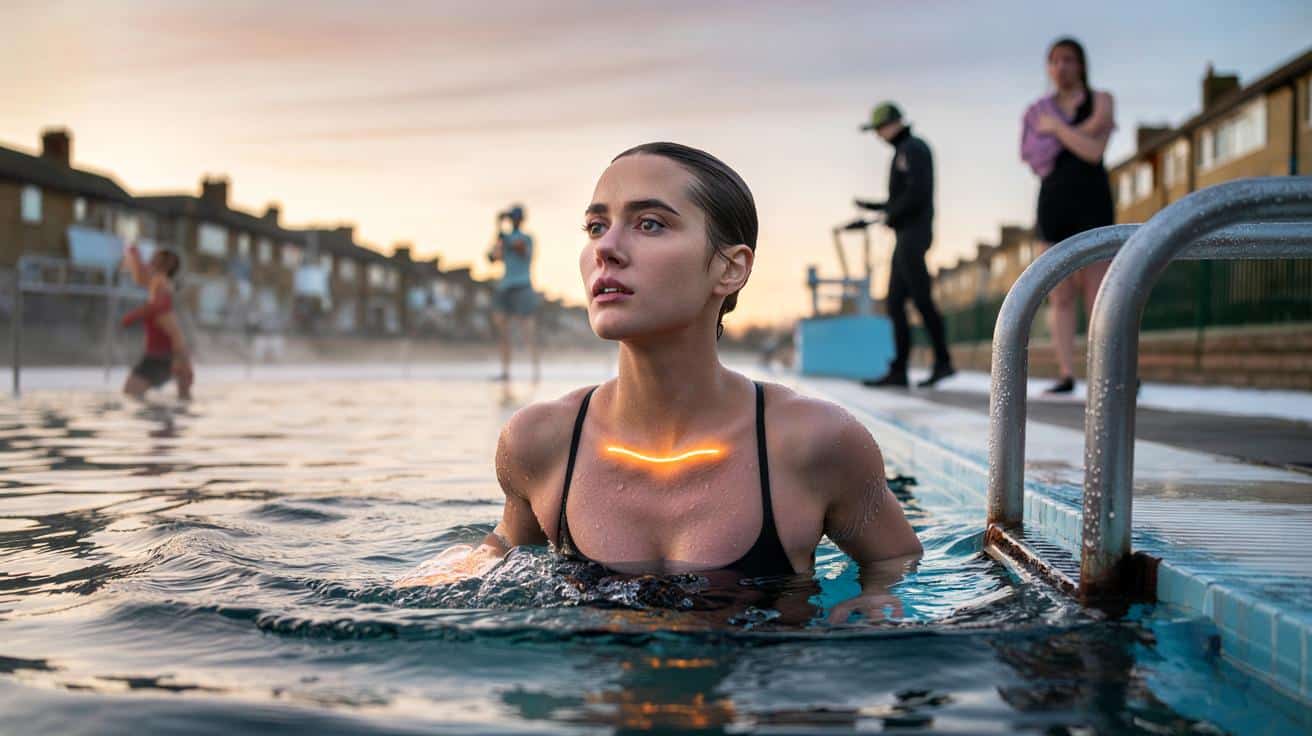
I watched a woman step off the slick steps of a London lido and sink to her shoulders in water that looked like steel. Her breath hitched. The surface ruffled in tiny rings as she held herself very still, eyes fixed on the horizon of biscuit-coloured houses. A lifeguard paced, sipping tea from a chipped mug.
After a minute, something changed. Her shoulders lowered. The chatter from her jaw softened. Steam rose from someone else’s cup and drifted toward her like a spirit. A runner on the towpath slowed, curious. We’ve all had that moment when time stretches and the body writes its own story. Her shiver eased. That’s when the science gets interesting.
What really happens in the first cold minutes
The first thing the cold does is grab your reflexes by the lapels. Skin sensors send a rapid-fire signal; heart rate spikes, breath quickens, blood vessels pinch to keep the core safe. **Cold changes your blood chemistry within minutes.** Stress hormones rise, including noradrenaline, and a quiet network of heat-making tissue — brown fat — flickers on like small fires under the skin.
This isn’t just theory played out in labs. In volunteer studies, mild, shiver-free cold has lifted resting energy use by around 10–20%, a tidy nudge without the teeth-rattling misery. One group sat in cool rooms, and their bodies released tiny fat-derived messengers with big names — such as 12,13-diHOME — the kind of molecules that tell muscles and hearts to work smarter. A commuter told me his one-minute cold shower on winter mornings feels like “wiping fog off the inside of my skull”. It’s not magic. It’s signalling.
Here’s the hinge. Cold is a stress your body can learn to read. Repeated, brief exposure seems to recruit more brown fat, coax some white fat to “beige”, and sharpen how tissues handle sugar and fats. That chemical jolt can also lift mood for a while, likely via the same messenger cascade that wakens you with a start. *Cold is a tool, not a trophy.* The surprise is less about calorie burn, more about orchestration — dozens of micro-messages aligning thermoregulation, mood and metabolism.
How to use the cold safely — and actually feel better
Start tiny. End your warm shower with 30–60 seconds of cool-to-cold water, three days a week. Breathe through your nose, slow and even; let the water hit hands and feet first, chest and neck last. Aim for a “3–4 out of 10” on your personal cold scale; speech still smooth, breath under control. Step out, towel off, then warm with light movement for five minutes. The real win shows up in how you feel the rest of the day.
Common mistake: chasing shock. That jaw-clench might feel heroic, but it’s not the goal. Stay just below shiver point, and keep your face out if you’re new — the gasp reflex can be fierce. Never combine breath holds with cold water. Mix it with social support instead: a friend, a lifeguard, a busy pool. If you live with cardiovascular issues, Raynaud’s, pregnancy, or you’re unwell, talk to a clinician first and favour gentle temperature dips. Let’s be honest: nobody really does this every day.
**The real win isn’t bravado, it’s consistency.** Treat cold like espresso, not espresso martinis — a clean nudge, not chaos.
“Cold isn’t there to prove you’re tough. It’s there to teach your system how to adapt.”
Here’s a quick safety crib sheet:
- Stop immediately if you feel chest pain, dizziness, or confusion.
- Leave the water if shivering becomes violent or speech breaks into staccato.
- Warm from the inside out: move, dress, sip something hot; skip the scalding shower to avoid afterdrop.
- Don’t go alone in open water; choose lifeguarded spots.
- No alcohol before or after. It scrambles body signals.
Why scientists care — and why it’s not just a fad
Cold exposure is rewriting the way we think about “fitness”. The data hint at a single input — brief cold — that ripples across systems we rarely connect: adipose tissue, brain chemistry, blood vessels, immune tone. In some studies, cold nudges immune cells toward a calmer state after exercise, not by blunting the training effect, but by tidying the mess. In others, those lipid messengers released in the cold pop up during workouts too, suggesting shared pathways between movement and chill.
There’s a cultural angle here as well. People don’t step into icy water to become Spartans; they do it to feel more like themselves. That makes the science useful only if it supports a life you can keep living. Maybe it’s two minutes of cool water while the kettle boils. Maybe it’s a winter swim once a week with neighbours and a thermos. **Start small, stop warm.** Share what works, skip what doesn’t, and notice what changes — energy, sleep, the way stress lands on your shoulders. The most surprising effect might be the one you measure in your day.
| Key point | Detail | Interest for the reader |
|---|---|---|
| Brown fat activation | Brief cold turns on heat-making tissue and can raise energy use by ~10–20% without heavy shivering | More warmth, steadier energy, potential support for metabolic health |
| Neurochemical lift | Cold spikes noradrenaline and can boost mood and alertness for a short window | Sharper focus for work or training, without another coffee |
| Signal molecules | Cold releases lipid messengers (e.g., 12,13-diHOME) that help muscles and the heart work efficiently | Benefits overlap with exercise pathways, making small doses worthwhile |
FAQ :
- Is a cold shower enough to get benefits?Yes. Even 30–60 seconds at the end of a warm shower can trigger useful signals without a dramatic plunge.
- How long should I stay in cold water?For beginners, under two minutes is plenty. Aim for “controlled discomfort” where breathing stays smooth and shivers are minimal.
- What’s the best time of day for cold exposure?Morning suits most people because it’s alerting. Avoid right before bed, as the arousal effect can nudge sleep away.
- Is cold exposure safe if I have a heart condition?Get personalised medical advice first. Many people should opt for milder cool exposure rather than ice-cold, or skip altogether.
- Should I pair cold with sauna or workouts?You can, but separate high-intensity training from deep cold if strength gains are a priority; use gentle cool-downs instead on heavy days.





Fascinating read—didn’t know brief cold could boost energy use by 10–20% without shivering. Any citations on the 12,13-diHOME pathway in humans outside lab settings?
Sounds cool (pun intended), but is the mood lift just placebo? I’ve tried cold showers and felt mostly miserbale tbh. Does the noradrenaline spike fade after a week, or keep adapting?