
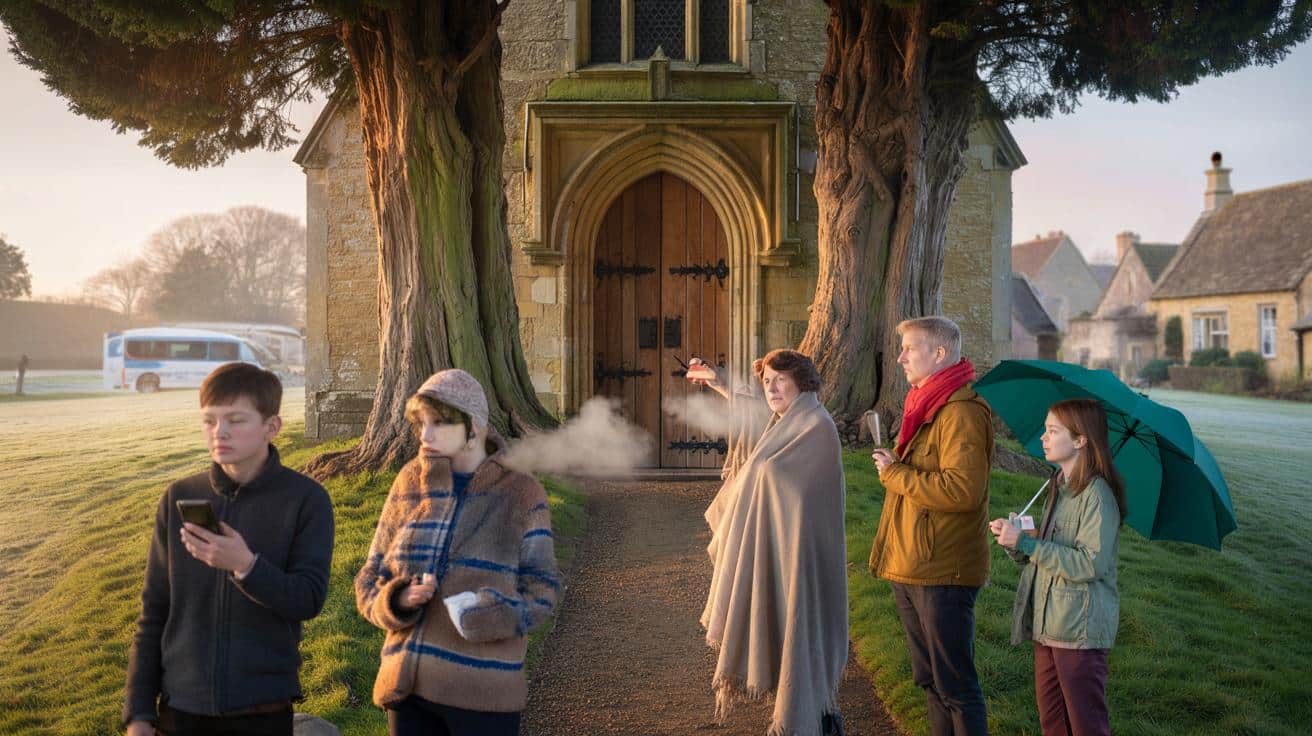
Stow‑on‑the‑Wold, where shop bells usually ring soft and slow, is now juggling coach drop‑offs, selfie sticks, and a single wooden door that has somehow become a global magnet.
I watched the first coach breathe out its passengers at 8.07am, steam curling from coffee cups as people blinked into the pale light. A cafe owner propped the door with her hip, muttering about extra almond croissants, while a teenager looked up from his phone and tugged his dad’s sleeve, pointing towards the church. The town felt like it was holding its breath. A queue bent around the ancient yews, quiet as a library, every face tilted towards the same weathered doorway with two trees growing out of it. **A wooden door is pulling crowds to the Cotswolds.** All for a door.
The day a door became a destination
At St Edward’s Church, an oak door framed by two aged yew trunks looks like something from a storybook. Local lore has long whispered that Tolkien saw it, or at least would have loved it, but it sat in gentle anonymity for years. Then a creator posted a 12‑second clip calling it “the real‑life portal to Middle‑earth,” and an algorithm flipped a switch. Overnight, Stow wasn’t just charming; it was trending.
By the weekend, the vicar had placed a handwritten sign asking visitors to wait between services, and a queue formed anyway. I met a couple from Glasgow who had driven through the night, still wearing their fleece blankets from the car as they posed, grinning, beneath the branches. On TikTok, the hashtag #TolkienDoor passed 8.3 million views in four days; the church’s donation box collected small fortunes in coins and crumpled fivers.
Why did a door do this? It’s small, photogenic, and easy to understand at a glance. It suggests secret worlds without a ticket price, a micro‑escape when everyone is hungry for a neat, digestible wonder. **The internet didn’t invent wonder; it just shortened the distance to it.** One clip becomes ten, ten become a thousand, and a quiet town wakes to find its pavements part of someone else’s pilgrimage.
How the town is coping — and what travellers can do
The fix on the ground is simple and human: timing, pacing, and kindness. If you want the door to yourself, go early on a weekday, then take a slow loop around the back lanes to stretch out the crowd. Park by the long‑stay and walk in, so residents aren’t boxed in by overlapping bumpers. Drop a coin for the church roof if you can, then slide into the high street where bakers and booksellers will absorb the rest of your morning.
We’ve all had that moment when a place online becomes the place you’re standing, and the spell is fragile. Don’t climb the roots, don’t touch the hinges, and listen for the church bell — that’s your cue to give way. Let’s be honest: nobody actually does that every day. If you need the shot, take two, breathe once, step aside. Your memory will feel richer if you leave room for someone else’s.
Local voices want the rush to feel like a welcome, not a stampede. The vicar told me he’s staggered but hopeful, because the door is made for looking and the town is made for lingering.
“In a week, we’ve seen visitors from three continents,” said Reverend Mark Langley, smiling with a hint of worry. “A door is a threshold. It’s also a reminder to come in, light a candle, then go out and meet the baker.”
- Best time: sunrise to 9am; avoid service times posted at the lychgate.
- Where to park: long‑stay on Maugersbury Road; free toilets nearby, blue‑badge bays marked.
- Spend it forward: pastries at The Old Bakery, paperbacks at the independent bookshop, a pint by the square.
- Alternative shots: the market cross, sheep‑spotted hills on King’s Hill, honey‑stone lanes behind Church Street.
What a viral moment says about Britain now
There’s something tender about people converging for a scrap of magic in a hedge of yew. It’s cheap, it’s outdoors, and it requires a small ceremony: arrive, hush, point, grin. As economies pinch and attention scatters, places that offer a tiny, non‑transactional wonder feel like balm. The town knows this, and you can sense it in the way a shopkeeper folds a bag just so, or a resident opens a gate with a smile that is both proud and protective. **A door like this makes us practise how to share.** It tests our manners and our appetite for small joys. And, if we’re lucky, it pushes us beyond the frame — into the bakery queue, the side lanes, the conversations that turn a viral stop into a real visit.
| Key point | Detail | Interest for the reader |
|---|---|---|
| Why the surge | A 12‑second viral clip framed St Edward’s yew‑trimmed door as a fantasy “portal” | Understands how a tiny visual cue can drive huge footfall |
| How to visit well | Arrive early, respect service times, use long‑stay parking, spend locally | Turns a quick photo‑stop into a smoother, kinder day out |
| Beyond the door | Market cross, hill views, indie shops, slow‑lane walks | Finds more value than a single selfie, spreads the love (and the spend) |
FAQ :
- Where exactly is the “Tolkien door”?It’s the north door of St Edward’s Church in Stow‑on‑the‑Wold, Gloucestershire, framed by two ancient yews.
- Is there a confirmed link to J.R.R. Tolkien?No official proof, just a long‑standing local belief that the doorway evokes his world — and it certainly looks the part.
- When is the best time to visit without crowds?Early weekday mornings are your friend; aim before 9am and check the board for service times.
- Can I take photos during services?It’s a working church, so step back during services and return after; you’ll get a better shot in the quiet.
- What else should I see nearby?Wander the market square, pick up a book from the indie shop, and loop out to King’s Hill for classic Cotswold views.




All this fuss over a wooden door? Guess we all need a portal on Mondays. 🙂