
Across the UK, a thin, stick-on “thermal film” has started showing up on walls and under desks, promising cosy heat for pocket change. People call it the “20p film” — a nickname born from the idea that it sips power so lightly you barely notice it on your bill.
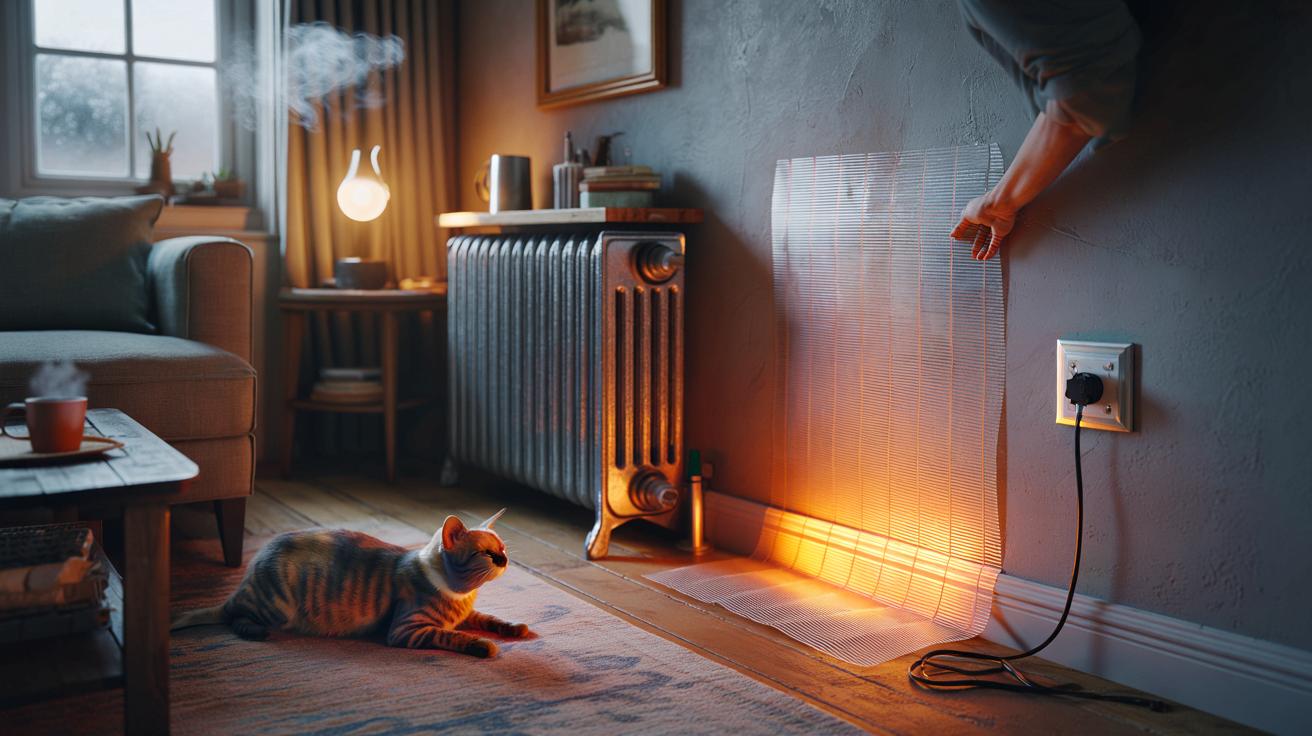
It was a Tuesday in late November, the kind of grey that gets into your bones, when I first felt it. A neighbour in a Midlands terrace peeled a backing sheet, pressed a wafer-thin panel to a north-facing wall, and clicked a tiny thermostat. The room didn’t roar to life; it settled. The cold corners stopped biting. A cat slid over and sprawled under the glow as if it had always known this was the warmest spot in the house. We watched the smart meter barely twitch while the wall turned into a gentle sun. The kettle hissed, the windows misted slightly, and the silence felt new. It wasn’t dramatic, but it was different.
Then came the thought you only whisper on a tight budget. What if this could replace the radiator?
Meet the “20p” thermal film people are sticking everywhere
You’ve probably scrolled past it: a paper-thin, plug-in sheet that radiates heat like a low sunset. It doesn’t whoosh air around or clatter with pipes. It just warms the surfaces and the people in front of it, the way the sun does in winter when you find that one good spot by the window. That’s why people say rooms feel less draughty — not because the air is hotter, but because your skin is.
The name comes from how it’s used. A modest panel — say 700–800W — costs roughly 18–22p an hour to run at a 28p/kWh tariff, and smaller 300–500W panels land in single digits per hour. In a Leeds flat where two renters trialled a 500W panel for evening use, their winter electricity rose by about £10 that month, while their gas fell by nearly £19 because they stopped firing the whole system for one cosy room. That’s not a lab test; it’s a lived kitchen-table result. Still, the smile when they talked about reading on the sofa said plenty.
Infrared film works differently from your radiator’s convection loop. It doesn’t push warm air round the room; it sends long-wave heat that’s absorbed by walls, furniture and you. The physics are simple: warm surfaces reduce radiant heat loss from your body, which is why you feel “toasty” even if the air temperature hasn’t shot up. That matters in British homes with cold masonry and stubborn north walls. Warm the mass and the space feels calmer, faster. The trick is to place it where you sit, not just where there’s an empty patch of plaster.
How to try it at home without tearing up the house
Start small with a plug-in panel you can stick to a cold wall near your favourite chair or mount under a desk. Choose a film rated for walls, with an integrated limiter and a plug-in thermostat you can set to 19–20°C. Keep a 10–15 cm breathing gap around the edges and avoid covering it with posters or shelves. If the wall is icy, add a slim reflective layer behind it to send more heat into the room. Use a smart plug to cap hours, then note your meter change for a week. Real life beats guesses.
Common mistakes are boring but costly. People slap a panel behind thick curtains and wonder why it underperforms, or they choose a panel that’s too small for the room and run it flat out. Others place it opposite glass and lose heat to the night sky. Put it where humans are, not where it’s easy to reach a socket. Let’s be honest: nobody actually does that every day. You’ll do it if it’s simple, tidy and feels good within ten minutes — so make it feel good in ten minutes.
We’ve all had that moment when you step into a room that’s technically warm but somehow not warm enough. That’s the gap this film tries to close.
“Infrared isn’t magic — it’s targeted comfort,” says a building physicist I spoke to. “If you warm the surfaces people face, you can run lower air temperatures and still feel right.”
- Place panels where you sit, work or gather; aim at bodies, not windows.
- Pair with a thermostat and schedule short bursts, not marathon sessions.
- Keep safe clearances and avoid damp zones unless the panel is rated for bathrooms.
- Don’t hide it behind fabric, and never drill through it — treat it like a live appliance.
Does this really mean the end of big heating bills?
There’s a reason this is taking off among renters and home workers. Gas boilers heat the entire circuit; thermal film heats the bit of life you’re living. If you spend long evenings in one room, the maths can flip in your favour. Run the film for two or three focused hours, let the rest of the house idle, and your bill reflects your routine instead of your pipework. *It feels subversive, like you’ve quietly rewritten the rules of winter at home.*
| Key point | Detail | Interest for the reader |
|---|---|---|
| Targeted comfort beats whole-house heat | Infrared warms people and surfaces directly, so you feel warm at lower air temps | Stay cosy where you sit and cut wasteful hours on central heating |
| Real-world running costs are modest | 300–800W panels typically cost 8–22p per hour at current UK tariffs | Budget in hours, not weeks; control spend with a smart plug and schedule |
| Placement is everything | Face people, avoid curtains and big glass, leave safe clearance | Get more warmth from less wattage by aiming heat where it helps |
FAQ :
- Does this replace my radiators entirely?Not for everyone. It can displace hours of boiler time in rooms you actually use, and some small flats manage most evenings on film alone. Whole-house replacement needs a proper plan.
- How much does it really cost to run?Multiply the wattage by your electricity price. A 500W panel at 28p/kWh costs about 14p per hour. Short, focused sessions add up slowly.
- Is it safe in a rented home?Pick a plug-in, certified panel with temperature limits. Stick-on or light bracket mounts are typically reversible. Always follow the manufacturer’s clearances.
- Where should I put it for best results?Near seating at torso height, aimed at you, not at windows or thick curtains. Under-desk panels are brilliant for home workers with cold feet.
- Is this the same as radiator foil or shrink film on windows?No. Radiator foil reflects heat, and shrink film reduces draughts. Infrared heating film actively produces heat; it’s an appliance, not just insulation.
The surprise isn’t that a millimetre-thin panel can feel warm — it’s how quickly your room feels calmer when the surfaces themselves stop sucking heat from you. A small panel won’t turn a leaky Victorian semi into a spa, and it shouldn’t be smuggled into risky corners like bathrooms without the right rating. But the promise is simple: spend pennies where your life actually happens. A few hours at the kitchen table, a quiet evening with a book, a tidy boost before bed. People aren’t hunting for a miracle; they’re hunting for control. That’s why this idea spreads in group chats and late-night reels, not brochures. If you try it, you’ll know within a week whether it suits your rhythms. And that’s the real reason it’s catching on.






Installed a 400W IR film by my sofa last week. Honestly, the room doesn’t feel ‘hotter’, but I feel warmer at 19°C and the boiler stays off most evenings. Smart plug shows ~2–3 hours/night and my meter barely twitches. This is the first ‘gadget’ that actually changed my winter routine. Thanks for the placement tips (aim at bodies, not windows) — that was the missing piece!
Genuine question: isn’t this just physics sleight-of-hand? The effeciency of resistive electric heating is always ~100%, so the savings come only from heating less space, right? That’s fine, but please don’t imply it’s cheaper per kWh than gas. Would love a side-by-side with air-source heat pumps for COP comparision.