
Some people learned to ride bikes without helmets, to wait for a parent’s call on the house phone, to fix a jammed cassette with a pencil. Others have never touched a landline or unfolded a paper map. This isn’t nostalgia. It’s about a quiet skill set that shaped how a generation reads risk, reacts under pressure, and finds a way when the lights go out.
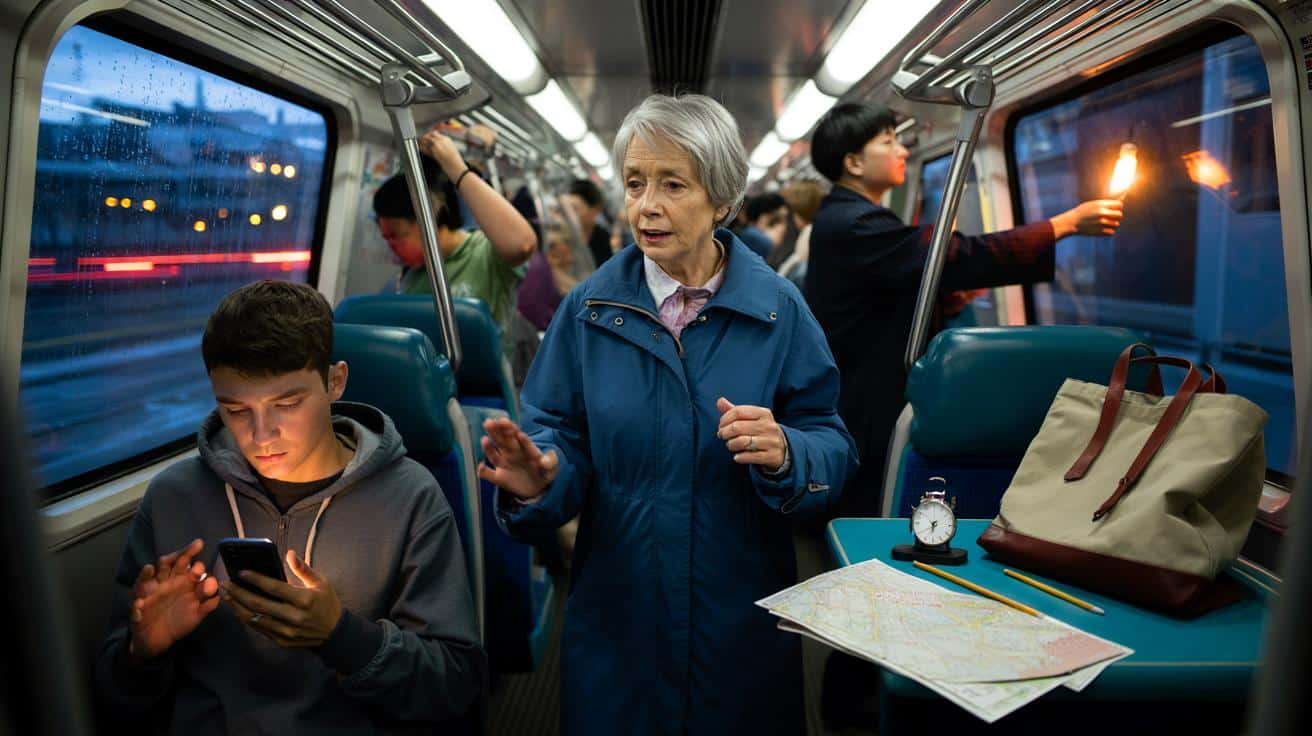
The Wi‑Fi dropped, the lights flickered, and a teenage boy next to me stared at a blank screen like it was a betrayal. An older woman in a navy raincoat looked down the aisle, took a breath, and began. “Torches on the phone. Bags off the seats. Aisle clear.” She didn’t bark. She organised. The carriage exhaled.
It felt oddly familiar — like the way my mum would turn a power cut into a camping trip with tea lights and board games. That woman had no rank, no badge. Just a switch in her head that flipped from waiting to doing. The train rolled on. People smiled in relief. She didn’t even look up.
There was nothing heroic about it. It was ordinary competence. And it’s rarer than it should be.
What the ‘survival instinct’ looked like before 1985
If you grew up before 1985, you likely built a toolkit you didn’t know you were building. You memorised phone numbers. You read the sky for rain. You learned to knock on a neighbour’s door when a key went missing. The world gave you little frictions that trained your senses and patience. **Convenience has streamlined our lives, and quietly outsourced our wits.**
Ask anyone who walked home at dusk with a Walkman and a set of rules in their head: stick to the lit route, don’t flash the cash, look over your shoulder once, not ten times. A friend called Moira told me how she’d scan the top deck of the bus for who’d be trouble and who’d be an ally if things kicked off. Not paranoia. Pattern recognition learned the long way.
That era normalised a level of self-rescue. No Google to settle arguments, so you learned to ask better questions. No satnav, so you learned streets by landmarks and smell — the sweet, oily air near the chippy, the bite of metal by the rail lines. The point isn’t romance. It’s calibration. When systems were fallible, you learned you weren’t.
How that instinct got edited out — and how to get it back
Start small. Turn everyday moments back into training. Try a “one-minute drill” at home: kill the power at the fuse box for sixty seconds, then restore it calmly. Find the torch. Check the locks. Speak out loud like you’re guiding someone else. Do it again next week with the router. **Resilience isn’t vintage; it’s a muscle.**
Common missteps? People go big and burn out. They buy survival kits, then leave them sealed. Or they mock the whole thing as prepper theatre. Go the other way. Boil it down to three moves: notice, decide, act. Notice the unusual smell on a bus; decide whether it’s electrical or food; act by moving seats or flagging the driver. Let’s be honest: nobody really does that every day.
“You don’t rise to the occasion, you fall to the level of your practice,” a London paramedic told me after a night shift. “Most calls aren’t dramatic. They’re about calm sequencing when people are frightened.”
- Micro-challenges: once a week, navigate somewhere new without your phone.
- Quick fixes: learn to change a tyre, stop a leaking tap, reset a tripped breaker.
- People map: know three neighbours by name and one by phone number.
The real difference isn’t age — it’s exposure and feedback
We’ve all had that moment when the lift stalls and the air grows still. Some freeze. Others reach for the alarm, then start checking faces. The split isn’t generational as much as it’s about reps. Older cohorts accumulated low-stakes failures. Younger ones often encountered polished systems that rarely misfire — until they do. *That first misfire can feel like betrayal instead of a nudge to improvise.*
I met a 22-year-old gig worker who cycles through central London. His phone mount snapped in the rain, maps gone. He paused under a railway arch, spotted the BT Tower, and triangulated by memory from a TikTok skyline tutorial. He grinned like he’d discovered fire. That’s the spark. **You can start rebuilding that instinct today.**
So what do we actually mean by “survival instinct”? Not doomsday bravado. It’s three things: situational awareness, resourcefulness under limits, and pro-social action. You scan, you hack, you help. Tech can be a crutch or a coach. The trick is to use tools as training wheels, not as your legs. Make the world slightly less smooth so your senses come back online.
So where does that leave us?
Think of it like language. If your childhood spoke fluent friction, you still dream in it. If yours spoke fluent convenience, you can learn the dialect. We don’t need to roll back to payphones and paper bus timetables. We do need to put our hands back on the world a bit more and let it push back.
This isn’t about shaming anyone born after 1985. It’s about invitation. Borrow the best from both eras. Use your phone to find a first-aid course, then pocket it and feel your hands remember. Talk to the person next to you on the train when the lights dim. The instinct wakes up fast when given a job to do.
One last thing. The woman in the navy raincoat didn’t save the day. She made a minute feel smaller. That’s what the older generation often carries: a bias to do the next useful thing without theatrics. If we share that habit across the aisle, across ages, the lights going out becomes a story we tell, not a scar we nurse.
| Key point | Detail | Interest for the reader |
|---|---|---|
| Everyday drills beat gear hoarding | One-minute power and signal cuts train calm sequencing | Gives a simple routine you can try tonight |
| Awareness is learned, not innate | Pre-1985 friction built pattern recognition through repetition | Explains why older habits still work under stress |
| Blend tech with touch | Use tools as prompts, then practice hands-on alternatives | Offers a balanced method without ditching convenience |
FAQ :
- What do you actually mean by “survival instinct”?Not wilderness lore. It’s the everyday ability to notice anomalies, make a quick plan, and act calmly for yourself and others.
- Isn’t this just nostalgic myth-making about older generations?Nostalgia is loud, but the point here is training. Exposure to small frictions built certain reflexes. Anyone can build them now with deliberate practice.
- Does technology make us weaker?Tools reduce effort, which can dull awareness if used passively. Used actively, they can coach skill-building and free capacity for better decisions.
- How can I teach my kids without scaring them?Turn it into games: map-reading challenges, kitchen fixes, mini blackouts with candles. Praise observation and teamwork, not bravado.
- What’s one thing to start this week?Pick a “no-map” walk to a café you’ve never visited. Note three landmarks on the way. On the return, navigate by memory and describe your route to someone.





Loved the ‘one-minute drill’—simple, doable, and not doomsday theater. Gonna try the router cut tonite and talk through the steps with my kids. Thanks for making resilience feel like a muscle, not a myth.
Isn’t this survivorship bias? Plenty of pre‑1985 folks froze under pressure. Do you have data (studies, not anecodtes) showing repeated “friction” improves outcomes vs just adding stress?