
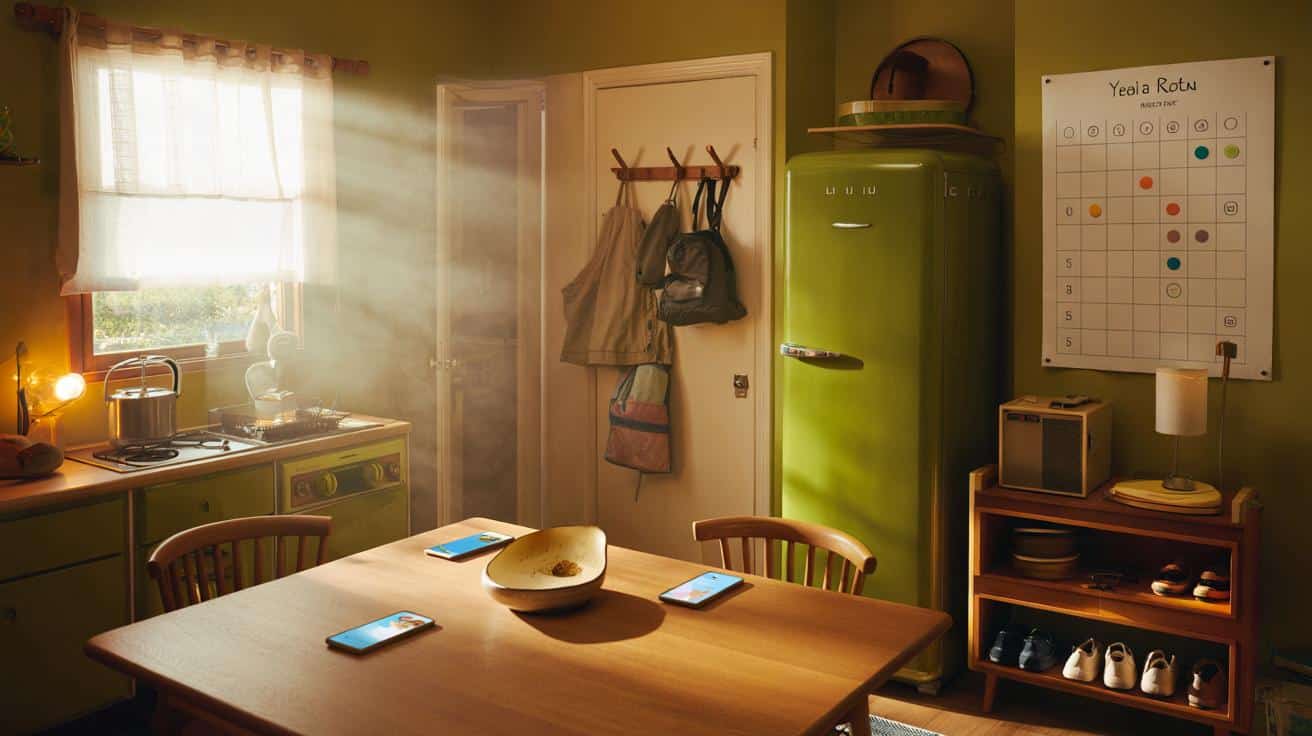
The modern home hums with notifications and half-done chores; stress spills from room to room. Psychologists keep pointing to something almost quaint: the plain old house rules our parents lived by.
The kettle clicks, the group chat lights up, and someone can’t find a PE sock. I’m fishing a spoon out of yesterday’s cereal bowl when a Teams ping arrives, then another. The house isn’t messy so much as noisy with unfinished things. A toothbrush on the sofa. A jumper trapped halfway off a chair.
I visit a neighbour who still pins a paper rota to the fridge, a relic from 1979 in faded ink. Breakfast is quiet. Shoes live by the door. Windows crack open for ten long breaths of cold air. Something in my shoulders drops. *For a minute, the room feels steady again.*
The fix isn’t new.
What the 70s quietly knew about household calm
Homes in the 70s ran on rhythm. Tea at six. Telly after chores. Coats on pegs, plates in the sink, lights down at nine. It wasn’t fancy, just predictable. Psychologists call these temporal anchors: recurring cues that tell your brain what’s coming next. When a day has a spine, small decisions stop chewing at your attention. The house grows less dramatic, more ordinary, and that’s the point.
I still remember Aunt Linda’s semi in 1978, all patterned carpet and the warm thud of the airing cupboard. You washed your hands, you laid the table, you chatted or wrangled with your siblings, and the world made sense. No one needed a mindfulness app because the moment you sat down, your body knew the script. We’ve all had that moment when the room settles and you don’t know why. It’s the ritual doing the heavy lifting.
When routines are steady, the mind stops scanning for what’s about to go wrong. Predictability calms the nervous system. Decision fatigue eases, arguments drop, and even the clutter feels less hostile because it moves along a known path. A simple rule like “finish one job before starting another” slashes attention residue. Little micro-rituals become handrails for your day, softening the corners where stress usually catches.
The five ‘forgotten’ rules to bring back now
One-touch tidy. Touch an item once and finish the action. Coat to peg, not chair. Plate to wash-up, not staging area. Post opened, sorted, binned or filed. The friction is front-loaded, the mess never snowballs. The fridge rota. Plan the week’s meals on paper and pin it where eyes live. Monday mince, Tuesday pasta, Wednesday fish. Repeatable beats clever. Add a standing shopping list underneath. Screen-free table. Devices into a bowl before meals; the radio can stay. Morning airing. Open every window for ten minutes, make the beds, let light win the first argument. Quiet hour. Pick 8–9pm, dim the lights, no laundry, no admin. Read, stretch, chat. Your brain gets the cue: the day is landing.
Start with two rules, not five. The house doesn’t change because you read a list; it changes because you rehearse it. Let kids set the rota or draw the peg labels, and model the behaviour more than you talk about it. Don’t police every slip. Let’s be honest: no one really does this every day. If you work shifts, slide the quiet hour and airing ritual to your version of evening and morning. You’re not chasing perfection, you’re building grooves the day can follow.
“Rituals are boundaries you can feel. The body learns what comes next, and anxiety stops scanning for danger.”
- The one-touch tidy: finish the small action now.
- The fridge rota: repeatable meals, written down.
- Screen-free table: phones in a bowl, conversation out.
- Morning airing: ten minutes of light and fresh air.
- Quiet hour: dim, slow, nothing urgent.
Leave room for life, keep room for calm
These rules aren’t about being stricter. They’re about shifting home from a 24/7 corridor of tasks to a place with edges and breath. When the table is for eating and talking, not doomscrolling, your mind digests properly. When the day lands with a quiet hour, sleep doesn’t have to fight for space. The old rhythms sound quaint until you practise them; then they feel modern in the best way, like well-made shoes that still fit.
Give people clear lanes and they relax into them. Give your future self fewer choices and you get time back you can taste. The 70s didn’t have the internet, but their little boundaries were built for today’s overload. Bring one back this week. See who you become when the house stops shouting and starts humming.
| Key point | Detail | Interest for the reader |
|---|---|---|
| Predictable rituals calm the home | Set daily anchors like meals, airing, and a quiet hour | Less decision fatigue, fewer arguments, better sleep |
| The “one-touch” habit | Complete the action now: peg, bin, wash, file | Clutter shrinks without marathon tidies |
| Screen-free table | Phones parked before meals, radio allowed | Real conversation returns, digestion and mood lift |
FAQ :
- Are these rules too rigid for modern life?Think of them as rails, not handcuffs. You flex the timing and the tone, but keep the shape so your brain recognises the cue.
- How do I get teenagers on board?Give them ownership. Let them pick a rota night, curate the playlist for the quiet hour, or run the “phone bowl” at dinner.
- What if my flat is tiny and drafty?Airing still works. Two windows cracked for five minutes, then shut. Light a lamp after to mark the shift from morning to day.
- We work shifts. Does this still apply?Yes. Move the rituals to your personal morning and evening. The body cares about consistency more than clock time.
- How soon will I feel a difference?Often within a week. Decision friction falls fast, sleep nudges better, and the house feels kinder because it has a rhythm again.






Love the idea of “temporal anchors,” but isn’t this a bit rose‑tinted? The 70s had fewer screens, diff rent workloads, and often at‑home carers. How do these rules adapt for single parents, neurodivergent families, or multi‑generational homes without adding guilt? Could you share concrete examples—scripts, visual cues, 10‑minute templates? Also, what’s the evidence base here: any randomized studies, or mostly clinician observation and lived experience?