
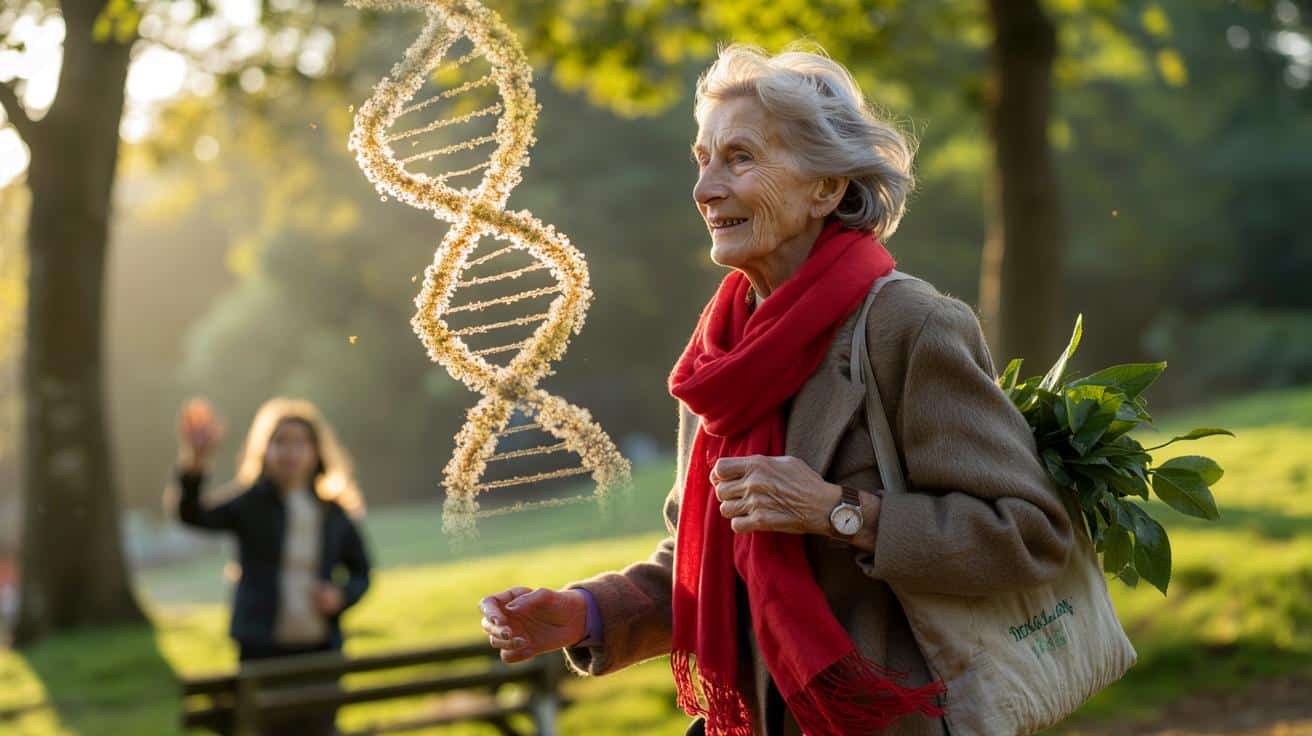
And now, a buzzy idea with a powerful hook — the “Super‑Ager gene”. The quiet suggestion that a handful of letters in your genome could tip you towards 100. It sparks an uncomfortable question in the queue at the chemist or on the park bench: is extreme longevity written in us, or mostly lived into? That unease is real. So is the curiosity.
It’s late afternoon on Hampstead Heath, light slanting through the trees like honey, and a 99‑year‑old woman in a red scarf strides past me uphill. No fuss, no huffing, just a small rhythmic push of the arms, as if her body remembers something the rest of us have forgotten. Her grandson calls: tea later, shortbread ready. She laughs without stopping. People watch her with that mix of wonder and envy you feel when someone seems to have found a cheat code. I think of lab reports and acronyms — FOXO3, APOE, CETP — and the way our fears stick to them. Then she disappears over the ridge. A breeze. A question.
The ‘Super‑Ager’ gene: what science actually knows
There isn’t one magical switch. Researchers talk about clusters: variants in FOXO3 that aid cellular stress responses, CETP tweaks linked to flexible cholesterol transport, certain flavours of APOE that lean towards brain protection rather than risk. Think of it as better housekeeping at the cell level — tidier repairs, steadier metabolism, calmer inflammation. It’s not fireworks. It’s maintenance. **Your DNA is not your destiny.** It’s the starting conditions on the pitch, not the final score on the board.
Look at the centenarian cohorts in Okinawa, Sardinia, and New England. Many of these people share specific gene patterns a little more often than the general population — the kind that keep insulin signalling sleek and lipids well-behaved. Family trees echo the effect too: siblings of centenarians tend to outlive peers by years. Heritability of exceptional longevity usually lands around the 20–30% mark in big studies, which is meaningful yet modest. One Okinawan analysis found a common FOXO3 variant showing up more frequently among men over 95. Useful clues, not guarantees. You’ll find outliers as well — smokers who reach 102, marathoners who don’t.
So what makes the difference? Genes and life run in tandem. A protective variant can blunt the harm of a rough patch; a risk variant can sit quietly in the corner if your routine blunts inflammation and keeps blood vessels supple. Epigenetics adds another layer: chemical notes scribbled on your DNA score that tell genes when to play louder or softer. Diet, sleep, stress, movement, relationships — they all nudge that volume control. Think network, not silver bullet. Think orchestra, not solo.
Traits you can spot — and nudge today
Try a 5‑minute “longevity scan” at home. Time your usual 10‑metre walk at a natural pace; brisk walkers often show stronger survival curves. Do five sit‑to‑stands from a chair without using your hands — under 12 seconds is a clean sign for midlife, under 15 in later years is still solid. Squeeze a jam jar hard for an informal grip check; a firm squeeze hints at robust muscle networks. Scan your week: at least three social contacts, most nights with 7–8 hours of sleep, a resting heart rate that doesn’t jump at the slightest worry. It’s not medical diagnosis. It’s pattern‑spotting.
Small tweaks matter. Keep protein evenly spread across meals to protect lean mass. Move often rather than only “working out” — stairs, short walks, light pulling and pushing. Leave a little space before bed for a wind‑down ritual, even if it’s just two slow breaths and the phone on flight mode. We’ve all had that moment when the sofa wins and the plan loses. Small, steady steps beat heroic sprints. Let friction do the work: put your trainers by the door, fruit at eye level, kettlebell near the kettle. Let’s be honest: nobody really does that every day.
I called a researcher who studies centenarians and asked what stands out beyond the lab numbers. The answer wasn’t an exotic compound. It was rhythm, community, and a stubborn cheerfulness that rides out dips without dramatics. Genes load the dice; your daily habits decide the game.
“In most centenarians we see a pattern: lower lifelong inflammation, good lipid handling, and remarkable consistency. Not perfection — consistency.”
- Walk after meals for 10 minutes to tame glucose swings.
- Eat plants from the colour wheel plus oily fish once or twice a week.
- Lift something a bit heavy every other day — a backpack, a box, your own body.
- Keep a standing coffee date or weekly call that you don’t cancel.
- Guard sleep like a passport: cool room, dim lights, repeat.
The open secret of extreme ageing
Longevity looks less like a breakthrough and more like a groove. People who reach 100 often carry gene variants that dull the sharp edges of time, yet they also live in ways that keep the edges from forming. They recover faster from stress, not because stress vanishes, but because their repair crews show up on time. They don’t chase hacks. They build scaffolding — simple rituals that make the good choice the easy one. A steady social circle. A daily walk stitched into errands. Food that doesn’t require willpower every evening. Longevity is a team sport, not a solo act. There’s mystery in the mix, sure. There’s also agency. The super‑ager signal isn’t a myth. It’s just quieter than the marketing.
| Key point | Detail | Interest for the reader |
|---|---|---|
| Genes guide, not govern | FOXO3, CETP, and APOE variants appear more often in centenarians, yet only explain part of the story | Reframes destiny into probability — useful without being fatalistic |
| Spot the traits you can feel | Gait speed, grip strength, sleep regularity, social ties, and calm glucose curves | Immediate, measurable signals you can improve this week |
| Make consistency inevitable | Design friction-light routines: short post‑meal walks, protein spread, standing dates, cool dark nights | Turns abstract longevity into daily actions that stick |
FAQ :
- Is there a single “Super‑Ager” gene?No. Researchers see clusters — for instance, FOXO3 for cellular stress resilience, CETP for cholesterol transport, APOE versions with different brain risk profiles. It’s a network effect, not a magic switch.
- Should I take a DNA test to see if I’ll live to 100?Consumer tests can be interesting, yet they don’t predict extreme longevity. They show common variants, not the full context, and they can’t read your life. Think curiosity, not prophecy. Check the privacy small print before you spit.
- Can lifestyle really “switch on” good genes?Not like a light switch. Epigenetic changes tune gene activity up or down over time. Regular sleep, movement, stress management, and diet shape those patterns. It’s slow influence, not instant magic.
- What everyday signs hint at healthy ageing?Brisk natural walking speed, a firm grip, steady energy after meals, 7–8 hours of mostly uninterrupted sleep, and a social calendar that actually happens. Fewer daily meds at later ages show up often in centenarian profiles too.
- Am I too late to start?No. Gains show up at any age. Start with one lever for 30 days — a 10‑minute walk after your biggest meal — then layer the next. The compound effect is real, and the body is surprisingly forgiving.





Loved the Hampstead Heath vignette and the refrain that “Your DNA is not your destiny.” The gene cluster framing (FOXO3, CETP, APOE) is the first time this hasn’t felt fatalistic. Also, the practical scans—walk speed, grip—are gold. Saving this for my parents and, frankly, future me 🙂