
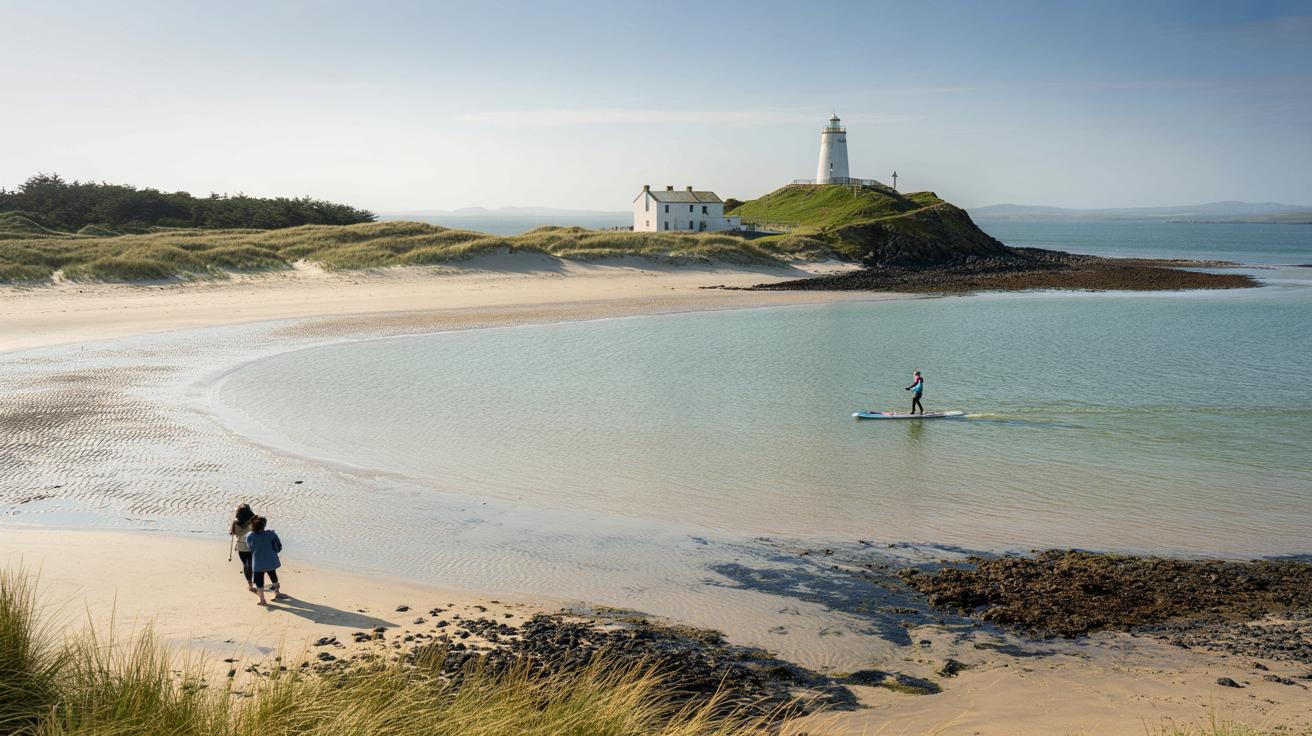
A tiny Welsh island where the water flashes lagoon-blue, the sand squeaks underfoot, and the horizon looks borrowed from a faraway honeymoon brochure. No long-haul. No jet lag. Just a tidal sliver of Anglesey that locals quietly adore—and which travellers are starting to nickname the British Bora Bora.
The sand was ribbed with last-night’s tide lines, and the pine forest behind me smelled faintly of resin and rain. Ahead, a lighthouse sat squat on a bluff, and the shallows glowed that improbable blue you only ever expect to see in postcards.
A cormorant arrowed past, low and serious. A couple crunched along behind me, holding coffee cups, whispering as if they’d stumbled into a chapel. The wind tugged at the dune grass. I watched a wave turn transparent at the lip, as clear as glass over pale sand.
Out here, the island has a way of shrinking the world. Twr Mawr, the little lighthouse, the old pilot’s cottages, the cross to Wales’s patron saint of lovers. Everything set against water so clear it feels like a trick. There’s a reason people call this place the British Bora Bora.
Where the water turns Tahitian-blue, without the plane
This is Llanddwyn Island, a tidal speck on the south-west tip of Anglesey. It sits off Newborough Beach, a place where wind combs the dunes and the sea lies shallow for metres upon metres. The effect on a sunny day is pure lagoon: bands of milk-turquoise, bottle green, then ink-blue beyond the sandbar.
On a quiet morning you can walk the causeway barefoot, the water lapping your ankles, and watch Snowdonia’s peaks rise like blue paper cut-outs across the Menai Strait. Gulls wheel. Oystercatchers stitch the shoreline. The island’s bones are low and black and volcanic, softened by thrift and grass. It never shouts. It simply gleams.
People come for different reasons and end up staying longer than planned. I met Carys, a paddleboarder with a flask and a dog, who swore the bay by the pilot’s cottages is “best just after breakfast, when it’s glassy.” A wedding party arrived later, the bride in white trainers, the photographer almost giddy about the light on the water. Smiles felt easy out there.
It looks tropical for reasons your eyes understand even before your brain does. Pale, crushed-shell sand reflects sunlight back through the shallows, turning the sea electric. The shelf stays shallow near the island, so waves break early and the inner water rests calm. Even the pines help, shielding gusts and keeping the surface smoother than you’d expect.
Anglesey sits in the path of mild Atlantic currents; add a clear sky and the glare goes luminous. Stand by Twr Mawr and squint: the pale spit to your left could be a motu. The black rocks edging the pools could be coral heads. Then a curlew calls, and you remember where you are.
Llanddwyn also carries stories that colour the view. Saint Dwynwen, the Welsh patron of lovers, is said to have lived here; the ruins of her church still watch the sea. There’s a cross on the headland, and two pocket-lighthouses, Twr Bach and **Twr Mawr**, like friendly chess pieces. Romance and navigation, faith and tide—things that belong together on a small island.
How to do Llanddwyn like a local
Timing is everything. Aim for a window from two hours before low tide to two hours after and the causeway becomes a film set. Park at the Newborough Forest car park (card machines in season), follow the pines to the beach, then walk right. It takes 20–30 minutes to reach the island edge, longer if the light keeps stopping you.
Pick a calm day if you want that Bora Bora glow; the colour pops hardest when the wind lies down. Early mornings in late spring or September are the sweet spot—warm enough to dawdle, cool enough to keep the midges shy. Bring water, something windproof, and shoes you don’t mind wet. Let the day write its own schedule.
Most people underestimate the tide. Don’t be that person. The island is “tidal” in that the link floods; it’s rarely dangerous if you’ve planned your window, but you can get cut off for a couple of hours. That’s not the worst fate—there are seals to watch and ledges to sit—but check the boards at the car park. Pack a small towel if you’re wading back.
A few gentle guardrails, learned the easy way and the hard way. The walk looks “short” and it is, yet sand and soft tracks are slower than tarmac. Flip-flops work for a beach day, not a headland potter—take light trainers. If you’re swimming, understand there are no lifeguards; the water is cold even in July, and currents run around the points. A shorty wetsuit buys you time and fun.
Dogs are welcome on parts of Newborough, with seasonal restrictions around nesting birds; check signs. Leave no trace—there are bins at the car park, not on the island. The wild ponies that graze the dunes are lovely to see, not to feed. Let’s be honest: nobody actually nails every sensible choice on every trip. A little forethought here goes a long way.
On a blue-sky day, even the sceptics go quiet for a minute. A Newborough ranger told me, “When the sun sits high and the tide starts to turn, the water over the flats turns this neon mint—people wander around grinning at it. That’s the Llanddwyn moment.”
“You don’t need a passport for wonder. You just need the tide in your favour.”
- Quick route: From Newborough car park, follow the beach right for ~2 km to the causeway.
- Best photo light: First two hours after sunrise; last hour before sunset.
- Low-tide window: About four hours centred on low tide; check local charts.
- Facilities: Toilets at car park; no services on the island.
- Top spots: Twr Mawr lighthouse, pilot’s cottages, Saint Dwynwen’s cross.
Why this Welsh speck stays with you
Islands do something to time. Llanddwyn, being small and tidal, does it faster. You arrive with chores and phone pings, and within a dozen steps your mind has been rinsed by light and space. The path kinks, you crest a lump of rock, and suddenly the sea is a sheet of transparent colour and the headland feels like a stage.
We’ve all had that moment where a place feels both impossible and intimately right, like a memory you forgot you owned. That’s the Llanddwyn trick. You could call it the British Bora Bora and not be wrong. Better still, you could call it a lesson in how close the extraordinary can be when you stop scanning flight deals and look west.
Share it carefully. Bring a friend who needs quiet. Bring a grandparent who once loved lighthouses. Go when the weather plays nice and the tide agrees, and you’ll come home with salt on your cuffs and a tiny lighthouse lodged in your head. **The happiness per hour is hard to beat.**
| Key point | Detail | Interest for the reader |
|---|---|---|
| British Bora Bora vibes | Pale sand + shallow shelf = lagoon-blue water on sunny, calm days | Know when and why the colour pops for standout photos and memories |
| Tidal timing | Best window is two hours either side of low tide for easy crossing | Avoid getting stranded; plan a richer, unhurried visit |
| Simple logistics | Park at Newborough, 20–30 minute beach walk to the island | Low-stress day out with minimal kit and maximum wow |
FAQ :
- Where exactly is Llanddwyn Island, and how do I get there?It’s on the south-west tip of Anglesey, Wales, off Newborough Beach. Drive to Newborough Forest car park and follow signed paths to the sand; turn right and walk along the beach to the tidal causeway.
- When’s the best time to see the water at its bluest?Calm, sunny days near low tide. Early mornings in late spring and early autumn are reliable, with softer light and fewer crowds.
- Can I swim there?Yes, people do. The water is cold and there are no lifeguards. Stick to sheltered coves, avoid headlands in swell, and consider a wetsuit. **Common sense beats bravado.**
- Are there facilities on the island?No. Toilets and bins are at the car park; there may be a seasonal café van by the forest. Bring water, snacks, and take all rubbish home.
- Is it dog-friendly and can I fly a drone?Dogs are welcome on much of Newborough with seasonal restrictions; look for signs guarding nesting areas. Drone use is regulated and often discouraged near wildlife—check current guidance before flying.





Adding this to my UK bucket list—who knew Anglesey could look so tropical? 🙂 Any tips for parking when it gets busy, and is sunrise really the best light?