
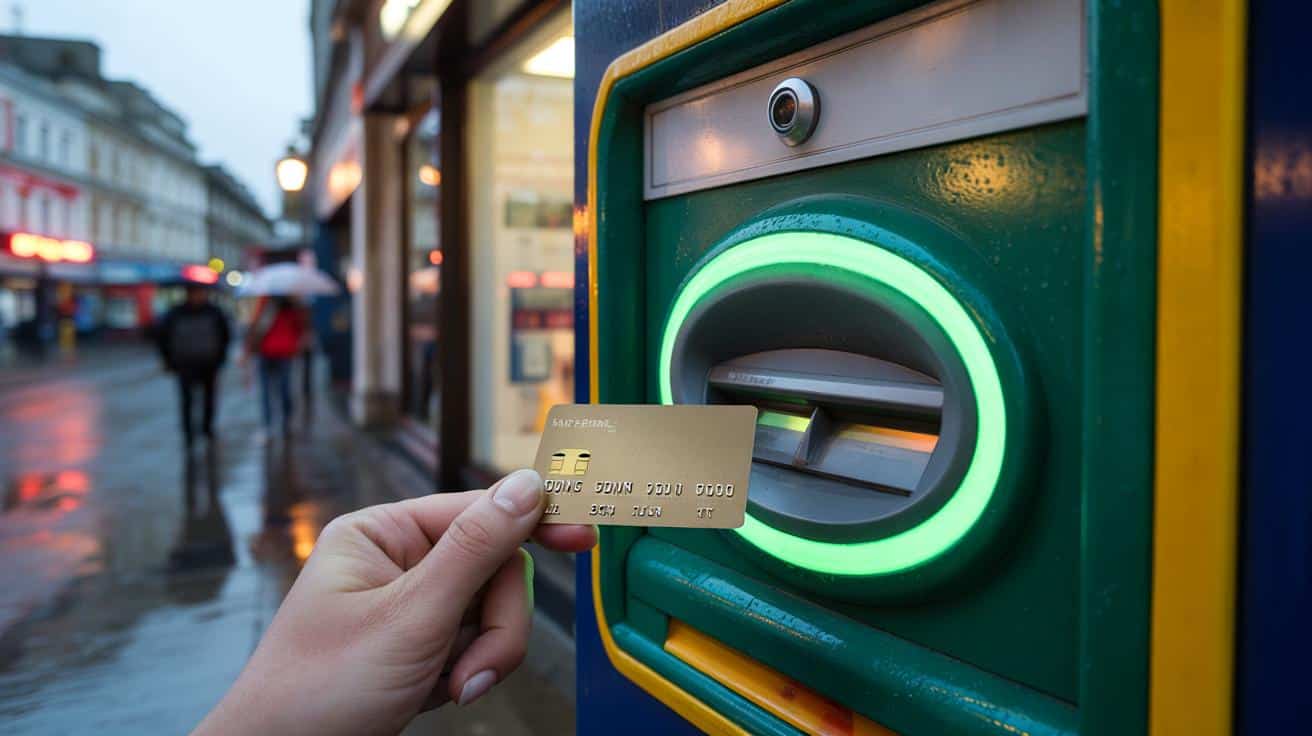
A soft, friendly blink on the ATM’s green ring is meant to say “ready”. In some towns, thieves have learned to make it scream “insert here” with cheap LEDs and a fake bezel. The trick works because we’re conditioned to trust the glow. Here’s what that blinking green light might really mean, why you should pause, and the exact moves that keep your card safe when seconds feel tight.
A small queue formed behind the high-street ATM, everyone half-looking at their phones, half-willing the machine to hurry up. The green ring around the card slot pulsed fast, almost eager, and for a second it felt like a green man at a crossing: go, go, go.
I stepped closer and the light rhythm shifted, brighter at the bottom, dimmer at the top. A man behind cleared his throat; the pressure to move was real. The plastic trim around the slot looked new, too glossy compared to the scuffed fascia. Something was off.
That blinking green ring isn’t always friendly
The green ring is a visual nudge, a little lighthouse for your card. Banks use light to guide you, but crooks know that cue as well as any designer. When they bolt a fake reader on top of the real one, they often add a flashy blink to pull your eyes — and your hand — into their trap.
On British high streets, reports keep surfacing of plastic bezels that look identical at a glance yet feel wrong when you touch them. In one case in Leeds, a shopper noticed the light cycling in a quick, uneven pattern and gently tugged the rim; the whole cover shifted a millimetre. She backed away and rang her bank. Police later found a deep-insert skimmer sitting behind that shiny green lip.
Here’s the quiet math: a real ATM’s lights tend to be even, steady, predictable across the estate. A fake add-on often uses a cheap LED strip with a harsher tone and a jittery pulse. It may not line up perfectly with the slot. **If the green light seems erratic, overly bright, or new on an old machine, don’t insert your card.** Walk to another ATM, preferably inside a branch or supermarket.
How crooks use the blink — and how you beat it
Start with a ten-second scan. Look for a mismatch in colour, gloss, or alignment around the card slot. Run a finger along the edges; real fascias sit flush, fakes have lips and flex. Try a gentle “wiggle test” on the green ring — don’t yank, just pressure. If anything moves, stop. Use the cash machine inside the bank, or switch to contactless cash withdrawal if your bank supports it.
We’ve all had that moment when the queue builds and you feel silly for being cautious. That’s exactly the moment thieves bank on. Let’s be honest: nobody does a full slot inspection every day. Your cash can wait; your card doesn’t get a second chance once cloned. If the light blinks strangely, step aside, take a photo, and use a different ATM on the same street. Your future self will thank you.
Think in layers. Cover your PIN with your spare hand the whole time, because fake bezels often arrive with tiny hidden cameras above the screen. Listen for odd whirrs from the card area. Compare this ATM to the one next door — same model, same lights, same feel. **If anything feels off, use your banking app to find a “trusted” machine or go cardless for that transaction.** And if you do spot a suspect bezel, ring the number on the back of your card, not a sticker on the machine. **Call the number you already trust, not the one a scammer might have planted.**
“Crooks don’t need to outsmart a bank’s systems if they can outsmart a tired person at 6pm,” says a UK fraud prevention lead. “The blinking ring is just a lure. Curiosity and hurry do the rest.”
- Steady vs. stroby: steady is normal, messy pulsing is a red flag.
- Tug test: light pressure on the bezel; any wobble means walk away.
- Cover PIN: from card-in to card-out, hand over keypad.
- Look for cameras: pinholes above the screen or on leaflet holders.
- Move inside: branch ATMs and supermarket units are better monitored.
The tech behind the trap, in plain English
Skimmers come in three flavours. The first is the bezel overlay — the most obvious, often with that green light — which captures magstripe data as your card passes through. The second sits inside the slot, “deep insert”, invisible unless you know what to feel for. The third doesn’t touch your card at all; it watches your fingers with a camera while a separate device captures data upstream.
Modern UK cards use chip-and-PIN, which makes cloning harder. That’s why criminals pair data theft with PIN capture, then use the magstripe abroad or target online spend. Banks are better at spotting this than ever, and ATM skimming isn’t the crime wave it once was. The risk hasn’t vanished on street corners where a quick add-on can clone dozens of cards in a day.
Lighting is psychology. The green ring is an “affordance” — a design hint that says “put the card here”. Thieves hijack that hint and exaggerate it. Think carnival lights on a quiet street. When the blink looks too eager, feels too bright, or arrived overnight on a scuffed machine, that’s your cue to apply friction. Step back. Reroute. Tell the next person in line why you’re leaving.
What to do when the green light blinks wrong
Take control of the rhythm. Pause, breathe, scan the fascia, and run that gentle tug test. Insert your card only if the ring looks and feels like other machines you’ve used; consistency is your friend. If anything is off, cancel the visit and switch to cardless cash via your app, cashback at the till, or a branch ATM inside glass and cameras.
Don’t narrate your fear aloud; just act. If a stranger urges you to “just try it”, step aside and let them go first — then leave. Tell the shop staff if the ATM is on their wall. Snap a quick photo of the odd bezel for the bank’s security team. If you did insert your card and the machine eats it, stand by the screen and call your bank from your phone. Don’t leave until you’ve spoken to a human and logged the incident.
This is about habits, not heroics. Build a three-step ritual you can do in under twenty seconds. If the light pulses faster than usual, or the plastic looks new on an old machine, treat it as a no-go. If you’re tired or rushed, choose a safer ATM you already know, even if it’s a two-minute detour. And tell someone else what you spotted — risk shrinks when knowledge spreads.
“Think like a pilot at take-off: same checks, same order, every time,” says an ATM engineer who services high-street units. “It’s boring until the day it isn’t.”
- Scan: fascia, slot, keypad, and any odd attachments.
- Shield: hand over keypad from start to finish.
- Switch: if in doubt, move to a monitored indoor ATM.
- Report: use your bank’s in-app chat or the number on your card.
- Reset: enable instant card freeze in your banking app.
Why this tiny light says so much about trust
ATMs are a handshake between people and systems we rarely see. The green ring is part of that handshake, a promise that the machine is ready and safe. When crooks learn to fake the promise — flashing rings, glossy bezels, neat little pinhole cameras — they aren’t just copying hardware. They’re borrowing our trust in small signals that usually serve us well.
This is where neighbourhoods help. If a machine on your commute suddenly looks “new” around the slot, odds are you’ll notice faster than a security team in a distant control room. Tell the shop owner. Ping your bank’s chat. Nudge the person behind you that something’s off. Small conversations stop big headaches.
I still think about that wet evening on the high street. The queue grumbled when I walked away, then one by one they drifted too, choosing the supermarket ATM a block away. Not heroic, just human. Maybe that’s the real fix: a little friction, shared out loud, when a light blinks too eagerly and your gut says wait.
| Key point | Detail | Interest for the reader |
|---|---|---|
| Blinking green can be a lure | Uneven, hyper-bright or newly added light rings often sit on fake bezels | Quick visual cue to avoid card capture |
| The 20-second ritual | Scan, tug test, shield PIN, switch if unsure, report in-app | Simple routine that prevents most ATM scams |
| Choose safer locations | Go inside branches or supermarkets; avoid isolated street units at night | Reduces risk without sacrificing convenience |
FAQ :
- Does a blinking green ring always mean the ATM is compromised?No. Some genuine ATMs pulse to show readiness. Treat unusual brightness, uneven flashing, or a glossy new bezel on an old machine as a warning and move on.
- What’s the fastest way to check an ATM without looking paranoid?A ten-second routine: visual scan, light finger run around the slot, cover the keypad, and watch for tiny cameras. If anything moves or looks mismatched, walk away.
- Can my chip-and-PIN card still be cloned at a skimmer?Chip data is hard to duplicate, so criminals pair card data theft with your PIN and often spend via magstripe abroad. Your vigilance blocks that pairing.
- What if the machine swallows my card after a weird blink?Stay by the ATM and ring the number on your card. Ask for an immediate block and a note on the ATM ID. Don’t leave until you’ve spoken to your bank.
- Are indoor ATMs really safer?Yes. Better lighting, CCTV, and staff nearby make tampering riskier for crooks. If you can choose, pick an indoor machine or a unit inside a busy supermarket.







Timely reminder. I’d always assumed the green ring meant « safe », but the uneven blink tip is gold — will definitley do the wiggle test now.
Some banks use pulsing lights by design. How do we reliabily tell « normal » from tampered in the wild — color, cadence, alignment? Any quick rule beyond « uneven/too bright/new bezel » to avoid false alarms?