
A quiet bend in the Atlantic, a small ferry, a strip of white sand stitching two green islands together. The kind of place you hear about from a friend of a friend, then keep to yourself. Not out of greed, but out of love.
Gulls tailed us like chancers, the cold air smelling faintly of salt and diesel. Forty minutes later, the Islas Cíes rose up, dark pines and cream beaches, like a postcard someone forgot to post.
I walked over sand that squeaked underfoot and found it: a lagoon so clear you could count the grains beneath. Children drifted on inflatable rings, adults stood motionless with their trousers rolled, everyone a little stunned by the colour. The Caribbean, but with eucalyptus on the breeze.
On the far side, Atlantic waves threw themselves at the outer shore. Inside, the lagoon lay still, a sheet of light green glass. A sandbar held it all in place, as if someone had gently cupped the sea in both hands. Then the tide began to turn.
The lagoon that tricks the eye
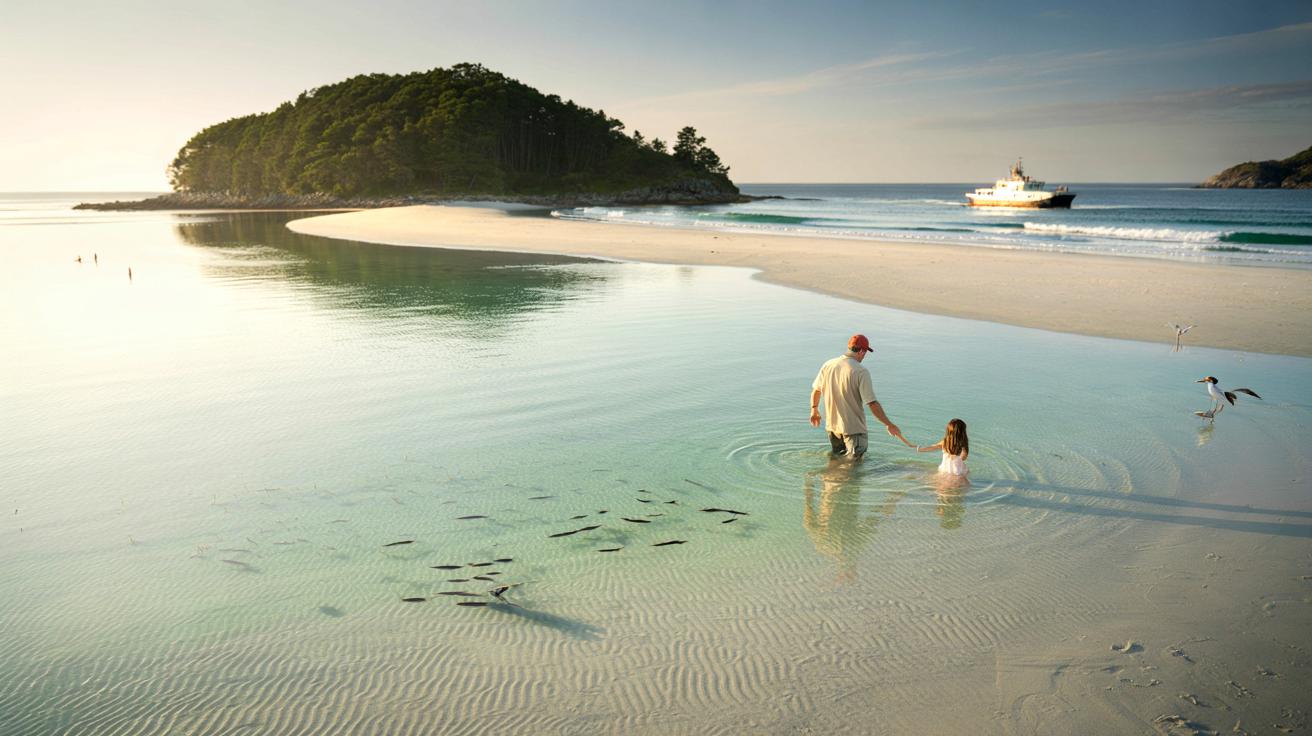
From above, Rodas Beach looks like a brushstroke of chalk connecting two islands. Up close, the lagoon behind it is the star. When the sun climbs, the water turns electric—emerald near the pines, turquoise where it thins over sand. Fish graze in tiny flickers. You can’t help staring.
In mid-morning, a man in a red cap waded out with his daughter. She squealed every time a shoal went past, then covered her mouth, embarrassed by her own joy. He laughed and told her to look for “silver arrows.” The water reached their knees. A cormorant surfaced, swallowed, vanished.
This lagoon exists because the ocean draws and releases, pulling water through breaks in the bar, then letting it rest. On a rising tide, it fills like a bath. At slack, it looks frozen. The clarity comes from the sand filtering and the low swell inside. It’s simple. It’s magic.
The islands sit inside a national park, which explains why the scene feels uncrowded even on blue-sky days. Visitor numbers are capped, paths are clearly marked, rubbish is carried back out. There are no cars. Your soundtrack is wind in the pines and the zip of a tent opening in the campground.
Head west over the ridge and the mood shifts. The outer beach faces the open Atlantic, rougher, wilder, colder. Back at the lagoon, the water can be a degree or two gentler, and a world calmer. Two beaches, two personalities, divided by 200 metres of sand and a few million years of geology.
We’ve all had that moment when a place refuses to match the map in your head. Galicia is meant to be brave seas, barnacles and mist. Then this lagoon turns up with Caribbean tones, and your brain does a double take. The Atlantic doesn’t care for our clichés. It does what it likes.
Getting there, and doing it right
Time it with the tide. Arrive on a rising tide to see the lagoon brim, the colours at their loudest, the sandbar sketching a clean arc. Ferry from Vigo, Cangas or Baiona takes around 40–45 minutes; book the boat and the park authorisation in one go online. Travel light, carry a dry bag, bring layers.
Common mistakes? Turning up mid-afternoon in peak July and expecting quiet. Forgetting the Atlantic bite—water can sit in the mid-teens Celsius even in high summer. Packing snacks is wise, as options on the islands are limited. Let’s be honest: nobody actually does that every day. But a simple picnic tastes different when the sea is this clear.
Locals will tell you that early June and September are the sweet spots. Fewer people, softer light, and **crowd-thinning shoulder season** prices on the mainland.
“Wait for the wind to drop, then walk the bar until your toes go numb. That’s when the colours switch on,” a ferry deckhand told me, shrugging like it was no big deal.
He’s right. And a few tiny touches make it better:
- Check tide tables the evening before; aim for mid-tide rising.
- Bring reef-friendly sunscreen and a reusable bottle; taps are at the campsite.
- Wear simple water shoes for shell patches near the channel.
- Pack a light towel; the breeze can nip when you step out.
- Keep your phone on aeroplane mode; enjoy the silence.
Protect the secret without keeping it
The Cíes are protected for a reason. Birds nest in the cliffs, dunes knit the island together, and the lagoon depends on a delicate push-and-pull that’s easy to upset. Treat it like a guestroom, not a theme park. Carry your rubbish, skip the drone, stay off the dune grass. It’s not difficult.
*It really does glow.* People come, blink, smile, then sink into the hush. That’s the ritual. **Glass-clear shallows** have a narcotic effect, slowing your breath, thickening time. You’ll start to notice tiny things—the pattern of ripples, the way a child’s laugh changes over water, the rhythm of ferry horns in the distance.
Tell a friend who’ll care for it. Share the name, but also the rules. The lagoon behind Rodas Beach isn’t fragile in a melodramatic way, just in the way that any beautiful thing is. And if you go, go for the right reasons: to stand in water so clean you can see your shadow drift; to feel a **tide-sculpted sandbar** underfoot; to leave the place as clear as you found it.
| Key point | Detail | Interest for the reader |
|---|---|---|
| Where and what | Rodas Beach lagoon, Islas Cíes, Galicia; a crystal-clear, tide-fed pool behind a sandbar | Pinpoint the exact spot that looks Caribbean without leaving Spain |
| Best timing | Rising tide, early morning or late afternoon in June or September | Catch the brightest colours and thinner crowds |
| How to visit | Book ferry and park authorisation; pack light; respect park rules | Make the trip smooth and low-impact, with fewer surprises |
FAQ :
- How do I get permission to visit the Cíes?Ferry companies guide you through a quick online authorisation as part of booking. Keep the code handy on your phone.
- Is the water actually warm enough to swim?It’s brisk, even in summer. Short dips are glorious; a thin wetsuit helps if you plan to linger.
- Can I stay overnight on the islands?Yes, there’s a regulated campsite near Rodas. Book ahead, especially in high season.
- What should I bring for a day at the lagoon?Light layers, reef-safe sunscreen, water, snacks, a small towel, and simple water shoes. That’s it.
- Are drones and loudspeakers allowed?No. It’s a national park with strict rules to protect wildlife and the peace that makes the place special.





Adding this to my Spain list—rising tide or bust.
Is it actually « Caribbean » or just Caribean-colored for 10 minutes at peak sun? Mid-teens water temps scream BRISK. Gorgeous, sure, but I’m packing a wetsuit, not a mango daiquiri.