
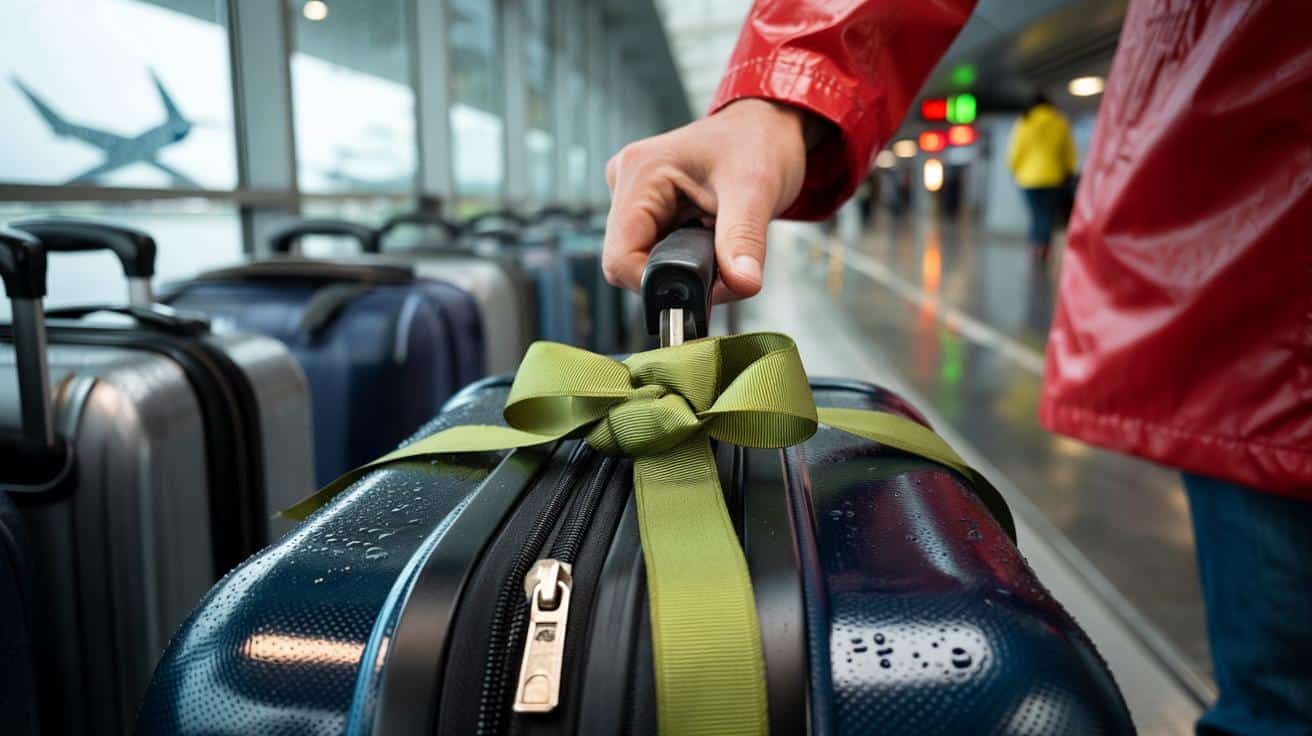
And that carousel dread that your bag won’t appear, or worse, that someone else will walk off with something that looks like yours. Here’s the twist — that brightly coloured ribbon on the handle isn’t just about spotting your suitcase in a sea of black.
I first noticed it in Gatwick on a wet Tuesday, a little ribbon tied in an odd, careful knot on a scuffed navy case. The owner, a woman in a red raincoat, reached it, paused, and smiled — as if checking a secret handshake. The ribbon wasn’t just loud; it was specific, looped through both zips and back around the handle in one tidy move. When my own bag came round, I copied her knot with a spare length of lime-green gift ribbon from a newsagent. A baggage handler watching the belt gave me a nod that said, smart. The case felt suddenly less exposed. It looked the same, yet not. You could tell if someone had been inside.
Not just for spotting your bag
We’ve been told to stick something bright on our luggage so we can pick it out fast. Fine. But that ribbon can do a job your eyes can’t: act as a simple, obvious tamper flag that tells you if the zips have been moved between check-in and hotel room.
Think of it like the flimsiest seal in the world that still shouts when it’s broken. You’re not locking anything. You’re creating a pattern you’ll recognise in a heartbeat — a loop through both zipper pulls, then a single tie onto the handle or a D-ring. If that pattern isn’t exactly as you left it, you know.
On a late flight to Manchester, I met a violinist who does this religiously. He ties a neon ribbon on the outside, then tucks a second tiny one inside his carry-on’s inner zip. Twice, he’s found the outer ribbon re-tied “not like mine”, as he put it, and had a quiet word at the desk before leaving the baggage hall. Most of us never notice a zip sitting half a tooth off. A ribbon turns that microscopic change into a billboard.
Why the hack works
Zip sliders drift under pressure, cases are jostled, belts flex. A ribbon forces the zips into a position you’ll remember, then makes movement visible. You’re not trying to outsmart security; you’re nudging casual fingers away and giving yourself a quick, human check.
There’s a behavioural nudge at play. A bright, unusual tie suggests the owner is paying attention. Opportunists look for speed and plausible deniability — the “I thought it was mine” shrug. A personalised, deliberate knot kills that line in a second and makes the bag feel watched.
And there’s something else. At the end of a long travel day, your brain is porridge. You think you closed the bag, you think the zip sat left-of-centre, you think the inside pocket held your charger. The ribbon draws a line in the sand: this is how I left it. If it’s different, you don’t gaslight yourself. You act.
The method, step by step
Cut 30–40 cm of ribbon — high-vis, matte, not slippery. Thread it through both zipper pulls, bring the ends together, and pass them under the nearest fixed loop on your case: a handle base or a fabric tab is perfect. Tie a single overhand knot, then a second to finish, leaving short tails. The zips sit snug together, and the knot rests where you can see it.
Before you walk away at bag drop, take a quick photo of the knot on your phone. Not a gallery shoot — one clear snap. At arrivals, check it while you’re still beside the carousel. If the knot’s gone or re-tied, pause right there and speak to the airline desk. Let’s be honest: no one triple-checks their bag after a red-eye once they’ve jumped in a taxi.
Pick ribbon that tells a story you’ll remember: your kid’s favourite colour, your club scarf shade, a neon stripe that sings against black polycarbonate. Avoid stretchy ribbon and anything so thick it jams the pulls. If you’re gate-checking a stroller or a musical instrument case, tie it to zips and a fixed loop just the same. And if airport security asks you to remove it for screening, breathe and re-tie it on the other side. It takes 10 seconds.
“A ribbon isn’t a lock,” a British airline security trainer told me. “It’s a signal. Most tampering we see is opportunistic. A visible signal reduces opportunity.”
- Not just to spot your suitcase. Make the knot distinctive: double-overhand, tails trimmed, sitting left of the handle.
- Stop casual tampering. Thread through both zips and a fixed loop so movement leaves a mark.
- Choose bold, matte colours. Slippery satin comes undone mid-belt; grosgrain behaves.
- Keep it airline-friendly. Ribbons aren’t locks; remove and re-tie if asked.
- Don’t block wheels, handles, or TSA access points. A neat knot, not a tangle.
What people notice when they try it
On a rainy Sunday at Heathrow, a dad with twin toddlers showed me his orange ribbon trick. He always ties the knot so the tails “point” towards the hinge side. In cramped hotel lifts, he opens on the correct side every time and nothing spills. Small win, zero fuss.
A cabin crew friend swears it helps at overhead bins. When passengers reach for the wrong black trolley, the ribbon gives them pause, and they stop mid-grab. It isn’t about creating a fortress. It’s about making your bag speak up for itself with a friendly, bright voice.
We all know that prickly feeling when a zip sits wrong, but you can’t place why. This little bit of theatre — a colour, a knot, a photo — gives you certainty. If nothing’s changed, you relax. If something has, you’ve got a clear moment to act before you leave the controlled space of the baggage hall.
Keep the conversation going
There’s a bigger travel truth hiding in that thin strip of ribbon: the fixes that work best are the ones you’ll actually do, even when you’re tired, late, or juggling a tea and a boarding pass. A ribbon lives in your wallet, weighs nothing, and still shifts behaviour — yours and other people’s. Try it on your next trip and watch how it changes your rhythm at the carousel, or the way hotel arrivals feel a shade calmer. Share your colour. Share your knot. Someone behind you in the queue might copy you, the way I did, and find that their journey ends with a little more peace of mind than it began. That’s the kind of travel tip that sticks because it’s simple, visible, and human.
| Key point | Detail | Interest for the reader |
|---|---|---|
| Tie a distinctive knot | Loop through both zips and a fixed point; double-knot with short tails | Creates a quick, tamper-visible pattern you’ll spot instantly |
| Use bold, matte ribbon | 30–40 cm of grosgrain in a colour you remember on no sleep | Stays tied on the belt and stands out in low light |
| Photograph the knot at drop-off | One clear phone snap before the bag disappears behind the curtain | Gives you proof and peace of mind at the carousel |
FAQ :
- Does a ribbon count as a lock?No. It’s a visual cue, not a security device. Think of it as a quick tamper flag that’s easy to re-tie when needed.
- Will airport staff remove it?They might for screening or inspection. That’s normal. Re-tie the same knot afterwards and carry on.
- What ribbon works best?Grosgrain or any matte, non-slippery tape around 1–2 cm wide. Neon or strong colours beat pastel in busy baggage halls.
- Could it get caught in machinery?Keep tails short and tie near a fixed loop. Don’t dangle it near wheels or telescopic handles.
- Isn’t a cable tie better?Cable ties are stronger but fiddly and single-use. Ribbon is reusable, quick, and communicates “noticed” without drama.






Love this. The “tamper flag” idea never occured to me. I’ll cut 30–40 cm of grosgrain and snap a photo at bag drop next trip. Feels like the right mix of low-effort and high signal. Also, “tails trimmed, left of the handle” is so specific it’s memorable. Definately stealing this.
Genuine question: if a baggage screener opens the case and re-ties the ribbon, how do you tell “not like mine” from turbulance shift? Would a quick photo really be enough evidence to get the airline to log an incident?