
British salad shelves keep wobbling between gluts and gaps. Weather, freight, and energy prices pinch at the wrong moments, turning a simple BLT into a minor logistics miracle. Supermarkets are now pulling a quiet lever: grow the lettuce inside the city, on racks of light, air and maths, so it’s never late to the party.
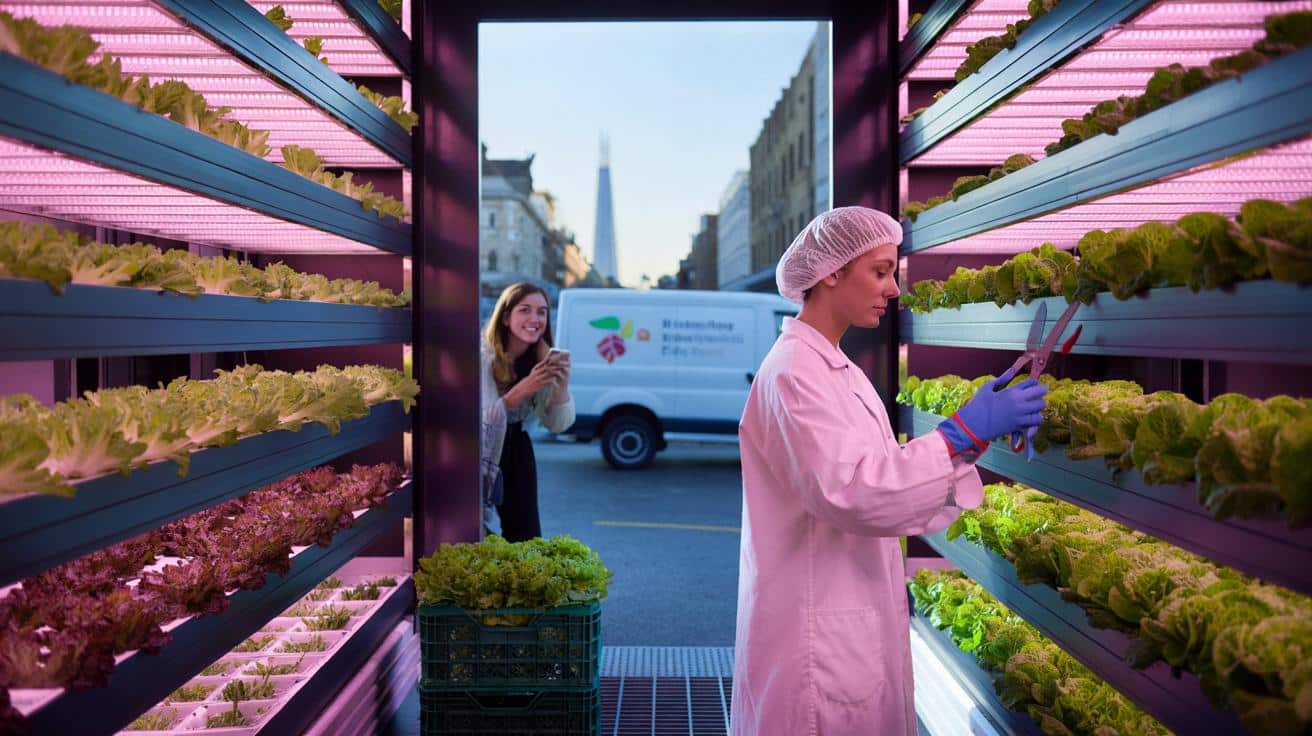
A soft electric purr behind a supermarket in East London, as if the building had a secret engine. I step through a plastic curtain and into a violet glow where trays of baby romaine rise like library shelves. A staffer in a hairnet snips leaves that look impossibly clean, a faint mist lifting off them like breath on a cold day.
He points at a screen: seed in on Monday, harvest the next Thursday. No mud, no weather, no wilted edges. A shopper peeks in through the viewing window, phone out, smiling at the purple. It feels a bit sci-fi until you hold the lettuce. Then it’s just food, cold and crisp. It never sleeps.
Stacked farms, stacked promises
Walk around the UK’s major grocers and you’ll notice the labels shifting: grown under LEDs, UK-grown year-round, city-farmed. The idea is simple enough—put the farm where the people are, then remove the chaos. Salads stop being seasonal drama and start acting like bread or milk. Quietly predictable.
In practice, that means micro-farms tucked behind stores, and bigger vertical farms in city-edge warehouses feeding multiple postcodes. A single room the size of a tennis court can hold layer upon layer of greens, yielding steady output week after week. Drivers don’t have to race up the M2 from a storm-battered greenhouse. They go three miles down the ring road before breakfast and call it a day.
The draw is consistency, not spectacle. Year-round output climbs because every variable gets its box—light, heat, feed, airflow—no guesswork, just control. Water use falls hard, since the system recirculates and wastes almost nothing. Shrink drops because leaves don’t spend days sulking in a lorry. Supermarkets like it because the spreadsheet stops hiccuping. Shoppers like it because the salad actually lasts past Wednesday.
How the ‘infinite’ cycle actually works
Picture a recipe, not a field. Seeds sit on a mat, germinate in a cosy dark shelf, then move to a tier where roots dangle into a gently flowing nutrient stream. LEDs push mostly blue and deep red with a lick of white to keep colour and flavour lively. Fans whisper across the canopy to toughen the leaves. *The room hums like a quiet engine.*
Temperature hovers where lettuce is happiest, with the root zone a little cooler than the air. Harvest happens in the morning, when leaves are plump with water, then straight into chilled packs designed to let them breathe just enough. This is the boring brilliance: repeatable, every day, without asking the weather for permission.
If you’re wondering what to look for on the shelf, follow freshness signals. Labels increasingly show the postcode or city, a short harvest date, and a QR code that leads to the farm wall. Let’s be honest: nobody really does that every day. Still, it’s a nudge—eat it soon, taste it crisp, and notice how little juice sloshes at the bottom of the bag.
“We can cut at 9 a.m. and have it on a city shelf before lunch,” says a produce buyer who’s spent years juggling delays. “Not perfect, but a lot fewer excuses.”
- Harvest today, shelf today: look for same-week harvest dates.
- 95% less water: a claim often tied to recirculating systems.
- No pesticide residues: grown indoors, away from field pests.
- Grown within miles: shorter journeys, fewer wilted edges.
What changes when cities grow lettuce
We’ve all had that moment when the bagged salad turns into swamp by day three. Bringing farms into the city tackles that silly waste. The leaves travel minutes, not days, so they hit your fridge with more life left in them. Less spoilage at the store, less guilt at home, and maybe fewer frantic “use-by” sprints.
There’s a bigger city story here too. Idle units near rail sidings become food engines. Early morning deliveries get shorter. Kitchens plan more confidently because the supply isn’t spooked by heavy rain in Almería. You won’t feel it as a revolution. It’ll just feel like lettuce stopped being flaky.
Energy hangs over the whole model. LEDs are frugal now, but power still costs and climate still matters. Many vertical farms lock in renewable deals or run at off-peak hours to trim both bill and footprint. The maths is messy, and it keeps evolving. That’s the point: unlike weather, maths can change.
The human scale of ‘infinite’ lettuce
Nobody’s promising literal infinity. What the new urban farms deliver is something closer to rhythm. A steady beat of greens, seedling to sandwich, with fewer bad surprises. It puts some dignity back into weeknight dinners, because the plan survives the day.
There’s also a subtle joy in knowing your salad grew in a building you’ve walked past a hundred times. Not a marketing trick, just a sense of place in food that often lost it. The farms aren’t romantic. They’re tidy, humming, a bit nerdy. That’s fine. Romance is for fruit in June. Lettuce needs rhythm.
Will every bag come from a city rack? Not likely. Fields and glasshouses still carry huge parts of the load, and they should. Vertical farms slip into gaps where distance and unpredictability used to win. If the result is fewer empty shelves and fewer soggy bags, it’s a quiet victory worth sharing.
| Key point | Detail | Interest for the reader |
|---|---|---|
| City-grown, year-round | Predictable harvest cycles close to stores | Fewer stockouts and fresher leaves midweek |
| Water and waste | Recirculating systems cut water use and shrink | Longer fridge life, less bin guilt |
| Energy trade-offs | LEDs sip power, but electricity still matters | Understand the real footprint behind the crunch |
FAQ :
- Is vertically farmed lettuce actually better for the planet?It uses far less water and slashes transport, while energy use depends on the electricity mix. Many farms now source wind or solar to push the footprint down.
- Does it taste different?Often crisper and cleaner, with less bitterness from stress. Flavour still varies by variety and recipe, just like field-grown.
- Why call it “infinite” lettuce?Because the cycle repeats daily—seed, grow, harvest—without waiting on seasons. It’s more about continuity than magic.
- Is it more expensive?Prices are narrowing as tech improves and waste falls. Weekly promos and own-label packs make it comparable to many imported salads.
- Can I visit or see how it’s grown?Some stores have viewing windows or tours, and many packs carry QR codes with live farm feeds. Peek, then eat.








This makes my midweek salads less of a gamble. If you can harvest at 9 a.m. and ship before lunch, that’s a game-changer. Fewer wilted edges, fewer bin-guilt moments, and I can actually plan dinners without praying to the weather. Quiet revolutions are the best kind.
Honest question: once you factor in electricty and cooling, is the carbon footprint truly lower than trucking from Spain in season? I love the 95% less water claim, but energy mix matters. Any LCA numbers for UK vertical farms on wind/solar versus grid-average?