
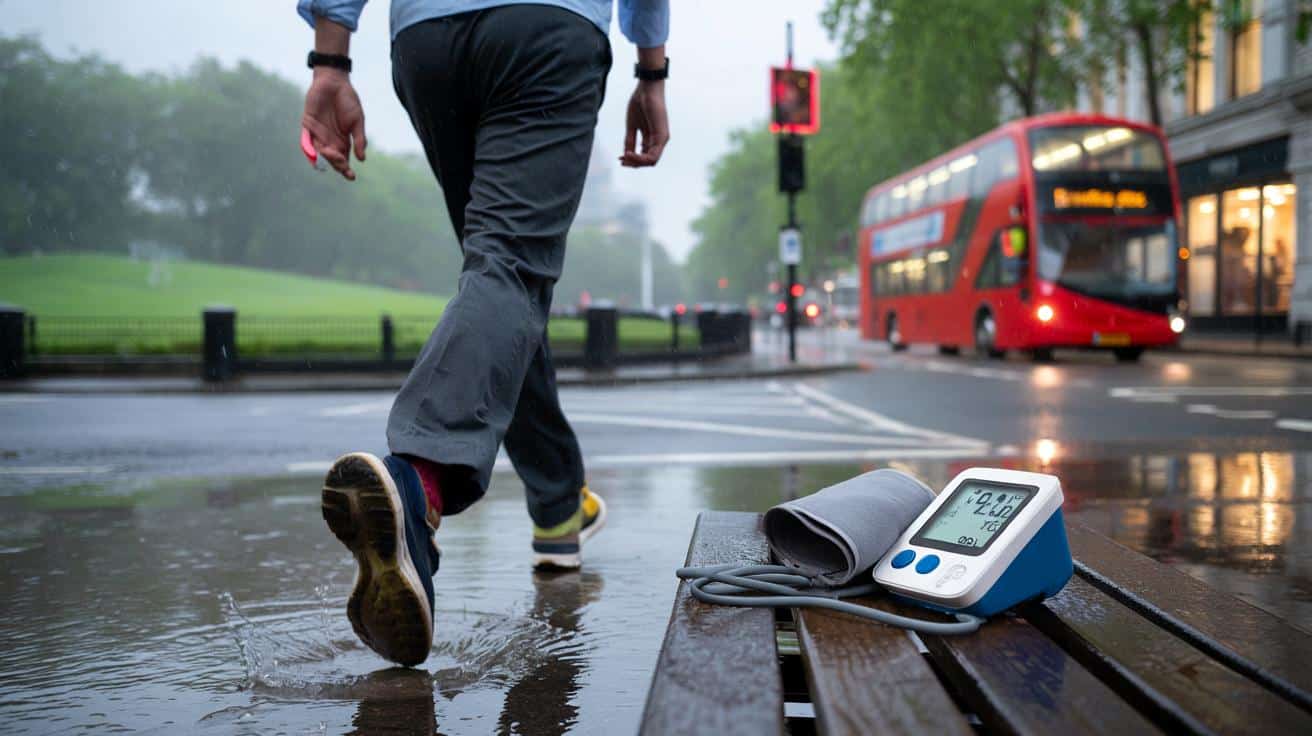
Not quite scary, just enough to make me think twice about strong coffee. So I tried something modest and doable: 5,000 steps every day for a month. Not 10,000. Not a marathon. Just a rhythm I could live with.
The first morning began in a soft London drizzle, the kind that looks harmless from a window and then sneaks down your collar. I set off before emails could find me, pavement slick, buses yawning awake. My watch nudged me at 800 steps and I felt vaguely silly, a grown adult chasing a number like a toddler chasing a balloon. The city was still, and I could hear my breath. I’d taken a baseline reading the night before: 137 over 86. The cuff had gripped my arm, humming its little threat. We’ve all had that moment where a tiny screen hands you a verdict you didn’t ask for. I walked faster past the bakery and tried not to think about salt. The month began with a drizzle and an awkward optimism. What happened next surprised me.
What 5,000 daily steps actually did to my numbers
By the end of week two, I noticed the cuff felt less dramatic. The morning reading didn’t sprint upwards like it used to after a poor night’s sleep. I kept a quiet log on my phone, no stickers or charts. Just numbers, time of day, how I felt. **My average fell from 137/86 to 129/82.** Resting heart rate drifted from 69 to 63. Sodium stayed roughly the same. Coffee stayed in the picture. My ankles felt less creaky on the stairs and my shoulders sat lower, as if someone had loosened the screws.
There was one day when a tense meeting showed up in the numbers. Late afternoon, still 3,200 steps on the clock, blood pressure higher than I liked. I walked the long way home—two parks, one hill, phone in pocket. Twenty-five minutes later, another reading. Down by 7 points on the top number. That little dip taught me the difference a brisk loop can make. I’m not saying walking is a magic wand. I’m saying it’s a nudge, every single day, and those nudges add up in ways you actually feel.
Why did such a modest target help? A daily 5,000 steps gave me regular, low-stress cardio. That means better blood vessel flexibility and a friendlier response from the nervous system that controls heart rate and tension. You get small bursts of nitric oxide that help vessels relax. You breathe deeper, you soften the edges of your stress. I didn’t lose much weight—about a kilo, probably a mix of water and weekend honesty—but my readings evened out. Less spiky. Less drama. **Pace beats perfection.** The body seems to like reliable signals more than grand gestures.
How I made 5,000 steps count
I kept it simple: three walks. A short one before work, a brisk 10–15 minutes at lunch, and a loop after dinner. The middle one mattered most. I aimed for a cadence where conversation was possible but not easy—roughly 100 to 110 steps per minute. Arms swinging, eyes up, soft landing on the midfoot. When I could, I chased a gentle incline. When I couldn’t, I added two 60-second “push” bursts at a faster pace. I kept it stupidly simple. That was the point.
Little hacks helped. I put my trainers by the door, not in a cupboard. I took phone calls as “walking meetings” around the block. I built a five-minute “default loop” I could start without thinking. *Soyons honnêtes : personne ne fait vraiment ça tous les jours.* Life threw rain, deadlines, toddlers, and takeaway menus. Missed a day? Fine. I made the next one brisk. I never chased steps at 11:58pm. Walking nudged my pressure when it felt like part of my life, not a punishment for living it.
Here’s the line I’d write on a Post-it above the cuff.
“Small steps, done often, beat big plans delayed.”
And here’s the tiny toolkit that kept me consistent:
- Set one “non‑negotiable” walk you take at the same time daily.
- Use landmarks for pace—“from the café to the zebra crossing” in under two songs.
- Keep a one-line log: time, steps, mood, BP if measured.
- Pick a hill or stairs for a 60‑second push, twice.
- Turn evening scrolling into a ten-minute loop, phone in pocket.
Where this leaves me (and maybe you)
I didn’t become a different person in 30 days. I became someone whose day has a quiet hinge in it, a place where pressure releases. The cuff still hums, the numbers still move, but they move inside a calmer range. **Small steps, done daily, change the tone of your day.** I can feel it in the way I answer emails. The way I fall asleep. The way my brain stops reaching for snacks when it’s really asking for air.
If you’re staring down a number like I was, 5,000 steps won’t solve everything. It might solve the first five percent. That first five percent is usually the hardest part. Start with one brisk loop and let it teach you what it can do. Your blood pressure is not a verdict. It’s a conversation with your habits, your sleep, your salt, your stress, your breath. A month of walking didn’t hand me a medal. It handed me a lever I can actually pull, on rainy Tuesdays and bright Saturdays alike.
| Key point | Detail | Interest for the reader |
|---|---|---|
| 5,000 steps lowered my BP | Average shifted from 137/86 to 129/82 over four weeks | Shows a realistic, achievable change without extreme effort |
| Intensity beat raw totals | Brisk cadence and two short pushes mattered more than extra steps | Focus on what to do during the walk, not just distance |
| Habits made it stick | Three short walks, same rough times, with a simple one-line log | Blueprint you can copy tomorrow without new gear or apps |
FAQ :
- Do I need 10,000 steps to lower blood pressure?Not necessarily. A consistent 5,000 with some brisk minutes can nudge BP meaningfully.
- When’s the best time to walk for BP?When you’ll actually do it. Many find mid-morning or after work calms readings.
- How fast is “brisk” in real life?Talking in short phrases, breathing deeper, roughly 100–110 steps per minute.
- Does a hill or staircase help?Yes. One or two short pushes raise the training effect without more time.
- Is 5,000 steps enough for weight loss?Often not alone. It can support appetite, sleep, and consistency while you adjust food.






This is the first walking piece that didn’t guilt-trip me. The drip-drizzle London details and the 3-walk routine make it feel doable. Pace over perfection is the line I needed. Adding two push bursts tonight. Thanks for the clear, grounded numbers.