
A veteran fire investigator says there’s one place many of us leave our air fryer plugged in that quietly turns risk into routine: the overworked extension lead on the kitchen counter. It feels harmless. It isn’t.
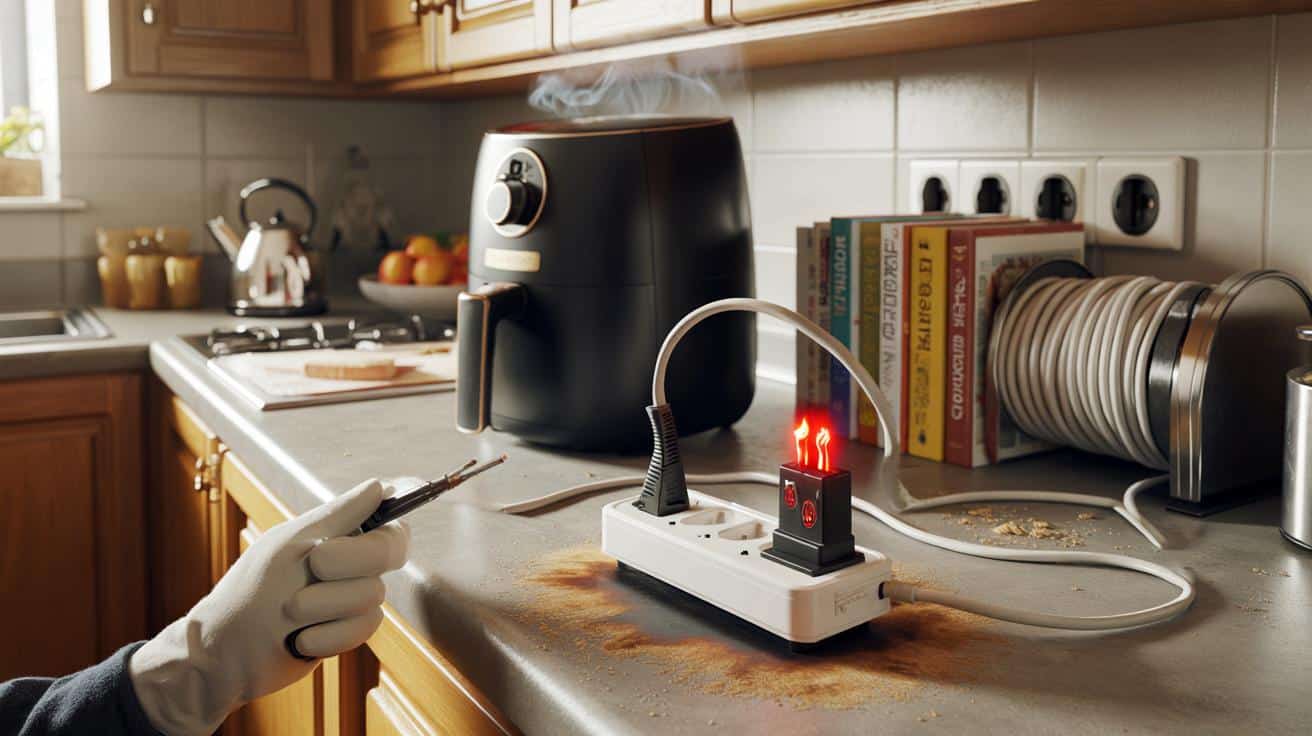
I’m standing in a quiet terrace kitchen where last night’s chips still scent the air, the kind of cosy room that gets busy fast at tea-time. The investigator kneels by a four‑way extension, its red switch glowing behind a line of gadgets. He taps the casing with a pen, traces the cable to a coil hidden by cookbooks, then points up towards the wall cabinets, yellowed by years of steam. The hum of a kitchen can lull you into believing everything here is friendly. He shakes his head. “Heat, grease, load. It all adds up.” He’s not dramatic. Just certain. Then he says the bit everyone remembers. A short warning that sticks.
Air fryer plugged in “here”? The hotspot you’re overlooking
That “here” is the multi‑way extension lead so many of us park on the worktop. It’s the reel left coiled behind the fridge or slipped under the microwave. An air fryer draws heavy current, and a four‑way adaptor often shares that same feed with a kettle, toaster or coffee machine. The plastic warms, the contacts wear, and a tucked‑away coil turns into a little radiator. You don’t see it. You feel it later.
Ask any watch officer about near‑miss calls. They’ll tell you about a Tuesday night when the air fryer kept its plug in a crowded block next to a bread bin. Steam softened the plastic. Grease dust crept into sockets. The family went upstairs, and an hour later the laminate had a brown bloom under the extension. No flames, just luck and a sharp nose. Fire service logs in the UK keep repeating the same pattern: overloaded leads in cramped, warm spaces.
Here’s the physics in plain English. Many air fryers run at 1,400–2,000W. On 230V, that’s roughly 6–9 amps on its own. A four‑way block rated at 13A total doesn’t have much headroom once a kettle or toaster joins the party. Add a coiled reel and you trap heat along the cable, which raises resistance, creating more heat. Tired plugs and budget adaptors add tiny pockets of arcing. In a kitchen, heat meets grease and wood. That’s a bad handshake.
What to do instead: the safe setup that takes two minutes
Plug your air fryer straight into a fixed wall socket, ideally on an RCD‑protected circuit. Give it clear space on a firm, heat‑resistant surface with at least a hand’s width behind and above for airflow. Keep the lead visible and uncoiled. When you’ve finished cooking, unplug the air fryer and let it cool with the basket open. Touch-test the plug and socket after the first few runs; warmth is a clue, heat is a red flag.
Common slip‑ups creep in on busy nights. People stash the lead behind appliances, drape tea towels over the fryer, or leave it nudging a wall cabinet. Grease mist settles, crumbs collect, and a cable bends just enough to stress the plug. We’ve all had that moment where the timer dings and a child shouts from the next room. That’s when shortcuts happen. Let’s be honest: nobody deep‑cleans a plug or tests an RCD every month. Build tiny habits instead—visible lead, clear space, off at the wall.
“I’m a fire investigator, and you should never leave your air fryer plugged into a multi‑way extension or a coiled reel. Use a wall socket and unplug it when you’re done.”
- Use a wall socket on an RCD‑protected circuit; avoid four‑way blocks and reels.
- Keep 10–15 cm clearance around and above; don’t tuck it under cupboards when hot.
- Wipe the plug and cable monthly; look for discolouration, brittleness, or wobble.
- Register your model for recall alerts; swap damaged leads, never tape them.
- Feel the plug after a long cook; if it’s hot, stop and rethink the setup.
Think broader: hidden risks that have nothing to do with recipes
Placement is half the battle. Don’t run an air fryer on a windowsill with direct sun, or on a wobbly trolley, or beneath a roll of kitchen paper. Keep it off the hob, even when the rings are “off”. Line the basket only with perforated paper that can’t ride into the element, and avoid overfilling so food doesn’t kiss the heater. If the cable is short, move the fryer to the socket, not the other way round.
Listen for signs that quietly warn you. A buzz at the plug, a faint fishy or sweet smell from plastic, a flicker in the lights when the fryer cycles—these are not quirky household “personality”. They’re early alarms. Many households pick a “temporary” spot that becomes permanent, like the under‑stairs corner with a reel and a dehumidifier for company. It works until it doesn’t. **Plug it directly into a wall socket** and treat the cable like a seatbelt, not decor.
Care also lives in cleaning. Grease acts like kindling when it finds warmth and oxygen. Empty the crumb tray. Wipe the back wall, especially the lip near the element. A clean seal reduces odours that mask the smell you actually want to notice: hot plastic. If your plug or socket ever feels more than mildly warm, pause. **Never ignore a hot plug**—that’s your kitchen whispering “not today”. Small checks keep family dinners in the safe zone.
One small change, a quieter kitchen
There’s a calm that comes from pulling the plug and seeing a blank switch. It’s a two‑second ritual, not a lecture. You buy an air fryer for speed and convenience, and it earns its keep when the week gets messy. Share a picture of where yours lives and ask your friends where theirs is plugged in. You’ll spot the risky corners straight away. Move it once. Feel the difference next time the chips are on and the house is full. That soft click at the wall becomes part of the rhythm.
| Key point | Detail | Interest for the reader |
|---|---|---|
| Don’t use extension leads | Air fryers draw 6–9A; blocks and reels overheat, especially when coiled | Prevents silent overloads and scorched plastics |
| Use a wall socket with RCD | Fixed wiring handles heat better; RCDs cut power fast on faults | Reduces shock and fire risk without slowing dinner |
| Unplug after use | Stops standby draw and removes a live load from a warm kitchen | Simple habit that eliminates a common ignition path |
FAQ :
- Is it safe to leave an air fryer plugged in all day?It’s safer to unplug after use. Standby circuits can fail, and a live plug in a warm, greasy space raises risk.
- Can I use a high‑quality surge‑protected extension?Not for high‑draw appliances. Surge strips protect electronics from spikes; they don’t fix heat from heavy current.
- What about a short‑term extension while I cook?Use the wall socket instead. If you must extend, fully uncoil a heavy‑duty reel and keep it cool and visible. Treat that as temporary.
- Is a smart plug a good workaround?Only if it’s rated above the fryer’s load and used at a wall socket. Smart doesn’t beat physics; heat still wins.
- How do I know if my setup is overheating?Feel the plug and the faceplate after a long cook. Warm is acceptable; hot is not. Look for discolouration, buzzing, or smells.








Good wake‑up call. Unplugging now and ditching the extension on the counter.