
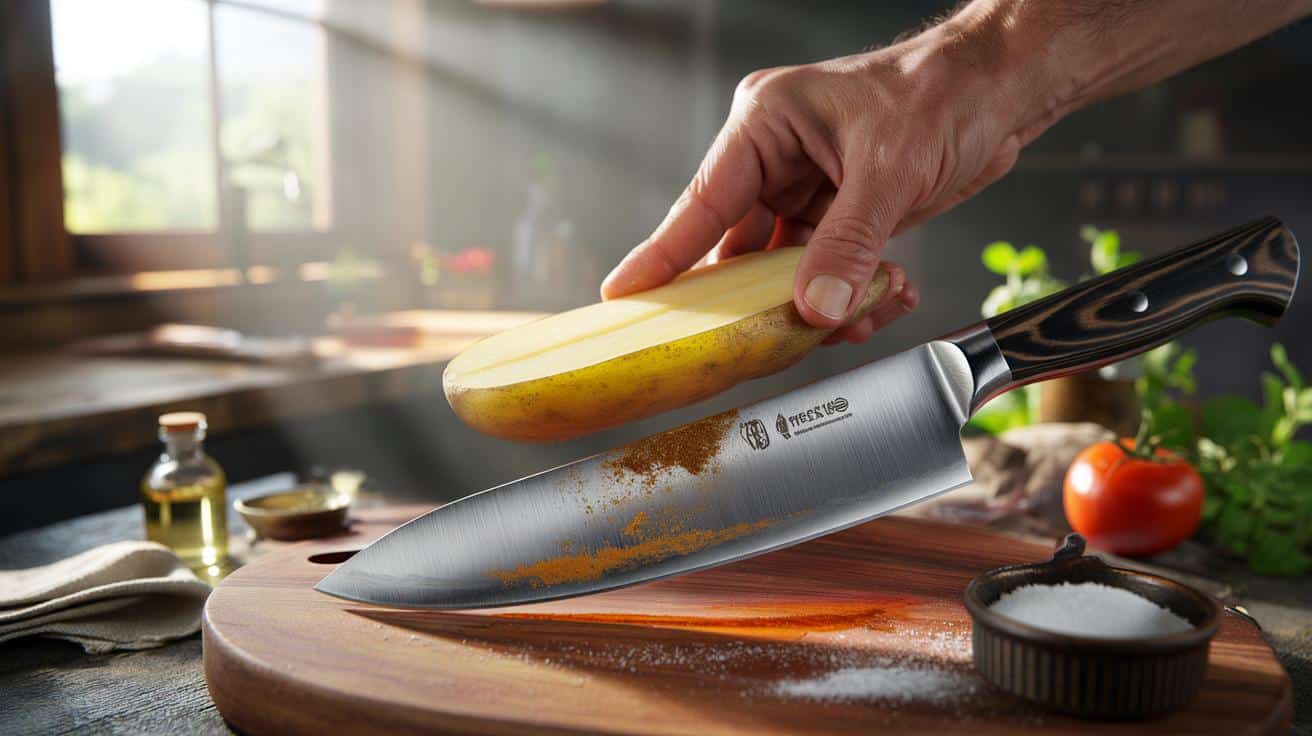
You rinse, you rub with a tea towel, you think you’ll “deal with it later,” and then the edge goes dull and the blade goes shy at dinner. **Rust is just iron meeting air and water.** The fix doesn’t need a workshop, a wire wheel, or a spendy paste. It lives in the veg drawer, next to the onions you forgot to use last week. A humble potato slice can turn that blush of rust into a clean, grey shine you’ll want to run along a tomato’s skin again.
The morning I tested it, the kitchen window had fogged from last night’s washing up, and my old carbon-steel chef’s knife wore a rash of orange like a bad mood. I sliced a potato—one lazy, thumb-thick round—and pressed it to the stain. The smell was faintly green, the starch tacky. Brown streaks lifted onto the potato, as if the rust wanted out. I rinsed, dried, and felt the blade catch light on a pepper’s surface with that crisp whisper you only get from a clean edge. So I reached for a potato.
The quiet chemistry hiding inside a spud
On first pass, it feels like a trick. You touch a raw potato to the blade, rub a few strokes, and the rust bleeds onto the slice like blush onto a cotton pad. This isn’t magic, and it isn’t scrubbing your knife within an inch of its life. It’s soft, quick, almost gentle—more like erasing pencil marks than sanding a fence. You’ll see tiny brown swirls on the cut potato, a neat little signature that says the oxide is breaking away from the steel and parking in the starch.
I’ve watched a friend in Manchester bring a flea-market Sabatier back from “pub shed” condition with nothing more than a potato round and a pinch of bicarbonate. Two minutes later, the blade went from rusty attic find to “let’s dice herbs.” He grinned, the way people do when they rescue something instead of replacing it. He said the quiet part too: he’d tried scouring pads before and ended up with micro-scratches that dulled the feel. The potato made it look like he’d actually cared all along.
Here’s why it works: potatoes carry oxalic acid, a mild acid that grabs at iron oxide and loosens its bond with the underlying steel. Salt or bicarbonate adds a fine, controlled grit—enough bite to lift oxidation without gouging the metal. Starch binds the mess, so you’re not just pushing rust around, you’re lifting it off. Stainless steel will respond when the rust is superficial; carbon steel replies even more eagerly, because the oxide layer is thin and honest. The moment the brown melts away, the grey underneath looks calmer, the edge more trustworthy.
How to de-rust a knife with a potato slice in two minutes
Set your kit on the counter: a raw potato, coarse salt or bicarbonate, a soft cloth or paper towel, warm water, and a drop of washing-up liquid if the blade is greasy. Slice a clean, thumb-thick round. Dip the cut face in salt or bicarb. Lay the knife flat, rub along the blade in smooth, lengthwise strokes, pausing where the orange is stubborn. Give it 30–60 seconds of contact; wipe, rinse, dry straight away, then finish with a thimble of neutral oil on the blade to seal the win. **Drying is the real miracle step.**
Don’t overthink it, just keep the moves small and clean. Go with the grain, never across the edge, and keep water away from wooden handles and the bolster seam. We’ve all had that moment when a damp sink and a late-night clean-up turn into next-day rust freckles. Let’s be honest: nobody dries every knife the second it’s washed. I keep a thumb on the spine so the blade stays honest. A light oil finish on carbon steel—once a month—turns “chore” into habit.
One more tiny detail: favour quick sessions over heroic scrubbing. Short passes let the acid work and the abrasive guide your hand, and you’ll stop before you buff away character. If a mark won’t budge, it’s probably a pit, not fresh rust, and that’s a job for a different day. Keep the hack for the everyday bloom that shows up when life gets busy.
“The potato trick is like a reset button,” says a bladesmith friend. “It removes the noise so you can feel what the knife wants to do again.”
- Rinse and dry immediately after the rub—don’t leave the blade wet on the rack.
- Avoid soaking knives in anything; water creeps under handles and builds trouble.
- Skip bleach entirely, and never pair acids with chlorine-based cleaners.
- If you cherish a patina on carbon steel, spot-clean only to keep the blade’s story.
What changes when you stop fighting rust the hard way
When the fix lives in your fridge, maintenance stops feeling like homework and starts feeling like a tiny ritual. You slice, you rub, the brown lifts, the blade breathes—then dinner carries on without a detour to the shed. You’ll notice the way a clean edge lands on an onion and slides through, how tomatoes don’t buckle, how herbs stay green because the knife isn’t tearing. The potato trick nudges you toward taking five seconds to dry the blade, to oil it every so often, to care in a way that doesn’t demand heroics or gear. **Share the trick, keep the knives you love.**
| Key point | Detail | Interest for the reader |
|---|---|---|
| Potato power | Oxalic acid loosens rust; starch carries it away; salt/bicarb adds gentle bite | Fast results without scratches, using a common ingredient already at home |
| Two-minute method | Slice potato, dip in salt or bicarb, rub lengthwise, wipe, rinse, dry, light oil | Simple steps that slot into everyday cooking with no special tools |
| Care after cleaning | Keep water off handles, dry straight away, oil carbon steel occasionally | Longer knife life, better performance, less faff and fewer replacements |
FAQ :
- Does this work on stainless as well as carbon steel?Yes. Light surface rust on stainless comes off quickly with a potato and salt or bicarb. Deep pitting won’t vanish, but the orange bloom that appears after a damp night will lift cleanly on both types of steel.
- Is it food-safe to use a potato on a blade?It is. You’re using a raw vegetable and rinsing the knife afterwards with warm water and a touch of washing-up liquid. Dry the blade immediately, then it’s ready for food work again without any odd smells or residue.
- Why not use lemon or vinegar instead?Lemon and vinegar are stronger acids and can edge toward etching if you overdo it. The potato’s oxalic acid is gentler and the starch helps trap the rust. You also get a built-in handle, which makes the rub easy and controlled.
- How long should the potato stay on the rust?Contact time of 30–60 seconds while rubbing is usually enough. For stubborn spots, pause for a minute, then wipe and check. Reapply once if needed, keeping sessions short to avoid over-polishing or lifting a patina you like.
- Will this sharpen my knife too?No. It cleans the steel and boosts cutting feel by removing draggy rust, but it doesn’t reset the edge geometry. For sharpening, use a whetstone or a trusted service. Clean first, then sharpen—your stones will thank you.








Just tried this on my old carbon-steel paring knife—potato + a pinch of bicarb—and that orange blush lifted in under a minute. Rinsed, dried, tiny dab of neutral oil, and the edge feels smoother on tomatoes. Thanks for the low-tech fix!
A spud spa for knives? Sounds like starch witchcraft. Does it help with light pitting or is that game over?