
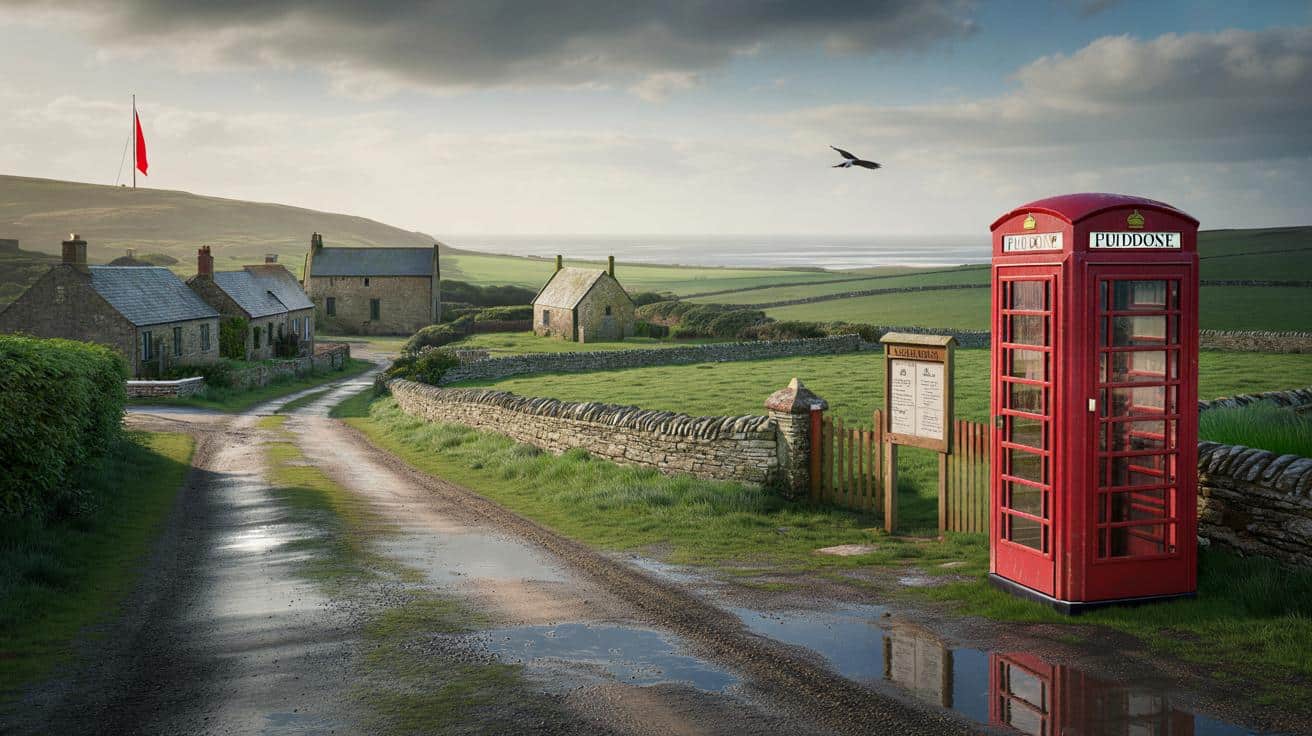
The “ghost” place people whisper about on long drives — left to the war, never quite returned. Some say it hasn’t changed since 1945. Step through its gate and the air feels older than your own memory.
I reached the abandoned village just after the rain, when hedges drip and boots go quiet. A chalky lane folded into a valley, then the first shells of cottages appeared like theatre flats left after the final bow. Wind moved through empty windows, low and patient, the way breath sounds in a sleeping house.
On the green, a red phone box still stands, paint dull as winter berries. The schoolroom waits with little slates and a map of a world that no longer exists. Outside, kestrels hover above the fields, as if they’ve taken over the watching. The sea sits just out of sight, and you can hear it when talking stops.
Time, for once, felt like it had put its boots up.
A wooden notice asks for care — a wartime voice still speaking. Somewhere beyond the chalk, you catch a far-off boom from a range that never really closed. Then the wind shifts. The village exhales. Something in you does, too.
A village borrowed by war, and never fully returned
Tyneham sits in a bowl of Dorset downland not far from the coast, a set of lanes and cottages plucked from a postcard, then left to the elements. It’s open only when the ranges fall silent, so you arrive on borrowed hours. There’s no neat square or pub chatter, just the rumour of lives, the shape of days that stopped.
The houses are roofless in places, but their thresholds remain strong underfoot. A garden wall keeps guarding a patch that used to be lavender and washing lines. You don’t see ghosts, not really; you see decisions. You feel how quickly a century of routines can be folded into silence, like a shirt placed carefully into a drawer and never opened again.
In 1943, residents were asked to leave their homes for the war effort. Some left notes on doors, polite and stubborn as village handwriting: we’ll be back, look after our things. That promise became a kind of weather. The school kept its chalk. The church kept its names. **Walk past the noticeboard, and the surnames read like a parish still taking attendance.** You realise how archive and air can live in the same room without arguing.
What survives when nothing “progresses”
There’s a story here, but it doesn’t shout. It lives in objects: an iron range black with the last meal cooked; a desk with an inkwell that looks like it could stain your sleeves today. The floorboards’ absence teaches you to glance down. Tyneham is gentle with visitors who are gentle with it. It answers quiet with quiet.
I met a couple near the school who said they’d first come in the seventies. They bring their children now, who bring theirs. The same paths, the same house bones, the same hedges learning everyone’s height. They pointed out the track to Worbarrow Bay, where the sea keeps licking the story clean. We’ve all had that moment where a place feels like it recognises you back — not by name, but by the way you slow down.
People say “unchanged since 1945” because the village hasn’t grown new corners or retail dreams. The map is still the map. The trick is that time kept working on everything else. Rain softened mortar. Ranges shook the soil. The Ministry opened and closed the gate like a breath through a season. **What you feel here isn’t stasis; it’s a pause held for so long it turned into meaning.** The past isn’t behind glass — it’s present enough to trip you if you stride.
How to walk a ghost village without breaking it
Think of your visit as a conversation, not a conquest. Arrive early, when the light is still deciding. Keep to the marked paths — not for rules’ sake, but because the ground remembers things you don’t want to disturb. Read the rooms like you’d read a person: notice what isn’t said, let the small objects have the loudest voice.
Check range opening times before you set off, as access is limited and variable. A paper map helps, since signal can sulk in the folds of these hills. Bring shoes that don’t mind chalk and puddles. Let the church display tell you what the guidebook can’t. Leave stones where they are. Leave stories the way you found them. Let’s be honest: nobody actually does that every day.
If you travel with kids, set them a tiny task — count window frames, sketch the bell rope — so the village stays a place, not a set. If you travel with someone who lived through the post-war years, listen more than you speak. **You don’t need a drone here; you need fifteen extra seconds of standing still.**
“The past isn’t fragile because it’s old; it’s fragile because it’s ours.”
- Check official range access before you drive.
- Stick to paths and heed red-flag boundaries.
- Take nothing; leave only footprints and a quieter pulse.
- Read the school and church displays; they’re the heartbeats.
The echo you take home
Places like Tyneham pull a trick on you. You arrive expecting drama — a film set, a scare, a headline — and you leave with something slower. The silence here isn’t empty. It’s full of labour, arguments, porridge, ink stains, Sunday boots, the crisis of a broken hinge, the relief of harvest. Ordinary life, parked and left in neutral.
I walked back towards the car park with a pocket full of nothing and felt oddly heavier. The kestrels were still on post, the sea still off-stage. I thought about how quickly our lives fill with plastic things, notifications, and improvements no one asked for. Then here’s this village, still itself, and still complicated. It didn’t get its people back. It got memory instead.
You can look at the Roofless House and think: ruin. You can look again and think: kept. Both are true, which is why the place works on you. Walk slowly. Let the wind be the only loud thing. Tell someone about it on the way home, the way you tell a friend about a film that leaves you quiet for a bit. That’s how these stories keep walking.
| Key point | Detail | Interest for the reader |
|---|---|---|
| Tyneham’s frozen rhythm | A wartime evacuation left the village’s map and mood largely unchanged | Feel what “paused since 1945” is like under your shoes |
| Access is borrowed time | Open only when ranges are inactive; paths and flags matter | Plan the visit right, avoid wasted journeys and risky detours |
| How to read a place | Let small objects and silences tell the story | Turn a photo stop into a memory you’ll actually keep |
FAQ :
- Is the village truly unchanged since 1945?It feels that way, but weather and military use have left their marks; the layout and atmosphere remain strikingly intact.
- Can I visit any day of the year?No. Access is limited to specific days when the ranges are closed. Always check official notices before travelling.
- Is it safe to explore the houses?You can enter certain buildings like the church and school; others are unstable. Stick to open areas and signed access.
li>What should I bring for the walk?Sturdy shoes, a paper map, water, and time to linger. Weather can change fast on the downs.
- Can I take photos or fly a drone?Photos are fine for personal use. Drones are generally a bad idea here — respect rules and the mood of the place.






This gave me chills. The bit about the village exhaling—wow. Thank you for treating Tyneham with quiet respect and offering practical tips without breaking the spell.
Quick Q: since access depends on the ranges, are weekends actualy open that often? Bringing kids—will a stroller/pram manage the chalky lanes, or is it mostly uneven ground?