
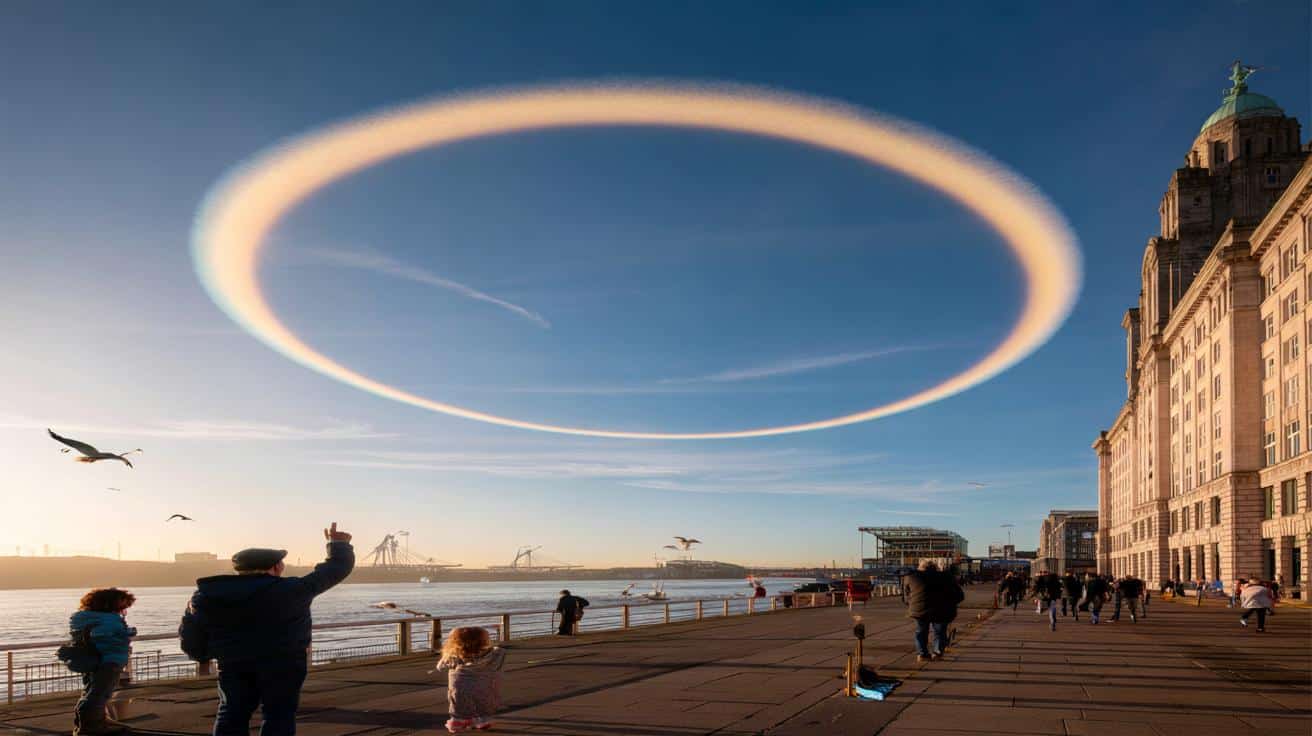
A giant, chalk-pale ring hung over Liverpool today, so clear it stopped people mid-step on Bold Street and along the Pier Head. Phones came out, tweets flew, and for an hour or two the city stared upward, asking the same question in dozens of different ways: what on earth is that white circle?
On Church Street I saw a bus driver lean out at the traffic lights, squinting past the corner of a building, while a couple argued about filters and ISO as if that might answer anything. A child called it “the moon’s window,” which felt oddly right for the middle of the day. *It felt like the sky had drawn a secret sign and waited for us to notice.* Then it widened.
A ring around the Sun, or something rarer?
Look closely and the first clue is where the circle sits. If it’s centred on the Sun, pale and evenly bright all the way round, you’re probably looking at a 22-degree halo. Tiny, hexagonal ice crystals in thin, high cloud bend sunlight at a fixed angle, sketching a massive ring across the sky. The diameter is enormous — a full arm-span at the end of your outstretched hand — which is why it reads as “giant” from street level. **The simplest answer is often the right one: a 22-degree halo.**
There’s another possibility, and Liverpool has seen it before: a fallstreak hole, sometimes called a hole-punch cloud. Imagine a uniform sheet of mid-level cloud with a sudden, clean-edged circle punched out, as if someone traced it with a compass. Aircraft passing through supercooled droplets can trigger ice formation that spreads, clearing a ring or disc. It looks ghostly, and it’s not centred on the Sun. We’ve all had that moment when a cloud looks staged — this is that, with physics underneath the theatre.
How to tell which one you saw today? Ask three things: was the Sun at the centre, was the ring uniform, and did thin, fibrous cloud stretch across much of the sky? If the answers are yes, it’s almost certainly a halo built by cirrostratus ahead of an incoming Atlantic front. If the circle sat off to one side, carved out of a flatter, thicker deck, that points to a fallstreak hole triggered by a passing plane. Both are natural. Neither is a portal or “chemtrail circle”. Look for subtle hints of colour too — halos can carry faint red on the inside edge.
How to see it safely — and capture it
Start with shade. Put the Sun behind a roofline, a lamppost or even your raised fist, then step the edge of your cover just off the Sun so the ring pops into view. With a phone, tap the sky away from the bright centre and drag exposure down a notch so the circle isn’t washed out. A polarising clip-on filter can deepen the blue and sharpen the ring. If you wear glasses, tilt your head slightly; some lenses naturally cut glare and help the halo stand out.
Think foreground. A halo above the Liver Building or framed by the cranes at the docks will do more than any zoom. Keep your horizon straight and shoot wide; haloes are larger than your instincts expect, so back up and include the scene. If you’re tempted to stare, don’t — let the building do the blocking and glance, don’t fixate. Let’s be honest: nobody actually does that every day. One more thing: flip your phone to 0.5x ultra-wide and take a second shot in case you misjudge the size.
“The trick is not bravery, it’s geometry,” a veteran skywatcher told me at Crosby Beach, smiling at the gulls. “Hide the Sun, find the ring, breathe. You’ll see it snap into place.”
**Never stare at the Sun; block it with a building or your hand.** If you’re sharing online, that context helps others spot it too. Try this quick checklist before you post:
- Is the Sun at the centre or off to the side?
- Was the cloud thin and wispy, or thick and uniform?
- Did you notice faint colour on the inner edge?
- What time did you shoot, and where were you standing?
- One wide shot, one detail: give people scale.
What today’s ring says about the weather — and us
A halo is a message from the upper air. Those ice crystals ride in thin sheets six to twelve kilometres up, often drifting in ahead of a front. A pale ring at lunchtime can mean thicker cloud by evening and rain within a day, which is why sailors and farmers used to watch for “rings round the Sun” as a quiet hint. A fallstreak hole hints at supercooled layers and busy skies, the atmosphere toggling from liquid to ice with a little nudge. It’s meteorology, glowing softly.
There’s also the way a city pauses. Busy streets go quiet for a heartbeat while strangers point at the same circle and wonder together, and the wonder matters more than we admit. Share the photo, yes, but share the moment too — the gasp, the tiny chorus on a bus, the way a child’s idea lands truer than the adult jargon. **No one on the pavement pretended it was normal.** The sky had a ring on and Liverpool, for once, looked up.
And if you missed it at lunch? Keep an eye out near sunset when the haze thickens and light slants longer; the ring can sharpen in the late gold. Night can bring a cousin: the moon halo, colder and calmer, a chalk wreath that wraps the night and makes your breath look like smoke. The same geometry runs the show, just dimmer. If you catch that one, step back another metre and let the streetlight trim the moon to the edge. You might gasp twice.
| Key point | Detail | Interest for the reader |
|---|---|---|
| How to tell halo vs hole-punch | Halo is centred on the Sun with a uniform ring; a fallstreak hole is a clean circular gap in cloud, offset from the Sun | Quick field test so you know what you’re looking at without guesswork or myths |
| Safe viewing method | Block the Sun with a building, reduce exposure on your phone, shoot wide for scale | Better photos, happier eyes, and a shareable shot that shows the full circle |
| Weather hint | Halos signal high ice cloud ahead of a front; showers or thicker cloud often follow within 12–36 hours | Turn a pretty ring into a practical forecast you can use on your commute or weekend plans |
FAQ :
- Is the white circle a UFO or some kind of “project” in the sky?No. A solar halo is sunlight bent by ice crystals in high cloud, and a fallstreak hole is a natural clearing triggered by passing aircraft in supercooled cloud. Both are well-documented optical and cloud physics.
- Is it dangerous to look at?The ring isn’t dangerous, the Sun is. Don’t stare at the Sun; hide it behind a building, pole or your hand and glance around it. Your phone screen is fine to use as long as you keep the bright disc blocked.
- How long does a halo last?Anywhere from minutes to a couple of hours. It depends on how uniform the cirrostratus is and whether winds aloft shear the ice crystals into other shapes. Take the photo when you see it; they fade without warning.
- Can this happen at night?Yes. The Moon often wears the same 22-degree halo, especially when it’s bright and high. It will look softer and grey-white rather than brilliant, and city lights can wash it out unless the sky is clear.
- Did a plane “make” the perfect circle?Planes can trigger a fallstreak hole, which looks like a disc or ring in a sheet of cloud, but they don’t draw haloes. If the Sun sits dead centre in the ring, it’s an optical halo, not aircraft art.







Definately the best explanation I’ve read. I hid the Sun behind a lamppost like you said and the ring snapped into view — wild. Also noticed a faint red on the inner edge just like you mentioned. Cheers for the clear, non-spooky writeup.