
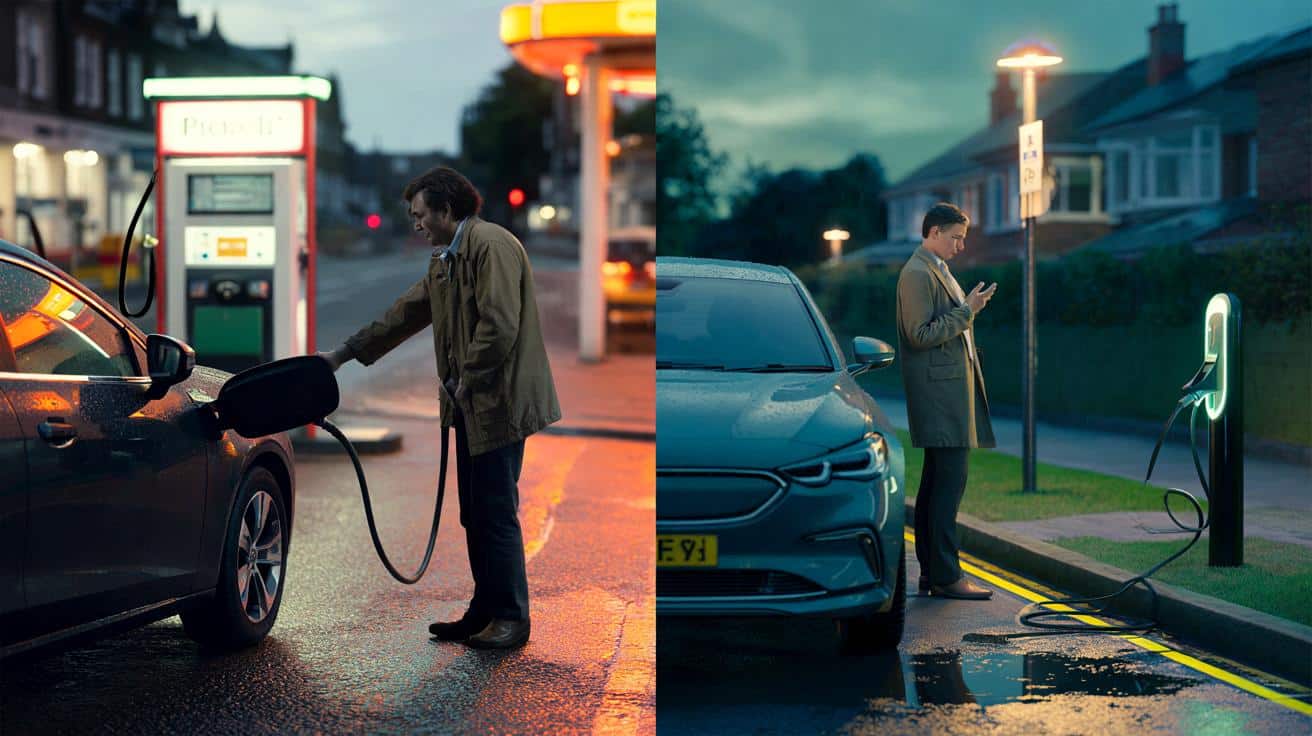
One driver grips a pump, eyes on the rolling digits. Across the street, another waits by a lamppost charger, hands deep in a coat, watching a phone tick from 34% to 61%. Both are thinking the same thing: is this still the cheapest way to get to work, see family, live a life? The price board glares one number. The charging app whispers another. Neither tells the whole story. We’ve all felt that quiet maths happening in the back of the head, the kind you do between yawns and traffic lights. *The answer, in 2026, is less obvious than last year and more personal than any headline.* And there’s a twist you might not expect.
The 2026 cost picture: what the numbers really say
Running costs have split into two realities. If you can charge at home overnight, an EV still looks like a bargain per mile. If you live on public rapid charging, the bill can jump enough to make petrol feel oddly sensible again. Energy prices have settled into bands: typical home rates in the high 20s p/kWh, off‑peak EV tariffs dipping into the single digits, and rapids on the road mostly above 60p/kWh. Petrol hovers on a seesaw of tax and wholesale swings. That spread is the whole ballgame.
Take a normal hatchback doing 10,000 miles a year. At roughly 4 miles per kWh, that’s about 2,500 kWh. On a cheap off‑peak rate of 8–10p/kWh, your “fuel” for the year lands near £200–£250. Swap that for public rapid charging at 70–80p/kWh and the same miles can cost £1,750–£2,000. A comparable petrol doing 45 mpg at around £1.50–£1.60 per litre? Think in the region of £1,400–£1,600 for fuel alone. Same journey, same rain, wildly different totals. **Home vs public charging is the swing factor.**
Here’s the surprising bit: the break‑even isn’t all or nothing. Do some back‑of‑envelope maths. With that 10,000‑mile EV, if your home rate is about 10p and public is around 75p, you only need roughly a quarter of your charging at home for the EV’s energy bill to beat petrol’s. If your home rate sits nearer 30p, the break‑even home share rises to around a third. The rest of the equation—VED for EVs now in play, insurance zig‑zags, tyre wear—can nudge the line either way. But the core curve holds.
How to work out your true running cost
Use a simple three‑step. First, note your annual miles and your car’s real efficiency: mpg you actually see, or miles per kWh on your dash over a month. Second, split how you refuel: percent at home or depot, percent on public infrastructure. Third, multiply. Fuel cost for petrol = miles ÷ mpg × 4.546 × price per litre. Electricity cost = kWh at home × home rate + kWh in public × public rate. Do it once, save it in Notes, adjust seasonally.
Watch the traps. Brochure range isn’t your winter commute. Cold knocks 10–30% off an EV’s efficiency. Motorway speeds do the same for petrol. Insurance has been weird lately for both. VED now touches zero‑emission cars too, which surprised some owners. Let’s be honest: nobody actually does that every day. Still, ten minutes with last month’s receipts and your charging app beats any generic calculator.
We all overthink the headline price and undercount the rhythm of our week.
“The cheapest car to run in 2026 is the one you can refuel on your terms for most of your miles,” says a fleet analyst who’s run thousands of vehicles through TCO spreadsheets. “That usually means home or workplace sockets. Not cables at a service station.”
- Real‑world 2026 costs: EV wins with regular home/off‑peak charging; loses if you’re mostly on rapids.
- On standard home rates, aim for 60%+ home charging to beat a frugal petrol.
- On off‑peak EV tariffs under 12p/kWh, you can tolerate far more public top‑ups and still come out ahead.
- High‑milers benefit most from EVs; low‑milers with street‑only charging can end up near petrol.
- Company car maths is a different game: low benefit‑in‑kind keeps EVs very attractive.
What this means for you in 2026
Your cheapest option isn’t a badge. It’s a pattern. If your life allows a cable on your drive or a socket at work, an EV still slices running costs cleanly, and the savings scale with miles. If your world is parking bays, school runs, and the odd frantic rapid on the ring road, the sums get closer—and sometimes flip. A used EV with a healthy battery and cheap night rates can beat a new petrol without breaking a sweat. A slick new EV charged mostly on rapids can feel like London coffee prices. The next step is not a guess. It’s a small audit of your week, your streets, your tariff. Then it’s a choice you can defend, even to your mate at the pub who swears by diesel. Or the neighbour who’s lived on kilowatts since 2019.
| Key point | Detail | Interest for the reader |
|---|---|---|
| Charging mix decides cost | Home/off‑peak tilts EV cheap; public/rapid tilts petrol competitive | See which side your lifestyle sits on |
| Efficiency matters | Use real mpg and real miles/kWh, not brochure figures | Prevents nasty bill surprises |
| Total cost, not just fuel | Include VED, insurance, tyres, depreciation, BIK for company cars | Find the actual cheapest option for your situation |
FAQ :
- Is an EV cheaper to run if I can’t charge at home?If you rely mostly on rapid public chargers, your electricity cost per mile can match or exceed petrol. Occasional public top‑ups are fine; living on them is where the edge blunts.
- What’s a realistic EV efficiency for UK roads?Plan around 3–4 miles/kWh for family cars, a bit higher in summer and lower in winter. Motorway speeds and cold weather pull it down.
- How long to “break even” on a pricier EV?Depends on miles and charging mix. High‑milers with off‑peak home charging can claw back the premium in 2–4 years. Low‑milers on public charging may not.
- Are plug‑in hybrids cheaper in 2026?They work if you actually plug them in most days and do short trips. Treated like a petrol with a heavy battery, they drink more than you think.
- Any incentives still make a big difference?Company car tax for EVs remains notably lower than petrol. Some workplaces offer free or cheap charging. Local off‑peak EV tariffs can be the quiet hero.








Bookmarking this. The ‘pattern, not badge’ line is gold.
Real-world check: 10k miles/yr, ID.3 around 3.8 mi/kWh. With ~70% home at 9p and rest at 69p, my 2025 fuel was ~£520. Previous petrol Golf at 45 mpg was ~£1,450. Your break-even maths tracks. Only surprise: insurence went bonkers this year.