
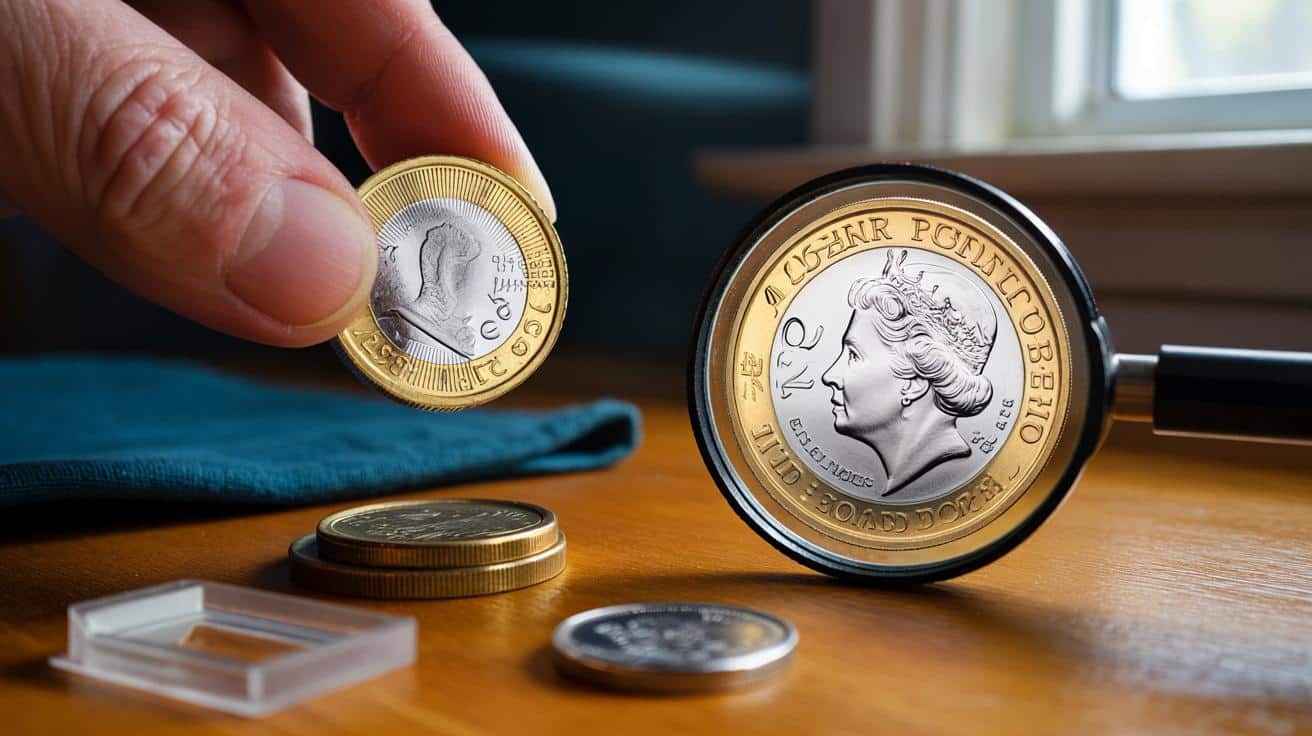
Not for a lost receipt or a linty sweet, but for a £2 coin with a tiny quirk that could turn small change into a small win. A specific “error” is back in the news, with collectors paying serious money for a coin most of us have spent without a second glance.
The bloke ahead of me at the corner shop dropped a handful of coins on the counter, and one £2 landed with that familiar bimetallic clink. He grumbled about bus fares. The cashier slid it into the till and the moment passed, invisible. On the walk home, I kept thinking about it. How many of these little discs swirl through our hands every week, uninspected, underloved? We’ve all had that moment when you realise a thing you’ve owned for ages might be hiding more than face value. I got home and tipped out my change on the table. The kettle hissed. I found my magnifier, even though you don’t actually need one. The secret lives on the edge.
The £2 “error” everyone is hunting
Here’s the headline-grabber: a small batch of the 2014 Lord Kitchener £2 appears to have been struck with the wrong obverse, leading to examples where the usual denomination wording is absent on the portrait side. That “mule” mix-up is what collectors call an error, and it’s the kind that can make sellers smile. Real-world sales have landed near the £100 mark, which is roughly 50 times its face value. Nothing about the design shouts from across the room. The giveaway is a missing word and a quiet edge.
Take the normal coin first. The reverse shows Lord Kitchener pointing, echoing “Your Country Needs You,” with “THE FIRST WORLD WAR 1914–1918” in the ring. Flip it and you’ll usually see the Queen’s portrait with legends including the denomination. On the suspected error, that denomination text isn’t there. A few have surfaced in wallets and coffee jars. Some in circulation look tired; others still carry a clean shine. The oddity has caused a flurry of listings, some chancers, some genuine, some hammered in bidding wars that end north of £80.
Why the fuss? Error coins are scarce by definition. The Royal Mint struck millions of Kitchener £2s for everyday use, so when a mismatched obverse sneaks through, it creates a tiny subpopulation that collectors chase. Scarcity meets a design most people recognise. That’s a sweet spot. And yet not every “missing” bit of text means you’ve found a mule. Worn letters can fade. Weak strikes can look odd. The market judges on clarity, condition, and proof that what’s missing wasn’t simply rubbed off by years of tills and trouser pockets.
How to check your change in 60 seconds
Start with the date: 2014. Look for Lord Kitchener pointing on the reverse. Flip to the obverse and read the legend around the Queen’s portrait. On a regular coin you get the denomination in the wording; on the suspected error that denomination isn’t present. Now tilt the edge to the light. You should see the inscription: “THE LAMPS ARE GOING OUT ALL OVER EUROPE.” Then a quick health check: the coin should be 28.4 mm across, about 12.0 g, and bimetallic with a golden outer ring and silver-coloured centre.
Give it a magnet test. A £2 shouldn’t stick firmly. If it clings like a fridge souvenir, something’s off. Peek for clean, even lettering and no signs of sanding or smoothing. Don’t clean it. Ever. Cleaning kills value faster than a spin in a coin sorter. Let’s be honest: no one actually does that every day. That said, a minute’s glance on the bus home could be all it takes. If you think you’ve got the mule, keep it separate in a little bag and take clear photos in daylight.
There’s a twist to avoid: the 2007 Abolition of the Slave Trade £2 has a version with a smooth, shiny centre from sets that many mistake for an error. It isn’t. And the 2015 Navy £2 with the “extra flag” look is a die clash, not a second mast. Different beast, still decent. Still, focus on the Kitchener coin. Watch for the denomination gap, the crisp edge motto, and honest wear. Yes, the clinky disc at the bottom of your purse might be a tiny lottery ticket.
“A genuine error stands out once you’ve seen a normal coin beside it,” says Mark, a Birmingham dealer who handles hundreds of £2s a week. “The trick is comparison and calm. Don’t force it. Real pieces don’t need a story.”
- Find: 2014 date, Lord Kitchener reverse, clear edge legend.
- Spot: denomination absent on the obverse for the suspected mule.
- Check: weight near 12 g, diameter 28.4 mm, non-magnetic behaviour.
- Keep: no cleaning, store safely, photograph in natural light.
- Verify: compare with a normal 2014 Kitchener coin side-by-side.
Keep it, list it, or swap it?
The market for modern errors is a living thing. Prices move with headlines, fresh finds, and how many land in public view. That means your coin is worth what a buyer agrees to pay this week, not last year. If you love the story, keep it. If you want to sell, browse completed listings, not just hopeful asking prices. Photograph both sides and the edge. Mention the date, the edge inscription, and that the denomination text is missing on the portrait side. A short, honest description beats a wall of hype.
Some go straight to online marketplaces and coin groups. Others prefer a specialist dealer, a fair, or even grading. A slab from an independent service can bring confidence for higher-end pieces, yet it costs time and money. That route makes sense if your coin is sharp and the error is clear. For everyday examples, a fair price and a clean sale can be just as satisfying. There’s also a gentler path: trade it with another collector for something you’ve always wanted. Value isn’t only numbers.
The fun sits in the habit. You start spotting the odd ones. You learn to read an edge like a headline. You notice that small design choices carry big meaning, especially when a line goes missing. That curiosity spills into other pockets of life—tickets, stamps, first editions tucked into charity shop shelves. Coins travel, pick up stories, and return home with new ones. The next time a £2 lands on your palm, pause for a beat and look. The prize is usually patience. And sometimes, it’s profit.
| Key point | Detail | Interest for the reader |
|---|---|---|
| What to look for | Missing “TWO POUNDS” wording on the 2014 Kitchener obverse, with the usual edge legend present | Pinpoints the exact error that can lift value |
| How much it can fetch | Real sales around £80–£120, with outliers based on condition and timing | Sets realistic expectations before listing |
| How to verify fast | Side-by-side comparison, edge inscription check, weight/diameter, quick magnet test | Gives a simple, repeatable 60-second method |
FAQ :
- Is the Kitchener £2 “missing denomination” error confirmed?Examples reported by collectors show the obverse missing the denomination, consistent with a mule. Numbers are unknown, and the market treats clear pieces as genuine until shown otherwise.
- What if the letters look faint rather than gone?That’s likely wear or a weak strike. True error pieces have the denomination wording absent, not just tired. Compare with a normal 2014 Kitchener £2 under the same light.
- Where’s the best place to sell one?Try eBay sold listings for pricing, then list with sharp photos. Coin fairs, specialist dealers, and reputable Facebook groups are solid options. For top-grade coins, consider independent grading first.
- Could mine be a fake?Yes. Watch for plated novelty pieces, wrong weight, and magnetic behaviour. Look for an even bimetallic join and the correct edge inscription: “THE LAMPS ARE GOING OUT ALL OVER EUROPE.” If in doubt, seek a dealer’s view.
- Should I clean it before selling?No. Cleaning scratches and dulls the surface, which kills value. Keep it dry, pop it in a small sleeve or coin flip, and handle it by the edges only.






Just found a 2014 Kitchener in my change after reading this—edge reads “THE LAMPS ARE GOING OUT…” and I can’t see TWO POUNDS on the obverse. Weight shows ~12g on my cheap scale, non‑magnetic. Before I get over‑excited, what’s the best way to prove it’s not just wear? Is a side‑by‑side comparison enough, or should I definately see a dealer first?