
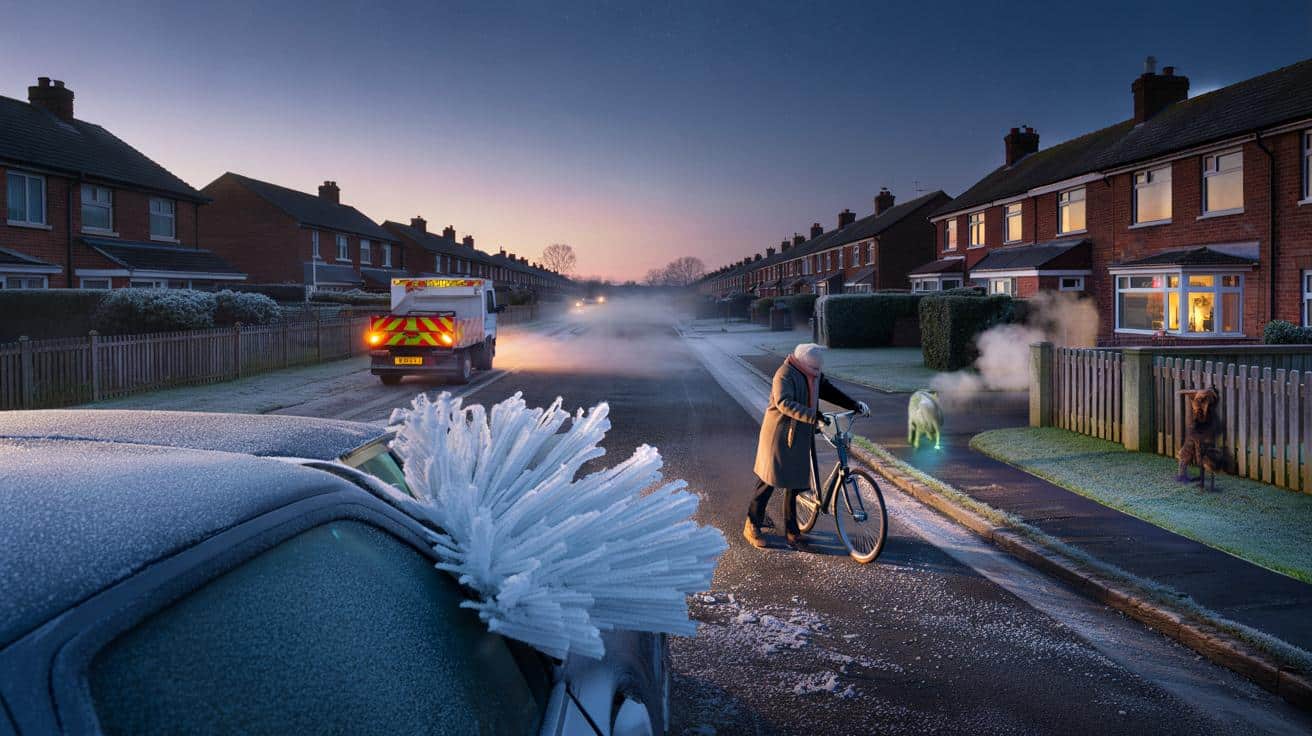
A cold, hard pattern is back. The Met Office has confirmed a run of freezing nights across much of the UK as winter tightens its grip, with widespread frost, pockets of dense fog, and a sharp drop in temperatures once the sun dips. Roads will glitter, lawns will crunch, and the nation will reach for scarves, scrapers and the thermostat. The question isn’t whether it turns cold. It’s how we’ll move through it.
The pavement had that glassy sheen that tricks the eye, and every parked car wore a thin, pearled rind of frost. Somewhere, a kettle clicked to life, and a dog tugged at its lead like this was any other morning.
A radio murmured from a kitchen window: Met Office, widespread frost, icy patches, temperatures below zero for many. A cyclist tested the brakes, thought better of it, and wheeled the bike back inside. The air felt steady and dry; the cold moved in layers rather than gusts. The real chill sat in the quiet.
And the cold hasn’t peaked yet.
Freeze returns: what the Met Office is seeing
Forecasters say high pressure and clear skies will anchor the chill for several nights, flipping evenings from brisk to biting soon after sunset. Urban centres may hover near zero, while valleys and open countryside plunge deeper. Frost and ice will be widespread overnight.
Expect the sharpest lows in northern England and the Highlands, where sheltered glens can shed heat like a sieve. In the south and Midlands, rural strips could slip to -3C or -5C by dawn, with city parks turning crisp white. Rural lows could dip to -6C in parts of Scotland and northern England.
It’s a classic winter setup: a pool of cold air and long nights that let warmth radiate straight to space. Clear skies turn fields into fridges; light winds stop warmer air mixing down. That’s why hedgerows sparkle while terraces a mile away stay damp and dark.
How to get through the snap: warm, safe, and sane
Try a five‑minute evening ritual. Close heavy curtains before dark, roll a towel along draughty doors, and set bedroom TRVs one notch lower than the living room. Bleed radiators, then run the boiler for a short, steady window rather than yo‑yo bursts.
Scrape screens with de‑icer or lukewarm water, not boiling water that can crack glass. Keep a winter bag in the boot: scraper, torch, gloves, a small fleece, a bottle of water. We’ve all had that moment when you thought you’d only be ten minutes. Let’s be honest: nobody actually does that every day.
If pipes worry you, drip the cold tap furthest from the stopcock and open cupboard doors around sinks to share warmth. Drive like the road is reading you back, gentle on steering and brakes, and drop a gear instead of stabbing the pedal.
“Keep it simple: layer up, plan the first ten minutes of your morning, and give the cold the respect it’s due.”
- Layers beat bulk: base, mid, shell.
- Warm the person first, then the room.
- Leave five extra minutes before any morning trip.
- Park facing east to catch the first sun on your screen.
- Check on one neighbour before bed.
What this cold spell means beyond the frost
The UK’s winter rhythm is part weather chart, part memory. Freezing nights shift how we move, cook, commute, sleep. They add a new soundscape: the scratch of a scraper, the shuffle on a station platform, the hum of gritters turning corners at dawn.
There’s also the gap between streets and fields, between terraced warmth and a bungalow at the edge of town. Energy budgets feel the draft first. These nights nudge us to share little things that make a difference: a spare hot water bottle, a lift, a quick text to a friend working the late shift.
In the quiet effort to carry on, you can feel a thread of togetherness pulling tight. Plans change, morning routines stretch, and we learn the tempo of a season that asks us to slow down. Morning travel will be slow and slick in places.
| Key point | Detail | Interest for the reader |
|---|---|---|
| Clear skies, hard frosts | High pressure locks in night-time cooling across many regions | Explains why frost hits even without snow |
| Rural vs urban split | Fields radiate heat faster; towns hold a small warmth buffer | Helps plan morning routes and parking |
| First-light hazards | Black ice on untreated paths, bridges, cycle lanes | Safer commutes and fewer slips |
FAQ :
- How cold will it get?Many places will dip below 0C overnight, with rural lows of -3C to -6C likely in colder spots. Cities may hover around 0C, with parks and riverbanks colder.
- How long will this last?Forecasters expect several freezing nights under high pressure, with a gradual easing when cloud and wind return. The exact end depends on the next Atlantic push.
- Will it snow?Snow needs moisture and lift. Clear, calm nights often bring frost without flakes. If an incoming front meets the cold air, a brief snow window is possible, mainly over hills.
- Are pipes at risk of freezing?Insulate exposed pipes, keep indoor doors open for airflow, and let a distant cold tap drip on the chilliest nights. Know where your stopcock is before you need it.
- Is warming the car on the driveway safe?If you idle, stay with the vehicle and keep it ventilated, watching local rules. Better: start, clear the screen fully, and roll gently to let the engine warm under light load.




Met Office says freezing nights—didn’t they promise a mild spell last week? I’ll believe it when my windscreen turns to glass at 6am. Forecasts are… fickle, definately.
Solid advice about layering and bleeding radiators. Any tips on keeping an old diesel from sulking at -5C? Also, does parking east really help or is that just folk wisdom?