
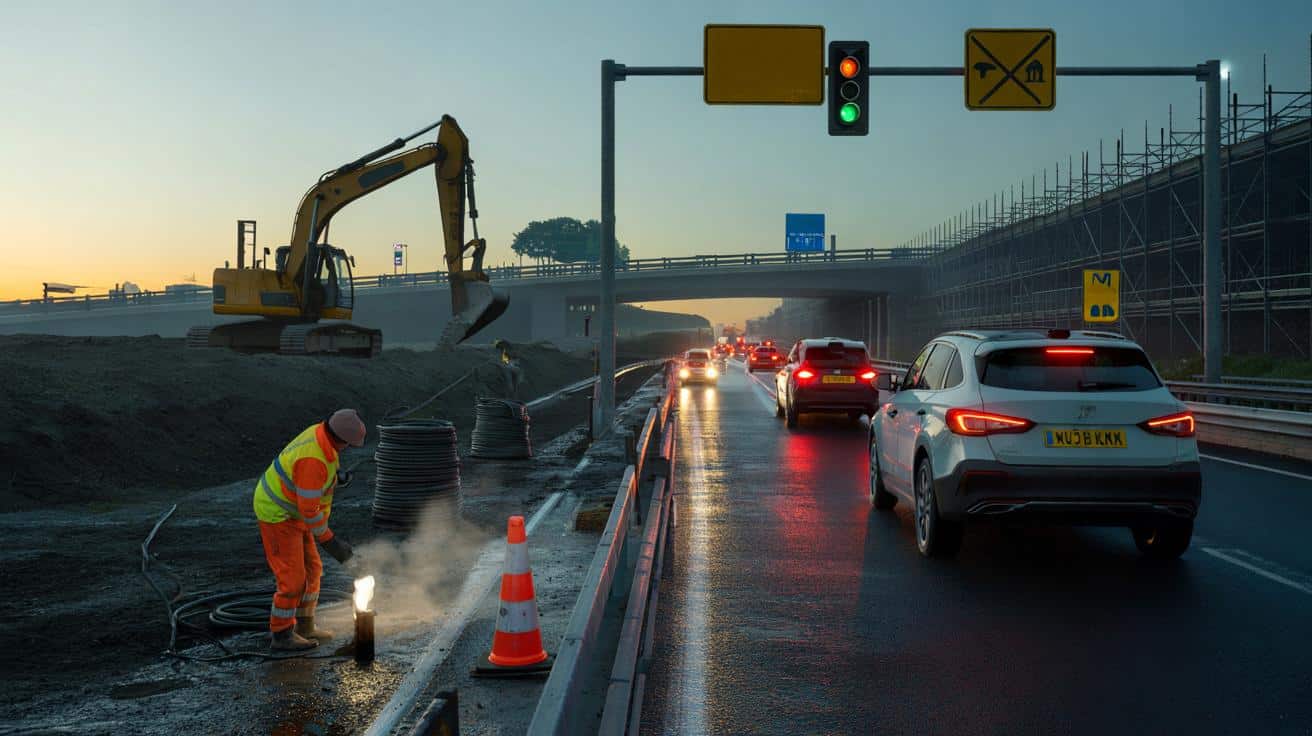
From motorway verges to high streets, a wave of upgrades is starting to bite, slowing school runs, delivery rounds and that last dash to catch the 08:12. The promise: safer junctions, stronger bridges, greener power. The reality, for now: queues, diversions and a nation learning new routes.
Dawn draws a cold line over the dual carriageway as brake lights stack into a neat, glowing ribbon. A hi-vis crew lifts cones with the rhythm of a factory shift; coffee steams from flasks on the tailgate of a pickup. Somewhere up ahead, a drill coughs and a digger lowers its arm, and the radio says “congestion” in that calm way that never matches your pulse.
We’ve all had that moment when the sign flips to “lane closed” and you bargain with the clock. You switch lanes, you rehearse an apology, you stare at the ETA and hope the numbers change. They do. In the wrong direction. The diggers are staying.
What the upgrades mean on the road right now
Across the UK, crews are tearing up tired tarmac, rebalancing junctions that never quite worked, and laying cables for a new spread of rapid chargers. You’ll see average-speed cameras where you used to see hard shoulder, and temporary lights on corners that felt fine until stormwater made liars of them. Delays will ebb and flow, but they won’t vanish this month.
Take Maya, a nurse from Croydon, who now leaves twenty minutes earlier for the late shift because the ring road is a chessboard of cones and narrowed lanes. She tried a rat-run once, met a bin lorry nose-to-nose, and decided the long way was kinder on her nerves. The upgrade is meant to widen a bottleneck by autumn; she’s counting down in podcasts.
Why all at once? Funding windows align, contractors become available, and councils race the weather while daylight runs long. There’s also the invisible stuff: water mains that need replacing before they burst, fibre pulled under pavements before town centres get resurfaced, bridges checked for stress after another wet winter. You feel the jam; you rarely see the spreadsheet that triggered it.
How to shave minutes off a disrupted commute
Pick a primary route and one “plan B”, then stick to that pair for a fortnight. Test both at your real travel time, not on a lazy Sunday, and write down the ETAs you actually get. Turn on live updates from two different apps, but let only one guide you through the last five miles so your brain isn’t pinballed by conflicting turns.
Don’t weave. The lane that looks faster rarely is, and late dives add risk as well as rage. Build a small buffer into any trip with a fixed arrival, even if it’s just eight minutes and a promise of coffee at the other end. Let’s be honest: nobody really does that every day. Try for three days a week and your shoulders will drop.
Think in time blocks, not roads. If the morning is chaos, shift one task to the night before, or move a pickup to mid-morning when the cones sit quietly and the crews take a break. If you can, slide a video call by fifteen minutes and reclaim the breathing space.
“Short-term pain for long-term gain isn’t just spin,” says a transport planner I met by a windswept site cabin. “We’re rebuilding the bits that break our days, not just patching them.”
- Leave at an odd minute (07:13 beats 07:15) to dodge the surge.
- Use “avoid motorways” once a week to map a calmer alternative.
- Batch errands along one corridor, not across town.
- Try park-and-ride on your busiest day; save it in favourites.
The bigger picture, beyond the cones
Zoom out and the story becomes less about onejunction-horror and more about a country refitting itself for the next twenty years. Roads are being strengthened against floods, pavements tamed so buggies and wheelchairs can glide, bus gates stitched in where narrow streets choke themselves. Rail upgrades push more people onto the roads for a few weekends, then give them back faster trains. It’s messy today because the future rarely arrives neatly boxed.
Patience on the tarmac is a civic act. Nobody applauds the crew in the rain at 3am, or the driver who holds back and leaves a gap for the slip-road merge. Yet those micro-decisions are what keep school runs on the rails and small businesses on time. Small choices compound into real time saved.
Maybe you’ll switch a habit and find the journey changes shape. Maybe you’ll tell a neighbour about that hidden cut-through and save them ten minutes twice a week. The upgrades will end. The choices we make while the cones are up might stick around in useful ways.
| Key point | Detail | Interest for the reader |
|---|---|---|
| What’s changing | Resurfacing, junction redesigns, bridge repairs, utility works, new EV chargers | Know why your route is disrupted and what the end state could bring |
| When delays hit hardest | Weekday peaks, overnight closures with knock-on at first light, wet-weather days | Pick smarter travel windows to avoid the worst pinch points |
| Best responses | Two-route strategy, time buffers, calmer B-road options, park-and-ride on key days | Practical steps to claw back minutes and lower stress |
FAQ :
- How long will the delays last?It varies by scheme. Some lane restrictions lift in a few weeks; bigger junctions and bridge works can stretch through a season. Look for weekly updates on council or National Highways pages.
- Why do works often start at the same time?Budgets, permits and contractor slots align, and utilities prefer to coordinate so the road is opened once, not five times. It feels clustered, but it reduces total disruption over the year.
- Are smart motorways expanding?Active plans have shifted toward safety retrofits and targeted upgrades rather than big new smart motorway stretches. Expect maintenance and technology refreshes where systems already exist.
- What’s the best way to plan school-run routes?Test two options at the exact time you travel, then stick with the calmer one. Keep a third back-pocket route for rainy days when everything slows. Share notes with other parents to spot patterns.
- Will public transport be any better during roadworks?Sometimes. Rail upgrades can mean bus replacements on weekends, yet city buses may get priority through temporary corridors. Check live apps the night before and the morning of your trip.







The long-term gains—safer junctions, stronger bridges, greener power—feel worth some pain, and this piece actually explains the why behind the queues. As a daily driver, the two-route strategy is solid advice. I’ll definately try the odd-minute departure instead of lane weaving that just spikes my pulse.
If budgets align, why not stagger starts by area so entire corridors aren’t hit at once? It still feels like every route flips to “lane closed” together. Could we get a public dashboard with dates and dependancies, not just vague “spring” estimates?