
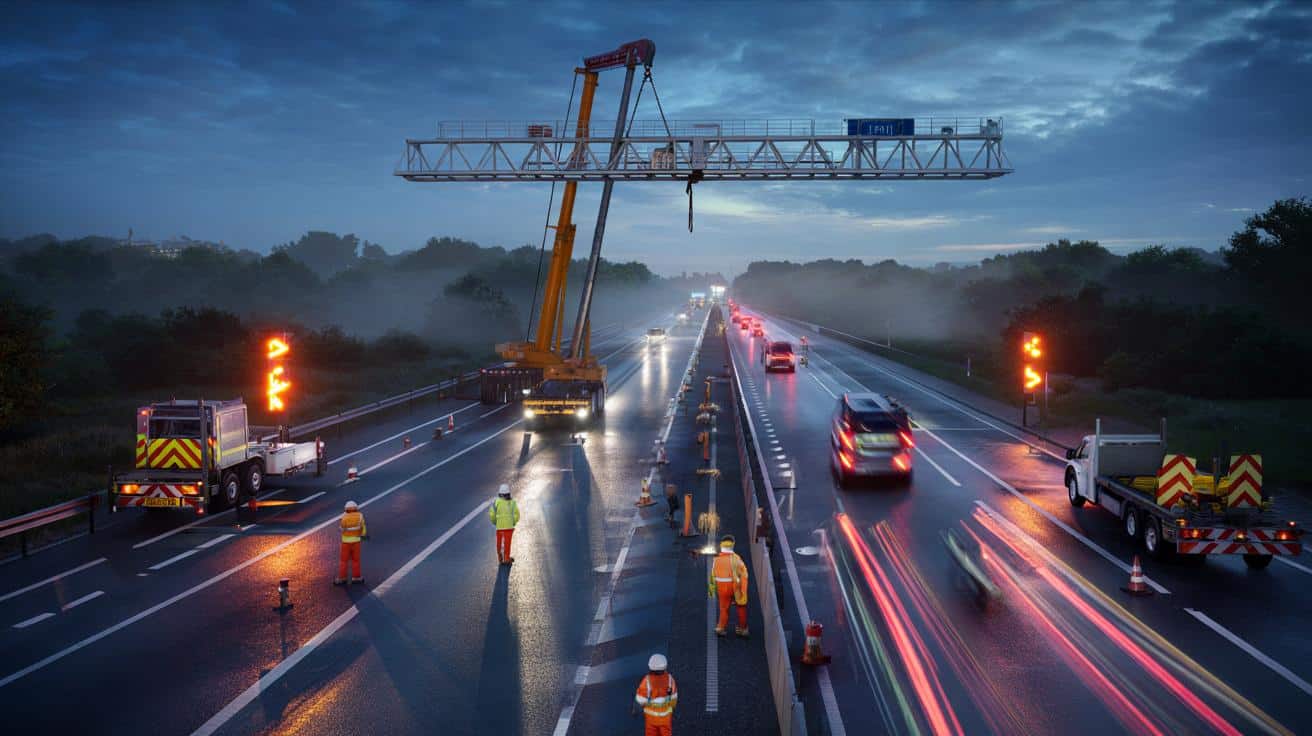
For a run of nights this month, a major stretch will close for essential works that can’t be done with traffic roaring past. It’s the sort of disruption that ripples far beyond the cones, nudging school runs, deliveries, hospital shifts, and late trains.
The first time I heard the closure dates, I was standing in the glow of a forecourt at Cobham Services, coffee cooling fast as brake lights streamed by. People had that darting look you see when plans are about to move a few inches out of reach. A builder in a dusty hi-vis checked his phone, swore gently, then shrugged like a man who’s seen worse on a wet Wednesday. A nurse folded a map she didn’t really need anymore and said she’d go the long way round if she had to. A digital board flashed “overnight closures ahead,” and the tantrum of horns from a junction meltdown drifted in and out like a bad song on FM. We’ve all had that moment where the road decides the shape of your day, not you. There’s a twist coming.
M25 works: where the squeeze is, and why it matters now
The M25 is set to close overnight between Junction 10 (A3/Wisley Interchange) and Junction 11 (Chertsey) on selected dates this month, as part of ongoing upgrades and safety improvements. Crews need full access to lift in new gantries, renew drainage, and resurface lanes that have taken a pounding. Diversions will send traffic via the A3, A245 and local links, with signed routes to keep heavy vehicles away from narrow streets.
On paper, it’s a few hours each night, likely from around 9pm to 6am, plus a pencilled-in full weekend closure later in the month if weather plays nice. In real life, that’s the after-work dash redirected into a puzzle of B-roads and headlights. A Heathrow cabbie told me he’ll swing south early via the M3 when he can. A family in Addlestone has already moved a birthday dinner to the Saturday afternoon slot. The M25 carries north of 200,000 vehicles a day on its busiest sections; even a pinch at night tugs on the whole loop.
Why close it fully instead of keeping a lane open? Because some work isn’t safe at motorway speeds, even with barriers. Lifting steel, drilling deck joints, replacing central reservation sections — these demand space, silence, and a predictable site. Short, intense closures also finish tasks in days that would otherwise drag across months. It’s the trade-off: sharper pain, shorter timeline. *Done right, the payoff is smoother, safer miles for years.*
How to move smarter during the shutdown
Set a personal cut-off for hitting the road before the nightly closure window, even if that means leaving twenty minutes earlier than you’d like. If you’re eastbound, consider the M3–A316–A205 orbit for London-side trips; westbound, the A3 northbound to the A245 and back is the signed shuffle, but the M4 via the A329(M) can be calmer for longer hops. Rail might win for a week: Woking and Weybridge have good late services, and a folding plan beats a late-night crawl.
Don’t just trust one app. Cross-check live traffic with your go-to sat-nav and the National Highways updates just before you set off. Keep an eye on weather too; a sudden band of rain can slide overnight works to the next clear window, which shifts the pinch point. Let’s be honest: nobody does that every day. But on closure weeks, those five minutes of prep can save forty at a standstill. **Small, boring checks turn into big, quiet wins when the cones come out.**
People trip over the same hurdles: leaving at the usual time “to see how it goes,” ignoring the signed diversion because it “looks longer,” forgetting that HGVs funnel onto specific routes and slow everything else. If you can, flex the meeting to Teams, push the gym to morning, nudge the airport transfer an hour earlier. **This isn’t just another lane closure; it’s a temporary rewrite of muscle memory.** Your future self at 11.15pm will thank present you for padding the clock by a notch.
“I’ll take an earlier train rather than take the long way round — it’s one week, not forever,” said Priya, who commutes between Guildford and Staines. “The worst journey is the one you think you can beat.”
- Best window: leave before 8.30pm or after 6am where possible.
- Signed diversion: A3 ↔ A245 ↔ local links between J10 and J11.
- Plan B: M3 or M4 arcs for longer cross-region trips.
- Night freight: expect HGV clustering on designated routes.
- Keep it human: water, snacks, a charged phone, and patience.
What closures like this say about how we travel now
These works aren’t just about swapping tarmac and tightening bolts; they’re a quiet referendum on resilience. The network is older than the cars riding it, and it’s being reshaped while we’re still driving. Climate pressure means bigger drains. Heavier vehicles mean stronger barriers. Crews race the clock while the rest of us race to bedtime.
There’s also the part no signboard can show: how we adapt. One household shares lifts and finds an extra hour of conversation. A florist moves her deliveries to dawn and discovers the roads at sunrise feel like a cheat code. A plumber on a night job keeps a flask in the cab and chooses the A3 over the backroads, because he’s seen what a single tractor can do to a plan. **The motorway doesn’t sleep, but it can be paused.** And in that pause, there’s a chance to rethink the rhythm.
The closure will pass, the cones will go, and the new surface will hum under a thousand tyres before breakfast. What lingers is the memory of how you flexed around it. That, and a reminder whispered by every diversion arrow: the fastest route isn’t always the best one for today.
There’s a strange stillness to a major road when it goes dark. It’s like a city holding its breath between acts. If you drive those lanes every week, you feel it in your shoulders, that slight shift in habit and timing. You might curse, you might shrug, you might discover a side street that becomes a keeper. And then night gives way, cones are stacked, radios click back to music, and the morning takes the space. The closure will test patience and planning, yes. It might also quietly nudge us toward journeys that feel a touch more considered, a touch kinder to the clock. Share what works for you. Your tip might save someone else from a long sigh at a blinking red tail-light.
| Key point | Detail | Interest for the reader |
|---|---|---|
| M25 J10–J11 overnight closures | Selected dates this month, typically 9pm–6am; weather may shift nights | Know when the squeeze hits to avoid late-night gridlock |
| Diversions and alternatives | Signed A3/A245 route; longer trips may suit M3 or M4 arcs; rail for late returns | Pick the route that fits your journey, not just the shortest line on a map |
| Preparation that pays | Cross-check traffic sources; leave earlier; pad time; simple car comforts | Turn small tweaks into big time-savers and lower stress |
FAQ :
- Which section of the road is closing?The overnight closures focus on the M25 between Junction 10 (A3/Wisley) and Junction 11 (Chertsey), part of a wider upgrade programme.
- Will there be a full weekend closure?A full weekend shutdown is pencilled in later this month, subject to weather and progress. Check same-day updates before you travel.
- What time do closures start and end?Expect roughly 9pm to 6am, with lanes tapering down before the hard stop and reopening in stages toward dawn.
- What’s the signed diversion?Traffic will run via the A3, A245, and local links between J10 and J11. HGVs will follow designated routes to protect smaller roads.
- How can I avoid the worst of it?Leave earlier, consider the M3 or M4 for longer cross-region drives, or switch to rail for late returns. Build a little slack into your plans — it’s the cheapest insurance you can buy.







Quick Q: are the overnight closures strictly 9pm–6am, or do lanes start tapering earlier? Wondering if leaving Cobham at 8:40 gets me through, or I’m stuck on the A245 maze.
Rail it is this week. Thanks!