
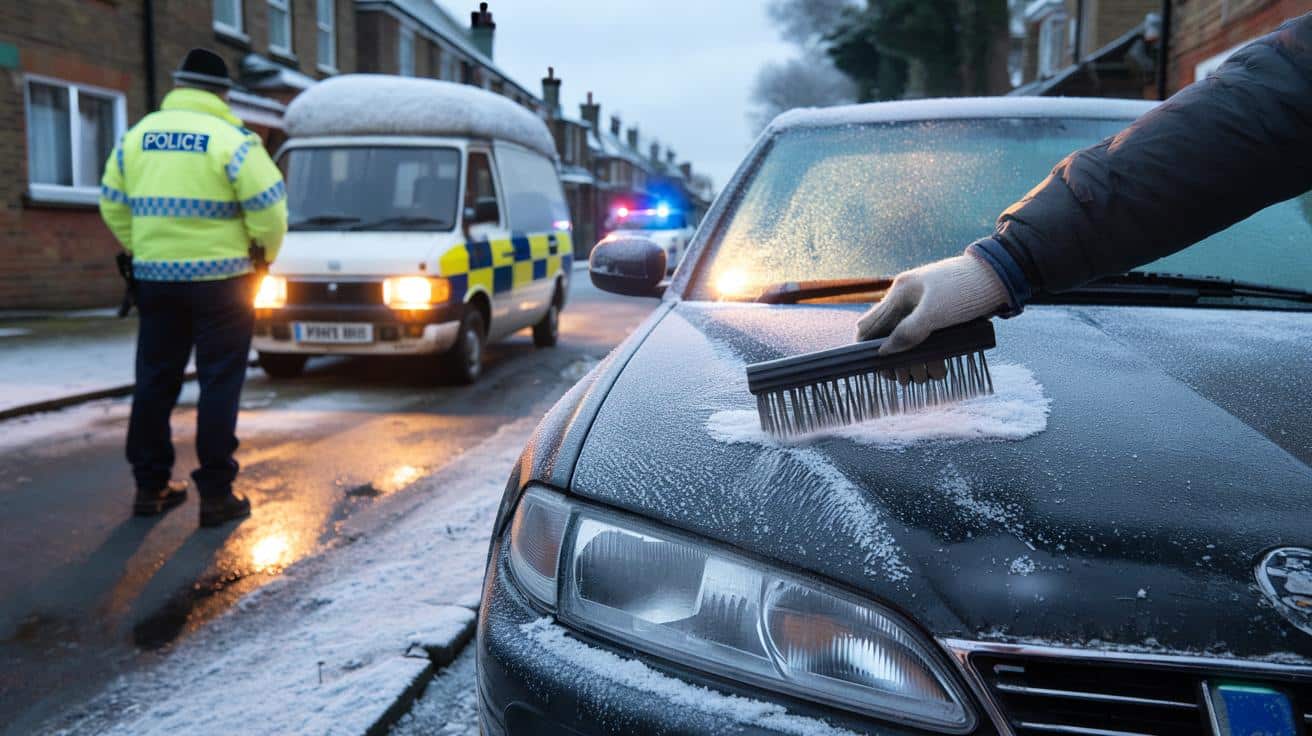
UK drivers are being warned: frost, mist and grimy plates aren’t just winter hassles — they’re fines waiting to happen when you turn the key.
45am, and the street sounded like a chorus of plastic scrapers. A man in a thin coat breathed steam as he carved a porthole in the frost, then glanced at his watch and shrugged. He climbed in, lights on, fan roaring, the world beyond the glass still milky and vague.
Two cars down, another driver wiped a number plate with a sleeve that was already wet through. A delivery van idled, unattended, with the cabin light glowing and its roof piled with snow like a forgotten cake. We’ve all had that moment when the clock beats our better judgement.
It’s the little things that cost you on winter mornings. And the rules are colder than the air.
Frozen glass, real fines: the quiet risk on your street
There’s a clear line in UK law: you must have a full view of the road and traffic ahead. That’s not poetry, it’s Regulation 30 of the Construction and Use rules and Rule 229 of the Highway Code. If you pull away with frosted glass or misted side windows, you’re gifting police an easy stop. In many forces, that can mean a £100 fixed penalty and three points for driving with an obstructed view. Lights and plates matter too. Dirty lenses and unreadable registrations get attention fast, and a plate that can’t be read carries a fine that can rise to £1,000.
On side streets across Britain last winter, community policing teams ran early-morning patrols and social posts with the same message: clear it all, not just a peephole. A Derbyshire driver learned the hard way after officers filmed his “letterbox” windscreen at a junction. He wasn’t aggressive. Just in a rush. He left with paperwork and the sort of red cheeks no heater cures. Another common scene: cars idling unattended on public roads while owners nip inside to “grab the scraper”. That’s an offence in many places, and council wardens are getting bolder about issuing anti-idling tickets.
Why the fuss? A frosted windscreen isn’t just inconvenient; it’s a blindness multiplier. Glare from low sun or headlights bounces off ice, cutting depth perception. You miss cyclists at your flank because the side glass is foggy. Your reaction time stretches by metres you don’t have. There’s also tech in play: ANPR cameras can’t read a salt-crusted plate, and that hobbles enforcement for everything from stolen cars to uninsured drivers. Keep driving like that and you turn a “quick school run” into a legal mess. Winter punishes shortcuts.
De-ice like a pro: a seven‑minute routine that saves fines
Start with the car locked and off. Brush loose snow from the roof first so it doesn’t slide onto the screen later. Use a proper scraper, not a bank card. Spray de-icer along the blade path and the edges of the glass where ice clings hardest. Now start the engine and set the fan to medium, warm but not scorching; recirculation off, so damp air exits. Mirrors, side windows, rear screen: work clockwise so nothing gets missed. Lights on, then wipe them. Finish by cleaning the number plates front and rear until every character pops.
Common traps? Boiling water on cold glass sounds clever until a hairline crack snakes across your windscreen. Wipers on frozen rubber can tear blades, which then smear badly in rain. Leaving an idling car unattended on a public road can attract a fixed penalty from council wardens, often £20 rising if unpaid. On a private driveway, you’re on safer ground, though thieves love a warming car. Snow on the roof feels harmless until you brake; then it slides forward and blinds you, or flies off and hits someone behind. Let’s be honest: nobody really does that every day. But that’s the standard the law expects.
One roads policing sergeant put it to me like this:
“If I can write ‘driver couldn’t see properly’ in my notebook, you’re already fighting uphill. Clear the glass, clean the plate, and I’ll drive past you. It’s that simple.”
- Clear: All windows, mirrors, lights and both number plates.
- Climate: Warm air, medium fan, recirculation off, A/C on to dry the air.
- Timing: Most cars are drive-ready in 5–7 minutes if you start the right way.
- Kit: Scraper, de-icer, microfibre cloth, a cheap head torch for dark mornings.
- Check: Wipers off until the rubber frees, then test jets and lights before moving.
Winter choices, shared roads
Here’s the real tension: winter mornings compress our patience. You’re late, the kids are arguing, the screen fogs again at the first big breath. That’s exactly when mistakes happen, and the law steps in. Fines aren’t just revenue; they’re leverage to nudge habits that keep everyone alive. An unreadable plate, a blizzard of roof snow, a “just a little” frost patch — they’re tiny choices with outsized consequences on a narrow, wet B-road. Friends swap tricks — a towel on the screen overnight, silica gel packs to kill cabin damp — and those rituals become winter armour. There’s a small pride in doing it right, even when your fingers sting. Street by street, the difference between a clean, bright car and a ghostly one is the difference between being seen and being sorry. Share what works, nick a better idea, and carry on.
| Key point | Detail | Interest for the reader |
|---|---|---|
| Clear view is law | Rule 229 and Construction & Use Regs require an unobstructed view; fines and points are possible | Know what police look for and avoid a £100 hit |
| Plates and lights matter | Unreadable plates can mean up to £1,000; dirty lights reduce visibility and invite stops | Two-minute clean that protects your wallet and safety |
| Idling rules bite | Councils can issue anti-idling fines on public roads; unattended warming is a theft risk | Warm the car legally and keep it on your driveway |
FAQ :
- Can I be fined for leaving my engine running to defrost?On many public roads, yes — councils can issue anti-idling penalties, typically £20 if you ignore a request to switch off. On private driveways, the anti-idling rules don’t usually apply, but theft risk rises sharply.
- Do I need to clear the roof as well as the windscreen?Yes. If snow slides onto your screen or blows off and hits others, you could face an offence such as driving without due care or having a dangerous load. Clearing the roof removes that risk.
- What’s the fine for an unreadable number plate?Failing to display a legible plate can lead to a fine up to £1,000. Police don’t need to prove intent — if it can’t be read, it’s a problem.
- Is using hot water on the windscreen allowed?It’s not banned outright, but it’s a bad idea. The rapid temperature change can crack glass. Use de-icer spray and a scraper, then let the heater finish the job.
- Do I need to clear side windows and mirrors too?Yes. The requirement is a full view of the road and traffic ahead and good all-round visibility. If side glass and mirrors are foggy, you’re not there yet.







Thanks for the straightforward reminder. I used to scrape a tiny ‘porthole’ and go, but after getting dazzled by low sun I stopped. My seven‑minute routine now: brush roof, proper scraper, de‑icer on the edges, mirrors last, lights and plates wiped, recirc off so the cabin actually dries. It sounds fussy but it works, and my windsceen stays clear once I set off. Cheaper than a £100 ticket.
Joining the letterbox-windscreen club used to be my winter sport. Now I race the kettle vs the de-icer and the de-icer finally wins 😅 Also, who else forgets the number plate until the last second?