
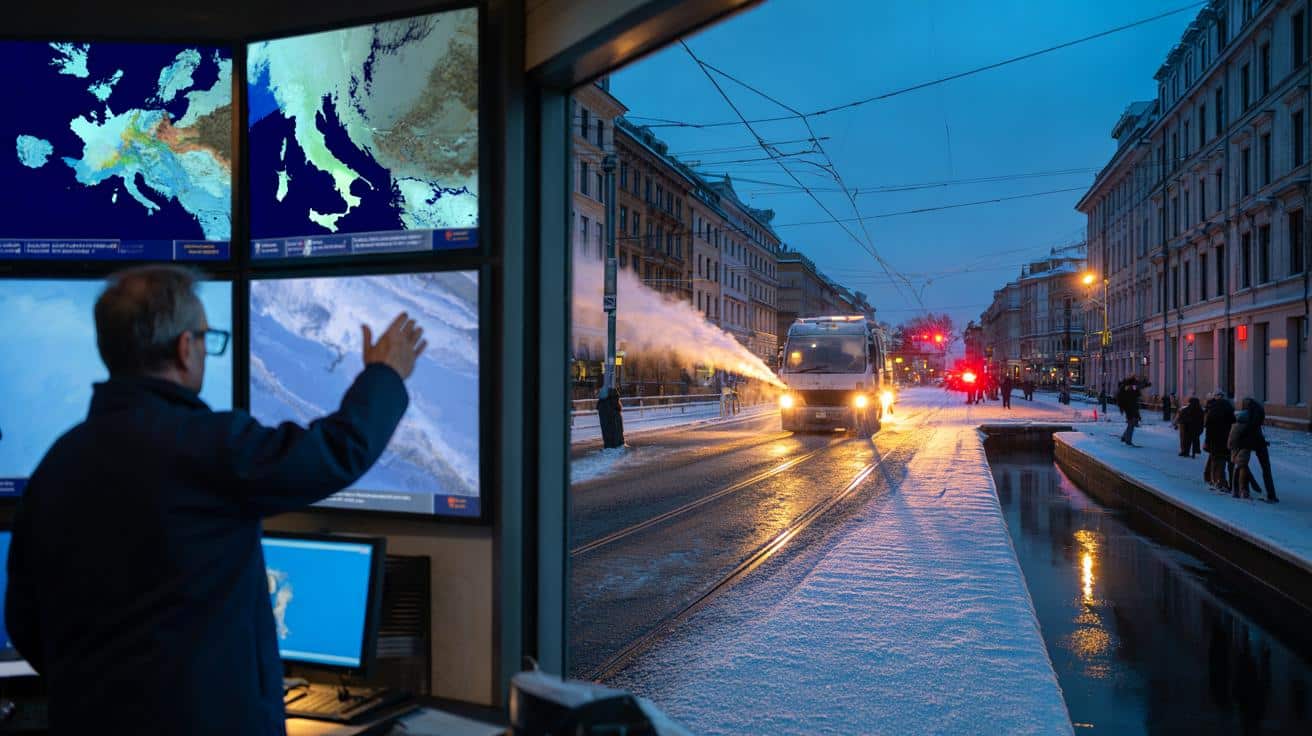
Weather experts are tracking the surge hour by hour, linking satellite loops with ground readings and energy dashboards. The question isn’t if it spreads — it’s how far, how long, and who feels it first.
On a side street before dawn, tyres hissed over salt as gritters made their second pass. Shop shutters clanged, breath hung in the air, and the canal wore a thin skin of ice that crackled when a moorhen tried its luck. It was the kind of cold that makes a city hold its breath. Two blocks away, a cafe owner laid out wet floor signs, not for spills, but for the black ice she could already see forming at the threshold. A weather app on the counter showed the continent glowing cobalt, the freeze fanning south in patient bands. Then the wind turned.
The cold arrives in layers
Watch the satellite loops and you can see it: a broad arc of Arctic air peeling off the pole and falling into Europe like a slow wave. Meteorologists call it an advection of continental polar air, but on the ground it’s simpler — a bite that starts in the lungs and ends in the bones. Forecasters say the air mass is as dense as it gets for midwinter, and it is on the move. In the margins of these maps, tiny arrows show low-level jets transporting the chill along valleys and through gaps in the hills. That’s where the surprise gusts live.
In eastern Germany, train crews talk about the steel singing when temperatures dive well below zero. In the Tatra foothills, farmers watch frost climb fenceposts like ivy, centimetre by centimetre before dawn. Energy grids feel it too, with demand curves that often rise 5–10% during these snaps as households chase a cosy living room. School timetables shift by half an hour to give buses a fighting chance. If you listen closely, winter has a sound: a quieter, tighter city.
Why now? A block has set up over Scandinavia and western Russia, a stubborn high that bends the jet stream and opens the gate from the north-east. Cold pools over Siberia have had days to deepen, radiating heat to space under clear skies, which lets temperatures sink like a stone. When that reservoir connects to Europe, the flow can be relentless. Models from Reading to Offenbach pick up the same signal: the pattern is self-sustaining while the high holds. Once the pressure slips or a low punches in from the Atlantic, the regime can flip. But that flip can take its time.
Living with the snap, not against it
There’s a method that helps. Start with layers: a breathable base, a warm mid, a wind-stopping shell. Cover the gaps around wrists, ankles and neck where heat escapes fastest, and go for shoes with room for air — cramped boots equal cold toes. Indoors, nudge warmth where it counts rather than overheating the whole house: a warmed bedroom before lights out, a living area zoned during the day, curtains drawn early. Pipes love a slow trickle on the coldest nights and a cupboard door left open under the sink. Small things, big difference.
We’ve all lived that moment when you think it’s only a two-minute dash to the shop, no hat needed, no gloves, and then the wind knifes the space between jacket and skin. That’s how you learn about wind chill the hard way. Check pavements that look merely wet — that sheen might be black ice hiding in plain sight. Keep batteries warm, from phones to e-bikes, because cold drains them faster than you expect. Let’s be honest: nobody really does that every day. But deep freezes reward the people who choose boring, repeatable habits over heroic fixes.
Cold snaps also ask for neighbourly thinking, and that starts with simple, shareable routines. Call the person upstairs who keeps the odd hours. Knock once on the door of the gent who walks with a stick. The cold is a community event long before it’s a headline.
“Cold spells don’t just arrive; they’re built upstream for days, then spill south when the gate opens.”
- Keep a small winter kit by the door: hat, gloves, torch, grit, spare phone charger.
- Set a two-minute “warm start” for the car, and clear all windows — not just a peephole.
- Agree a check-in time with a friend, even if it’s just a thumbs-up emoji.
The science, the stakes, the story we tell
This kind of cold doesn’t cancel climate change. It sits inside it. As the Arctic warms faster than mid-latitudes, the temperature gradient that powers the jet stream can weaken, making its path wobblier. That wobble can lock in blocks and feed extremes — heat streaks in summer, cold spills in winter — shifting the odds, not rewriting physics. Cold is never only a temperature; it’s a chain reaction. It tests power grids and rail lines, yes, but it also tests how we plan cities, how we time our mornings, how we look out for each other. Share the map if you like. Share the thermos, too. This front will pass, as all fronts do, and we’ll talk about it later in the pub as if it were simple. It wasn’t. And that’s the point.
| Key point | Detail | Interest for the reader |
|---|---|---|
| Arctic air advection | High pressure over Scandinavia channels dense, dry air south-west into Europe | Explains why temperatures plunge quickly and stay low |
| Wind chill and microclimates | Valleys, river corridors and urban canyons amplify gusts and ice risk | Helps plan safer routes and clothing choices |
| Preparedness beats heroics | Layering, pipe protection and neighbour check-ins reduce harm | Practical steps that prevent costly emergencies |
FAQ :
- How long can a blocking high keep Europe cold?Anything from a few days to a couple of weeks; it lasts while the high remains dominant and the Atlantic stays muted.
- Is extreme cold proof that global warming has stopped?No. A warming climate can still deliver cold outbreaks; it shifts probabilities and can influence jet stream behaviour.
- What’s the difference between air temperature and wind chill?Air temperature is what the thermometer reads; wind chill expresses how wind speeds up heat loss from skin, making it feel colder.
- Why do trains and grids struggle during a freeze?Steel contracts, ice forms on moving parts, and electricity demand rises as heating loads surge, creating a tougher operating environment.
- What’s the simplest way to reduce heating costs in a cold snap?Seal drafts, use heavy curtains early, zone heat to occupied rooms, and lower flow temperature on modern boilers for efficiency.






Strong piece—linking satellite loops, low-level jets, and the Scandinavian block makes the story click; really intresting. But could you include a rough timeline for when the high might decay? The ‘self‑sustaining’ bit is clear, the exit strategy is less so.
My coffee froze before I could sip it 🙂