
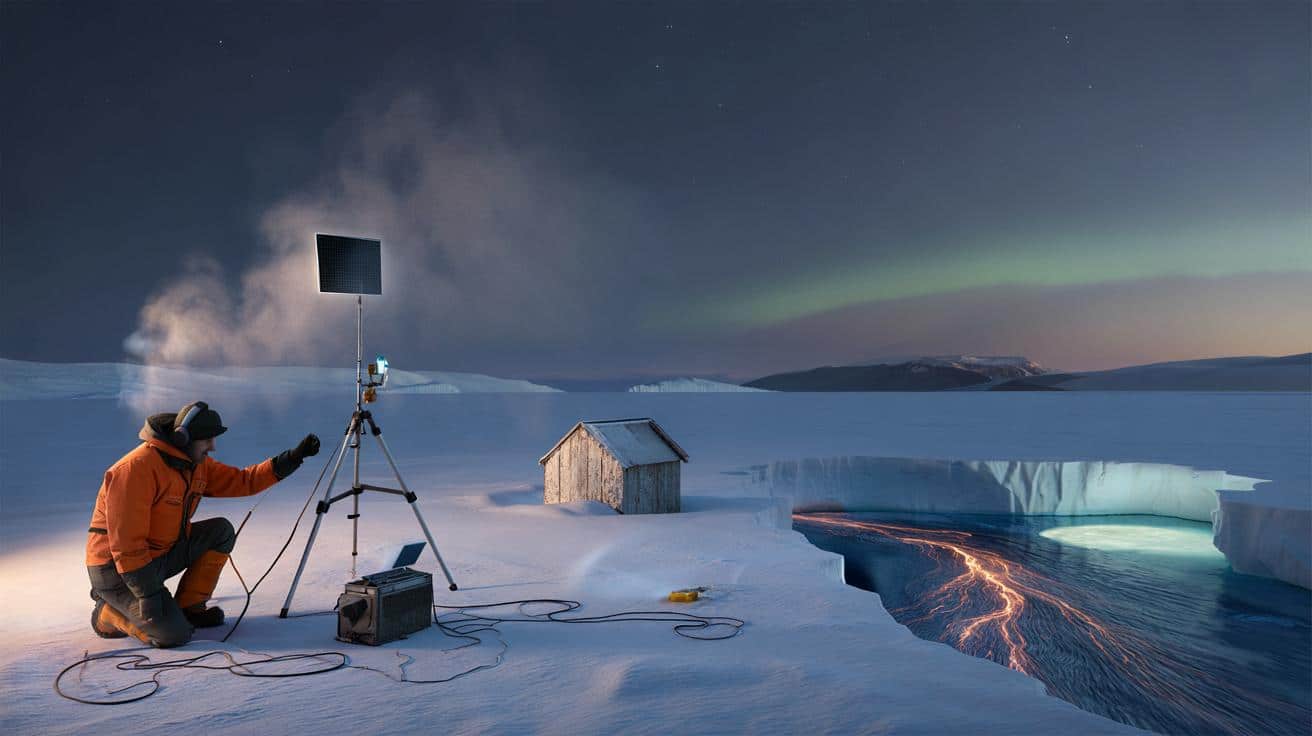
Not just the usual groans and snaps of winter, but long, low rumbles, sudden pressure jolts and the faint signatures of heat where none should be. Scientists are watching the readouts like hawks, trying to decide if it’s water racing, ice shearing, or magma quietly warming a world that looks frozen still.
The wind scratched at the field hut like a restless animal. Inside, a laptop screen pulsed with tiny quakes from far beneath the white horizon, each blip a breath from the dark. A researcher lifted one earcup and squinted at the static, as if listening harder could slow the noise down. The radio cracked to life; a GPS station uprift had just dipped by a few centimetres, then bounced back, like a held note released. Somewhere under our boots, something shifted. Then the ice answered.
The ice below is louder than it looks
Antarctica was meant to be silence, but the sensors disagree. Seismometers are picking up bursts of tremor that arrive in clusters, like whispered conversations under the floorboards. GPS towers sway on their legs as the surface slumps and springs, marking hidden lakes filling and draining in the dark. **The ice is not still; it’s alive.** Each wiggle on a graph is a hint that the under-ice plumbing and the crust beneath are busier than maps admit.
Take the Whillans Ice Stream, a slow monster by day, a sprinter by night. Every so often, the ice suddenly slides a few tens of centimetres in a stick–slip jolt, rattling the crust with a signature thud. Nearby, a subglacial lake has been seen to empty in a rush, dropping the surface by up to a metre across days, then refilling over months. The water doesn’t trickle; it pulses along pressurised tunnels, racing toward the sea under a roof of ancient ice.
These are not random twitches. When basal water pressure rises, ice can decouple from the bedrock, freeing it to lunge forward until friction bites again. Where the crust is thin and warm in West Antarctica, geothermal heat may prime the system, keeping water liquid and the bed slippery. Add tides flexing ice shelves and storms sending ocean swell into cavities, and you get a region tuned to hum. **What happens under West Antarctica will shape coastlines far from the pole.**
How scientists are listening in real time
The watch begins with a web of ears. Field teams bolt broadband seismometers into the snow, shielded from wind, synced to GPS time. Radar from satellites like Sentinel‑1 sweeps the same spots every few days, catching surface shifts that betray action below. If you want to follow along, start with public dashboards: look up CryoSat‑2 for thickness, ICESat‑2 for elevation, and IRIS for station seismograms. A few clicks turn the ice sheet into a live feed.
Reading the noise is part skill, part patience. A long, fuzzy tremor might be meltwater roaring through a hidden channel; a sharp, high‑frequency crack could be crevassing at a shear margin. Wind can masquerade as quakes, and sea ice breaking up can ring like a bell through the shelf. Let’s be honest: nobody really does that every day. Start by comparing multiple stations, then cross‑check with satellite passes from the same week. It feels like detective work because it is.
“We’re not waiting for a single big boom,” a glaciologist told me, rubbing frost from a sensor lid. “We’re watching a chorus swell.”
In practical terms, that means setting alerts for a handful of hotspots and letting the data nudge you, not chase you. Here’s a simple list to keep your eye on next:
- Thwaites Glacier grounding line: retreat steps and flexing patterns.
- Bransfield Strait: tremor clusters tied to submarine volcanoes.
- Pine Island Glacier: shear‑margin rifts and shelf vibrations.
- Subglacial lake cycles: sudden drops in surface elevation.
- Southern Ocean swell: storm‑driven pulses under ice shelves.
What it could mean for the rest of us
There’s a reason this matters beyond maps and microscopes. When subglacial water routes reorganise, ice flow can speed up, thinning shelves that act as brakes. If pockets of extra heat persist in key basins, they can keep that water flowing, nudging glaciers closer to the sea. *This is the sound of a frozen world breathing.* We’ve all had that moment when a map suddenly feels like a story. The unusual activity doesn’t scream collapse; it whispers that the system is sensitive. **Data is moving faster than the ice is melting.** The next big change may start as a small, almost polite tremor.
| Key point | Detail | Interest for the reader |
|---|---|---|
| Subglacial signals are rising | More tremor clusters, lake‑drain pulses and GPS jolts | Helps you spot early hints before headlines arrive |
| Warm spots matter | Geothermal heat and ocean swell amplify hidden flows | Explains why some glaciers respond faster than others |
| Real‑time tools exist | Satellites and public seismograms offer open windows | Lets you follow the story yourself, not just read it |
FAQ :
- Is this unusual activity a sign of an imminent volcanic eruption under the ice?Not necessarily. Some tremor swarms link to magmatic movement, especially around the Bransfield Strait, yet many signals come from water and ice dynamics. Scientists look for patterns across multiple instruments before using the “eruption” word.
- Could these under‑ice changes speed up sea‑level rise?They can contribute. Faster basal water flow and thinning ice shelves reduce friction, which can accelerate glaciers. The effect stacks with ocean warming that undercuts shelves from below.
- How do researchers monitor places no one can reach?They combine satellite radar and laser altimetry with autonomous seismometers, GPS poles, and occasionally boreholes. Ocean robots and moorings listen in cavities beneath ice shelves where ships can’t go.
- Can I view the data myself without specialist software?Yes. ESA’s Sentinel Hub shows radar passes, NASA’s Earthdata hosts ICESat‑2 tracks, and IRIS provides station seismograms in a browser. Many projects, like the International Thwaites Glacier Collaboration, share updates openly.
- Should I treat viral “Antarctica is erupting” posts as credible?Be sceptical and check the source. Look for multiple lines of evidence, timestamps, and context from recognised polar institutes. Sensational claims rarely include the raw plots or the caveats that experts live by.





This read like a thriller—thx for the pointers to Sentinel‑1, CryoSat‑2, and IRIS. It’s rare to see an article that shows how to verifiy the signals yourself; the ice feels alive after this.