
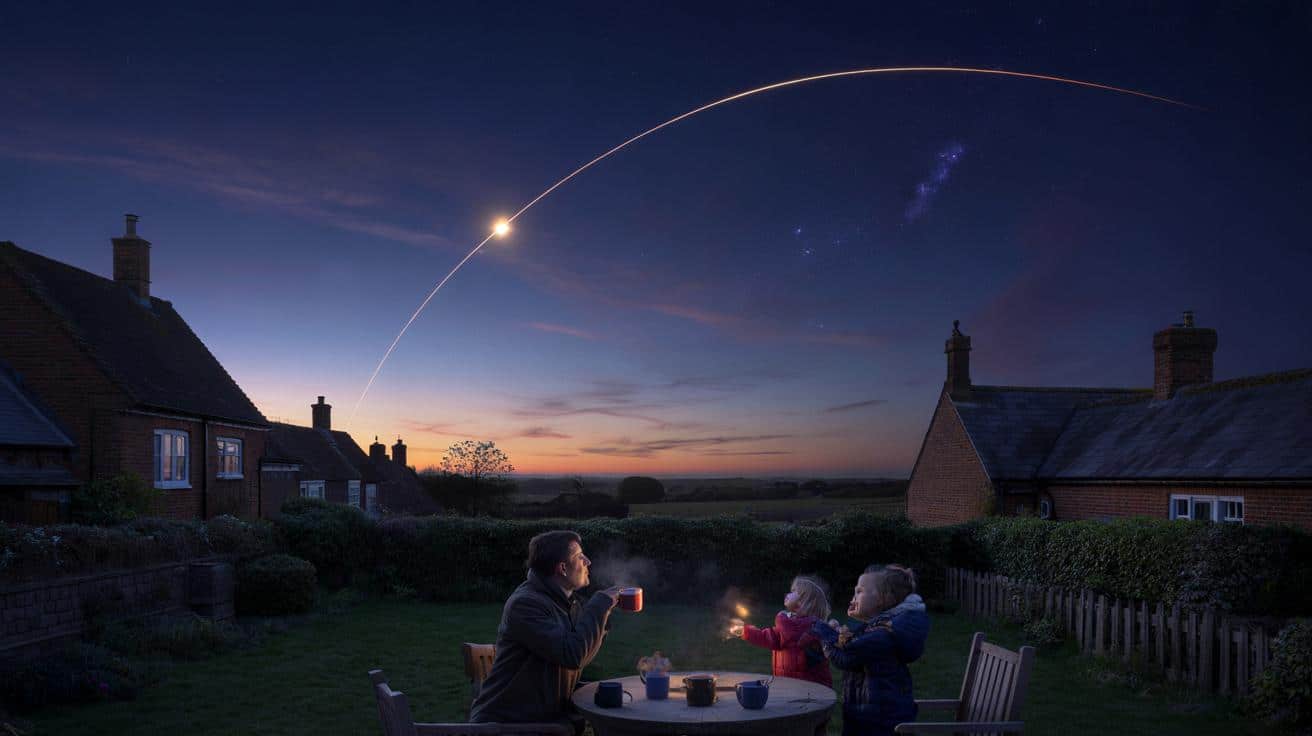
A bright, silent streak will sweep across UK skies this week — the International Space Station making prime-time passes that last only minutes. The trick is knowing when to look up.
A hard, bright point slid above the rooftops, too clean for a plane, unblinking, carving an arc over the neighbour’s chimney as if someone had drawn a ruler through the night. In the hush between passing cars, you could feel the country turning, the faint radio hiss of the A-road drifting over the hedges while that light kept moving, steady and sure. My phone buzzed, the alert I set days ago. There it was — the Space Station, crew awake, windows glowing. You don’t expect to feel part of it. Then you do.
Britain’s best free show: what you’ll see this week
From Cumbria to Cornwall, the ISS shows up like a luminous pebble being skipped across the dark. It glides, it never blinks, and it crosses your sky in two to five minutes, sometimes longer. **It can outshine every star in view, rival Venus, and then vanish as if a dimmer switch was flicked.** That fade is the moment it slips into Earth’s shadow, the sunlight falling away as it sprints on.
At about 420 kilometres up, the station loops the planet roughly every 90 minutes, barrelling along at 17,500 mph. That speed looks gentle from a back garden, which is part of the magic — a fast thing moving slow, the human brain trying to square both truths. In a good pass, the track starts low in the west or northwest, climbs through the south, and drops away in the east. You might catch it skimming past Orion’s shoulder or cutting above the Plough, a celestial photo-bomb you don’t need a lens for.
Why this week? The orbit lines up so the UK gets a run of evening and pre-dawn passes when the station is still lit by the Sun while our ground is dark. Twilight becomes your ally. The geometry means there are clusters of nights when the arc climbs high and bright, then quiet spells when the timing goes awkward. Winter helps for convenient viewing, with early dusk and long throws of darkness before bed. The upshot is simple: this week gives you multiple chances, some high, some low, all brief.
When to look and where to face
The cleanest method starts on your phone. Head to NASA’s Spot the Station or Heavens-Above, pick your nearest city, and check the next visible passes. Focus on ones with a “max height” above 30° and a duration of 3 minutes or more — those are the crowd-pleasers. Set a silent alert for five minutes before, step out, give your eyes ten seconds to settle, and scan low in the west or northwest. **You don’t need a telescope — just a clear view and a bit of patience.**
We’ve all had that moment when the pass time comes and you’re squinting at the wrong bit of sky. Planes will try to trick you with blinking beacons and slow turns, so trust the glide: no flashes, no contrail, just steady motion. Streetlights won’t ruin it, though a darker patch helps. If clouds are scrappy, find a gap and hold it — the ISS can pop in and out like a fish in surf. Let’s be honest: nobody actually sets an alarm for every single pass all year round.
Pick a landmark to anchor your gaze — a rooftop line, church spire, or the top of a tree — then sweep to the right as the minute ticks over. On higher passes, it’ll race through the southern sky and feel almost overhead; lower tracks hug the horizon and can be trickier. If the app says “appears WNW, max SSW, disappears ESE”, give yourself a modest pivot: start west-northwest, track south, finish toward the east-southeast.
“The ISS is the gateway drug of stargazing,” laughs one long-time skywatcher in Derby. “You see it once by accident, then you start timing your evening cuppa around it.”
- Best windows cluster 45–90 minutes after sunset or before sunrise.
- Look for arcs above 30° altitude for the brightest, longest views.
- Planes blink; the ISS does not. Satellites drift; the ISS moves with intent.
- Cloud gaps matter. So does a clean view of your western and southern horizons.
Share the moment, keep looking up
There’s a hush that falls when a small group steps outside and looks the same way. Kids get it at once: the light is moving, and it means people are up there. If you want to make it a memory, give the pass a tiny ritual. A hot mug on the step. A countdown from ten. A phone photo won’t capture it well, which is almost a relief. Not everything needs a screen to be real. You could bring a map of the constellations and trace the path with a finger, then swap stories about places you’ve flown over, or wish you could. The station becomes a postcard from orbit, written in light, signed by strangers who feel oddly close.
| Key point | Detail | Interest for the reader |
|---|---|---|
| Timing | Use NASA Spot the Station or Heavens-Above; aim for passes 45–90 minutes after sunset | Gives you a clear window so you don’t miss the short show |
| Where to look | Start low in the west or northwest, track high to the south, fade toward the east | Makes the arc predictable, even for total beginners |
| What you’ll see | A bright, unblinking “star” moving fast, often brighter than anything else | Helps you tell the ISS from planes and slow satellites |
FAQ :
- How do I find exact times for my town?Use NASA’s Spot the Station or Heavens-Above, enter your location, and note the next visible passes with max height and duration. Many UK weather apps also list ISS alerts.
- Which direction does the ISS travel over the UK?Common tracks start in the west or northwest, arc through the south, and head east. The path varies by pass, so follow the “appears / max / disappears” notes in your listing.
- How long does a pass last?Typically 2–6 minutes. Bright, high passes feel quicker because there’s more sky to cross overhead, yet they’re the most striking.
- Can I see it from a city or under light pollution?Yes. It’s bright enough to punch through urban glow. Thin cloud can scatter light, but gaps work wonders.
- Is it the same as Starlink trains?No. Starlink appears as a line of dots soon after launch. The ISS is a single, steady, bright point. **If it flashes regularly, it’s a plane.**




Can’t wait to show the kids tonight! Set my Spot the Station alert and I’ll be scanning WNW a few minutes early. Thanks for the clear tips—no telescope needed, just patience. Sky-watch cuppa ready 🙂
Does it really get brighter than Venus over UK skies, or is that a bit of journalistic sparkle? I’ve chased a few passes that were barely there. Any specifics on mag for the upcoming evenings?