
A draught that doesn’t belong. One homeowner’s curiosity pried up the past and revealed a forgotten room under his lawn — the kind of find you can’t stop thinking about once you’ve seen it.
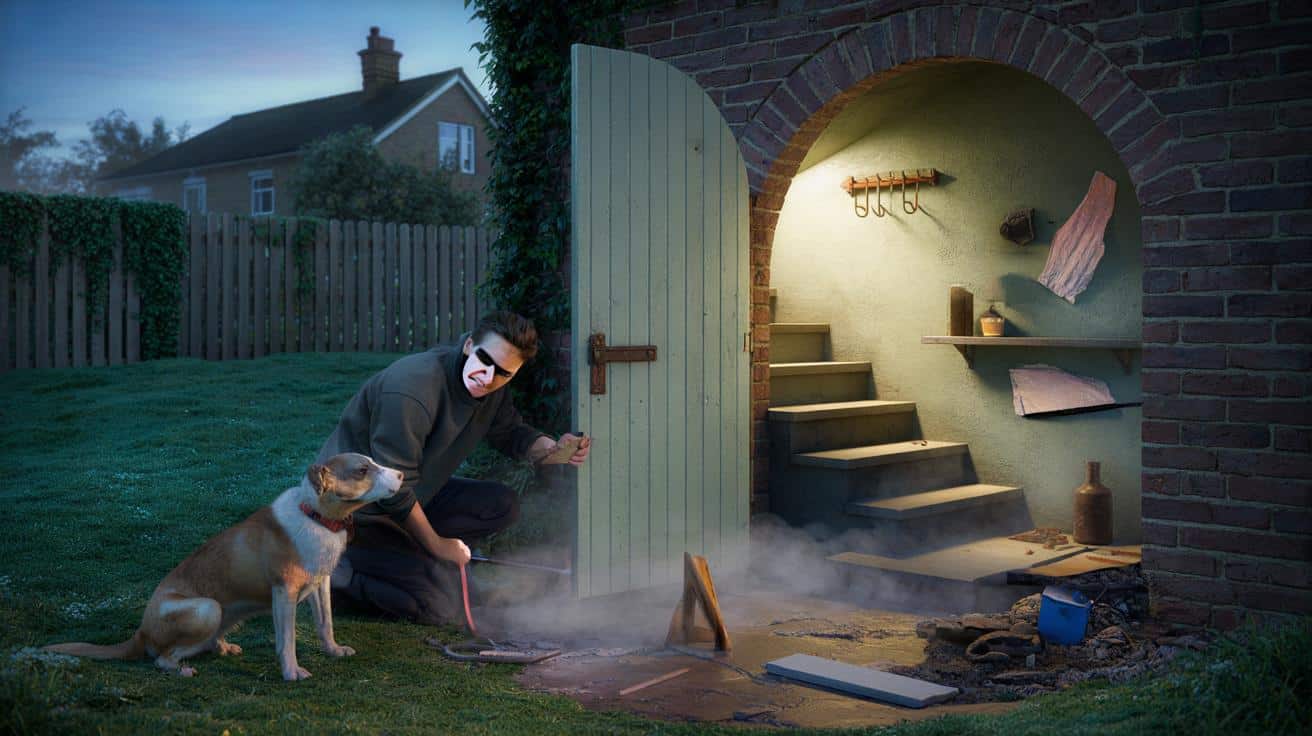
It began with the dog scratching at the same pale rectangle by the back steps, morning after morning, as if the stone itself had a pulse. Mark Ellison knelt, pressed his ear to the slab, and heard something that isn’t a backyard sound — the soft, hollow echo of space. He levered the stone with a paint-stained pry bar, and the garden exhaled: cold air, clay damp, a smell like winter fruit cellars and mothballs. A brick arch blinked awake. Spider-silk shivered on iron hinges. Ellison’s phone torch caught the first three steps descending into a curved room where the temperature dropped five degrees in a breath. He looked at his wife; they both laughed like teenagers caught out. Something was down there.
A buried room and a rush of cold air
Ellison’s torch beam turned and caught a ceiling like the inside of an old teacup: mottled, domed, hand-laid. There were hooks set into the walls, a ceramic shard, a brown bottle wearing a corset of dust. Not rubble. Not a service void. A room with purpose. He stood at the threshold and felt the human scale of it — someone had come here with a basket, a lantern, a plan to keep things safe and cool long before the plug socket. The garden he’d mowed for years was, all along, a lid.
His surprise isn’t rare, only rarely spoken about. In Greater Manchester, a couple found a brick-lined tunnel last spring that led to a cramped chamber with benches; their estate agent thought it was a bin store. Down in Kent, a family uncovered a perfectly preserved dome behind a privet hedge, packed with straw and slate shelves. Plenty of Britain’s 5.8 million pre-1919 homes carry quiet extras — old wells capped with carpentry, coal holes, little arched nooks for ice. We think we know our plots. The ground keeps its own counsel.
What Ellison found likely had a straightforward name once. An ice pit to stretch summer. A root cellar to keep carrots crisp and cider honest. In some streets, it’s a **wartime shelter**, bricked shut when the sirens stopped and nobody wanted to look at fear any more. These spaces fall out of deeds and family talk as houses change hands, gardens are levelled, and the last person who knew the steps by heart moves away or passes on. Paperwork is tidy. Memory is not. That’s how a domed room becomes a myth until a dog scratches and a pry bar squeaks.
What to do the moment you find something
First move: pause. Take wide shots and close-ups before you poke, and note the exact spot on a quick sketch or your phone’s map. Prop the opening for ventilation without forcing doors or pulling bricks; a wedge of timber and a length of rope can be your best friends. Hold back from going in. Test the air from above with a handheld CO monitor if you have one, and toss in a handful of flour or talc to see how air moves. Phone your local council’s Building Control and ask for guidance, then look up your county’s Historic Environment Record to register the find. A curious day is easier when it’s also methodical.
We’ve all had that moment when excitement sprints ahead of judgement. People tap at mortar, drop down a step, and post a “Look what I found!” reel before they’ve even taken a breath. Easy mistake. Slow is kind. Your garden isn’t going anywhere. Beware of hidden services that have drifted from old maps: water, a live cable, a forgotten oil line. Watch out for the ground around the opening — it can slump. Let’s be honest: nobody really checks the deeds for Victorian voids every year. Put a temporary cover on the hole that a child or fox can’t shift, and then call in a pro.
Ellison spent the first hour being the caretaker of a mystery, not the hero of a dig. That mindset matters; you protect the story by protecting the structure. He rang a local archaeologist and a damp specialist, and he kept his feet on the grass while he waited.
“People imagine treasure chests,” says Dr Amelia Hart, a community archaeologist in Dorset. “The treasure is continuity — the way a **hidden chamber** speaks to the house above it.”
- Take photos, note location, and cover the opening securely.
- Ventilate gently; avoid entering until air quality is checked.
- Contact Building Control and your Historic Environment Record.
- If there’s any sign of gas, fuel, or unstable walls, call a professional immediately.
Why these buried spaces still matter
There’s a reason the air feels different down there. It carries the habits of people who lived by seasons rather than screens, who built small technologies into the earth because the fridge hadn’t been invented yet and fear had to be made manageable. A **Victorian icehouse** is a design lesson in passive cooling. A brick shelter is a study in community engineering and stubbornness. These structures sit between architecture and folklore, stubbornly present, stubbornly out of sight. They are not just “old rooms”; they are work, fear, thrift, and the kind of ingenuity that doesn’t shout.
Your takeaway doesn’t have to be a dig. It can be the thought that your plot is layered, that your fence posts hold a theatre of old lives, and that curiosity can be a kind of care. Share the story with neighbours. Ask the oldest resident on your street what they remember of cellars and trapdoors. *You might find the map you need is a conversation.* The ground is not a void. It is a book with a few damp pages, still legible if you read slowly.
| Key point | Detail | Interest for the reader |
|---|---|---|
| Pause and document | Photograph, sketch, and secure before stepping in | Protects safety and preserves the site’s story |
| Call the right people | Building Control, Historic Environment Record, local specialists | Turns a surprise into a supported, legal discovery |
| Think beyond “treasure” | Icehouses, cellars, and shelters reveal past lifestyles | Connects your home to the wider history under your feet |
FAQ :
- How do I tell if it’s an icehouse, cellar, or shelter?Look at shape and fittings: domed or bottle-shaped chambers with hooks and shelves suggest storage; narrow entrances with benches and blast walls point to wartime shelters.
- Could entering be dangerous?Yes. Risks include bad air, loose brickwork, hidden wells, and live services. Ventilate, test air if possible, and wait for professional advice.
- Do I need permission to explore or restore it?If the structure is listed or part of a scheduled monument, you’ll need consent. Even if not, speak to Building Control before alterations.
- Will this affect my home insurance or property value?Sometimes. An intact historic feature can add charm; a hazardous void can add cost. Inform your insurer and keep records of expert assessments.
- What if I find artefacts inside?Leave them in place for initial documentation. Photograph, note location, and consult your local museum service or archaeologist before removal.






This reads like a ghost story—love the detail about the cold air and the domed ceiling. Please update after the archaeologist’s visit! If it’s an icehouse, the hooks and shelves make perfect sense; if it’s a shelter, those benches might still be there. Either way, fantastic find.
Are we sure it’s not just a service void? Hooks and a dusty bottle don’t automatically mean « purpose ». Did anyone check the Historic Enviroment Record or old drainage maps? Photos can be missleading.