
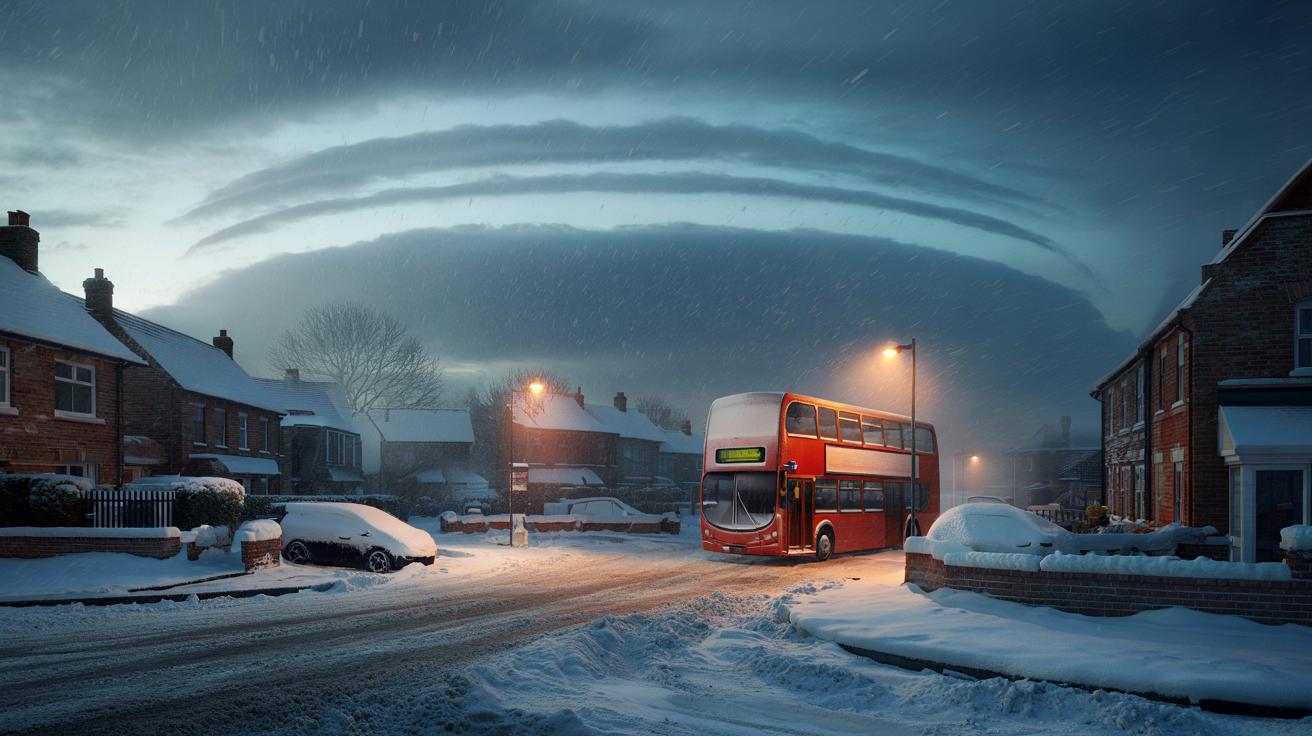
A rare atmospheric chain reaction is lining up across the Arctic and North Atlantic, and the early signals point to the kind of snow that rewrites winters. Forecasters are watching a “triple‑polar” setup that could funnel deep cold and explosive snowfall towards the UK. The real question people keep asking: is your postcode on the list?
The air had that metallic edge you taste before a storm, and the streetlights caught a slow, suspended mist, like a held breath. We’ve all had that moment when the sky feels like a ceiling about to drop, when even the pigeons sit quiet on the ledges, and you think, right, this is different.
What the “triple‑polar” setup really means
Think of three locks clicking at once: a shaken stratospheric vortex, a Greenland block, and a Siberian air feed. When these align, the jet stream kinks, pressure flips, and Arctic air can spill south in slabs, not dribbles. *This is the kind of setup that turns drizzle into drama.*
The stratosphere is the high‑altitude steering wheel, and recent disruptions there ripple down like a slow‑motion wave through the atmosphere. On the ground, a stubborn high near Greenland corrals storms, forcing them on a colder, more southerly track. **That’s when the UK becomes the crossroads where Atlantic moisture meets polar cold, and snow happens fast.**
In plain terms: cold air first, then a moisture‑rich low, and the overlap zone is where the big totals land. Altitude amplifies everything, which is why hills and moors feature early on the watchlist. Lower towns can flip from sleet to proper snow in a single band if the cold undercuts at the right moment.
Signals, stories, and the maps that matter
Early‑stage model clusters from the big hitters — think ECMWF and GFS — are showing more members favouring a Greenland block and a northerly feed. That doesn’t “guarantee” your street turns white. It does load the dice for a multi‑day cold spell with embedded snow bands that can stall over the same places. **Some postcodes could see disruptive snow depths within hours.**
There’s a pattern to who hits the jackpot first. Highlands and Cairngorm corridors, Pennine spines, Lake District passes, Peak District edges, Welsh uplands, and the South‑West moors. Then, if the cold digs in, big flakes start visiting lower ground — the kind that cling to wheel arches and stop buses at roundabouts. One winter in ten delivers that view from the kitchen window where the world turns monochrome between breakfast and lunch.
Why “heaviest in 20 years”? It’s not hype if the three locks hold. A clean northerly fetch, a blocking high that won’t budge, and a conveyor of moisture are the ingredients behind the legendary UK dumps people still talk about. Climatology says these line‑ups are rare, but when they do arrive, totals double on high ground, and drifting makes a nonsense of simple centimetre counts.
How to read your risk — and what to do with it
Start with altitude, then exposure, then track. Find your place on a contour map: 150–200 metres is the tipping zone, 300–400 metres moves you into “sticking fast” territory. Overlay that with likely bands from north or north‑east, and understand that coastal strips can flip either way if the air mass only just clears the dew point. Winds swing, bands stall, and that’s where the totals suddenly spike.
Next, think microclimate. Valleys trap cold air and sharpen ice risk; west‑facing slopes grab the fattest flakes on a north‑westerly; urban heat can delay settling by an hour then lose the fight at dusk. Grit your steps, charge the torches, and keep the car kit boring and useful: scraper, blanket, flask, shovel, phone power. Let’s be honest: nobody actually checks their emergency kit every day.
Here’s the part you came for: a living watchlist, built from altitude, exposure, and current model trends. It’s not a promise; it’s a nudge to get ready before the band is on your street.
“Cold finds the cracks. Snow finds the stories.”
- Scottish Highlands and Grampians: IV2–IV4, IV13–IV14, PH15–PH26, AB31–AB36, DD8–DD9, KW14 uplands
- Central Belt fringes and Trossachs: FK17–FK21, G63 high ground
- Lake District and Cumbrian Fells: CA9–CA12, LA22–LA23 passes
- Pennines and Dales edges: DL8–DL11, BD22–BD24, HX7, OL3–OL5, S36
- Peak District rims: SK17–SK23, S32–S33
- Northumberland high routes: NE19, NE48
- Snowdonia and Cambrian spine: LL24–LL41, SY18–SY25
- Moors of the South‑West: PL20–PL21, TQ13, EX20–EX21
- NI uplands and Mournes: BT31–BT34
What to expect next — and why this could travel
If the air mass keeps its bite and the block stays stubborn, snow bands start to wander. That’s when commuter belts and coastal towns get their moment, often with a wet thump that turns to powder as temperatures fall through the afternoon. **Lower levels may flip from rain to heavy, wet snow in short, violent bursts.**
Road crews will chase the bands, not the map. Trains slow, schools make case‑by‑case calls, and small businesses pivot to the kettle and the WhatsApp group. Soyons clairs: disruption doesn’t need record totals — it needs a bad hour at the wrong junction.
Forecast confidence lives in windows, not weeks. The three‑day window is where detail sharpens: where the pivot lines set up, how sea‑surface temperatures shave the edge off coastal snow, which valley ends up under the streamer that just won’t move. No list is perfect, but this is your early warning map in words.
Where this leaves us — and where you come in
Maybe this fizzles. Maybe it roars. The story of a rare “triple‑polar” winter is written in small choices households make before the first flake, and in the quiet collaboration of neighbours once it arrives. Share the watchlist, check on someone who won’t read this, and keep an eye on the official warnings as they tighten. The most surprising thing about big UK snows isn’t the depth, it’s how quickly ordinary streets become their own weather worlds. Tell us what you see from your window when the band arrives, and we’ll build the picture together.
| Key point | Detail | Interest for the reader |
|---|---|---|
| Triple‑polar setup | Stratospheric disruption, Greenland block, Siberian feed align | Explains why this event could deliver outsized snowfall |
| Postcode watchlist | High‑risk prefixes across Highlands, Pennines, Dales, Peaks, Wales, SW moors | Quick way to gauge local risk without a degree in meteorology |
| Actionable window | Three‑day horizon sharpens track, altitude zones trigger sticking | Helps time decisions on travel, school, and home prep |
FAQ :
- What exactly is a “triple‑polar” event?A shorthand for three cold‑favouring drivers aligning: a disturbed polar vortex, a blocking high near Greenland, and a northerly/siberian air feed into the North Atlantic.
- Could this be the heaviest snow in 20 years?It’s on the table if the three drivers lock and moisture overlaps the cold; the ceiling is high, yet outcomes vary street by street.
- Is my postcode guaranteed snow if it’s on the list?No. The list highlights higher odds, especially with altitude and exposure. Local factors can flip the outcome either way.
- When will confidence jump?Inside 72 hours. That’s when model clusters converge, pivot lines sharpen, and warnings usually upgrade.
- Where should I check for live updates?Start with the Met Office warnings page and your local council’s grit/road updates, then add trusted radar apps to watch bands in real time.








Great explainer. Quick Q: at 180m just outside SK17 with a NE exposure, are we likely to see settling or will urban warmth delay it? Any guidence on the Tue/Wed window for travel, or should I shift plans 24hrs earlier?