
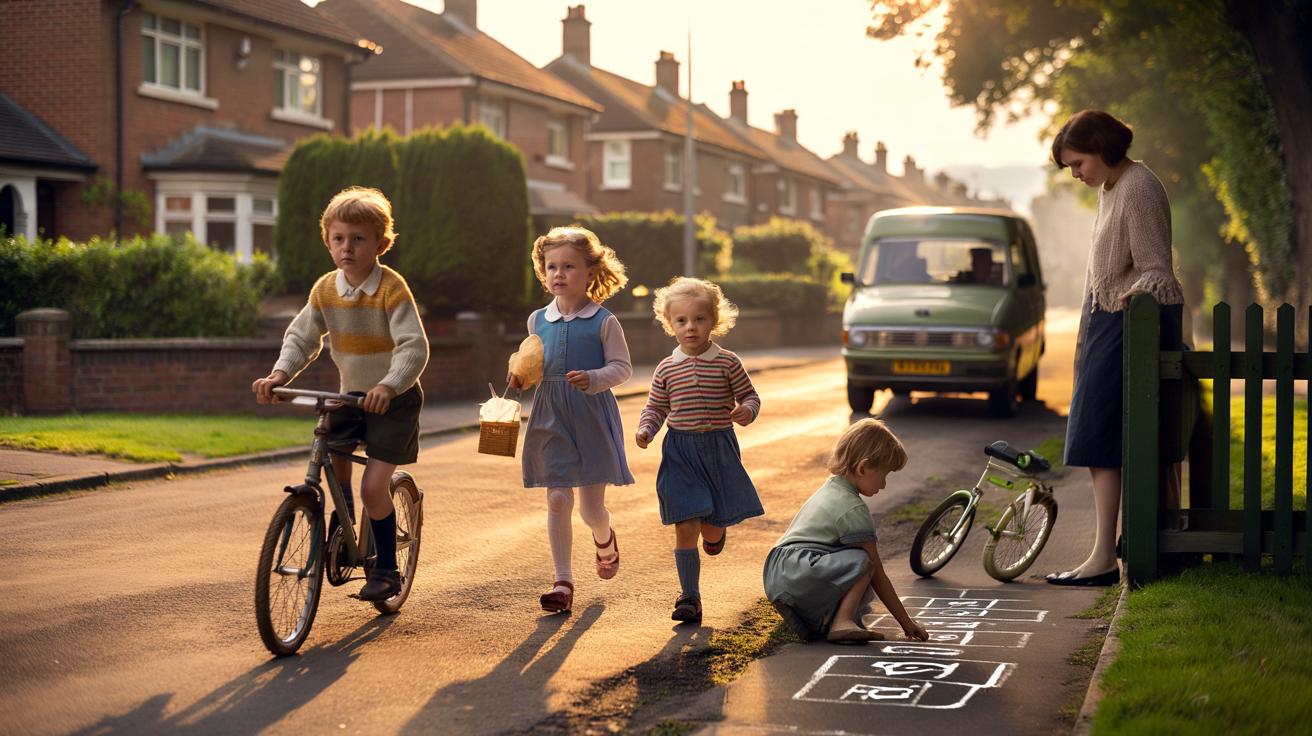
Yet teachers whisper about shrinking attention spans, and parents quietly wonder when resilience slipped out of the room. Scientists point to a simple habit many British households practised without thinking in the 1960s. It wasn’t a hack or a gadget. It was a daily rhythm.
The cul-de-sac was still warm from the day, the tarmac giving off that soft evening scent. A neighbour in a cardigan leaned on his gate and told me about 1969: bikes dumped on grass, knees scabbed, someone’s mum calling “Tea!” into the open air, and a ragged pack of children sprinting home from somewhere undefined. He didn’t say “independence”. He just said, “We roamed.” A delivery van rolled past us. No children. Only glowing lounge windows and the low blue hum of cartoons. Across Britain, the after-school soundtrack has changed, and so has childhood’s shape. Older people remember the carefree bits; younger ones remember the anxieties. What if the old shape still fits?
The 1960s habit we quietly abandoned
Here it is in one sentence: kids used to spend long stretches outside in their own company, with loose rules and light-touch oversight. **They walked to school, knocked for friends, invented games, and got themselves home.** The point wasn’t risk for risk’s sake. It was practice. Practice making tiny calls, reading a street, sorting out a squabble, deciding when the game stops. In research language, that’s executive function and autonomy. In ordinary language, that’s learning how to be brave without an audience.
Talk to someone who grew up in Leeds, Liverpool, or Llandudno in the 60s and they’ll tell you the same story with different streets. “We were out after breakfast, back by tea.” Survey data back that memory in broad strokes: far more children walked or cycled to school then, and independent “roaming distance” was larger by many postcodes. Public health studies keep linking that free play and active travel with stronger mental health, social skills, and self-regulation. A classic paediatrics report even called play “a fundamental building block” of development. The science sounds fancy. The scenes were scruffy.
Why does this make kids feel unstoppable? Because independence grows in the gap between “I think I can” and “I did”. The brain wires itself through practice under mild stress, not lectures. When children judge a puddle jump, navigate a corner shop, or take turns at the park without a referee, they learn to calibrate risk and recover from small stumbles. **Grit is not a personality you hand down; it’s a muscle built through many tiny, voluntary challenges.** Researchers studying “independent mobility” repeatedly find ties to confidence, persistence, and even better sleep. It’s not magic. It’s mileage.
How to bring it back, safely, on your street
Start with a “freedom ladder”. One small rung at a time. Begin with micro-errands inside the home block: posting a letter, taking the bin round, picking up milk with a sibling. Then add timing and territory. Ten minutes to the green and back, with a simple check-in rule. Draw a neighbourhood map together and mark safe spots, friendly doors, and “turn-back” lines. **Set the boundary, then step back.** You’re building competence, not testing them. Confidence follows competence, not the other way round.
Common snags happen in our heads. You picture every worst-case headline and forget the millions of uneventful journeys that knit a child’s sense of “I can”. We’ve all had that moment when the silence feels too long and your thumb hovers over the phone. Breathe. Keep the steps small and predictable. Pair up with a neighbour so kids move as a cluster at first. Let’s be honest: nobody does this every day. Try twice a week. Celebrate the boring. If something wobbles, dial back one rung, not the whole ladder.
Community matters here, not in a grand way, but in quiet nods at the gate and a WhatsApp group that isn’t panicky.
“Resilience isn’t taught from a sofa; it’s absorbed from doing,” says one developmental psychologist I spoke to. “Give children frequent, low-stakes chances to act without an adult solving every bump.”
Think of these as simple, repeatable “freedom reps” that fit real life:
- Knock-for-a-friend Fridays: 30 minutes of doorstep-to-doorstep play.
- The Mini-Market Mission: choose and buy one item with a list and a coin purse.
- School Gate Shuffle: walk the last 400 metres without an adult shadow.
- Park Perimeter Rule: stay inside the railings; meet back at the bench at 5:10.
- Bus Two Stops: ride with an older sibling, then alone when ready.
You’re creating muscle memory, not a stunt.
The ripple effects you’ll notice — and the ones you won’t see yet
You might spot obvious changes first: easier bedtimes, sunnier moods after school, fewer crosswords about screen time because there’s somewhere better to be. The subtler shifts take a season. Friends become collaborators rather than spectators. Little arguments don’t melt into tears as fast. A child returns with a story you didn’t witness and you learn to say, “Tell me more,” not “Why didn’t you…” That’s the power move. It’s strange and lovely when your child starts to carry their own story home. Unstoppable isn’t loud. It’s steady. It’s the kid who misses the kerb, rights the wobble, and tries again, almost without thinking. And yes, it’s you, learning to trust that good things grow in the small spaces where you aren’t in charge.
| Key point | Detail | Interest for the reader |
|---|---|---|
| Independent outdoor play builds resilience | Unstructured time boosts self-regulation, risk calibration, and confidence | Understand why “free time” isn’t wasted time |
| The freedom ladder | Step-by-step independence: micro-errands, defined zones, timed check-ins | Practical method to try this week without drama |
| Community safety net | Friendly doors, simple rules, light-touch neighbour coordination | Make it feel doable even on busy streets |
FAQ :
- Isn’t this risky?All childhood carries risk. The aim is “little-and-often” challenges, not reckless leaps. Start small, set clear limits, and expand gradually.
- What if we live in a flat or a dense city?Use stairwells, courtyards, and short street loops. Create fixed rendezvous points. Corner shops and libraries make brilliant micro-destinations.
- What age is right to begin?Think skills, not birthdays. If a child can follow a two-step instruction and cross a quiet road with you, they can start the first rungs.
- What about neurodivergent children?Break tasks into smaller chunks, rehearse routes together, and use visual maps. Independence is still the goal, the path just looks more tailored.
- Other parents think I’m careless. How do I handle that?Share your ladder approach and boundaries. Invite a trial walk. Most worries soften when people see the structure.







Loved the focus on “freedom reps.” We’ve become referees instead of spotters. Trying the Freedom Ladder this week—post a letter, then the park perimeter rule, tiny steps. Thanks for the concrete ideas; “confidence follows competence” really lands. Wish us luck! 🙂
Isn’t this just nostalgia dressed up as science? Streets are busier, phones distract drivers, and fear isn’t baseless. Do you have recent UK data on injury rates vs independent mobility, not just 60s memroies? Also, how do you handle unsafe neigborhoods where “friendly doors” aren’t guaranteed?