
Today’s parents juggle calendars, permission slips and location-sharing apps, yet feel oddly powerless. The kids look spotless, the timetables hum, the anxiety lingers. Scroll any forum and you’ll find it: a quiet envy of the 1960s childhood — scrapes, chores, roaming, grit. Did that “old school” upbringing forge something we now miss?
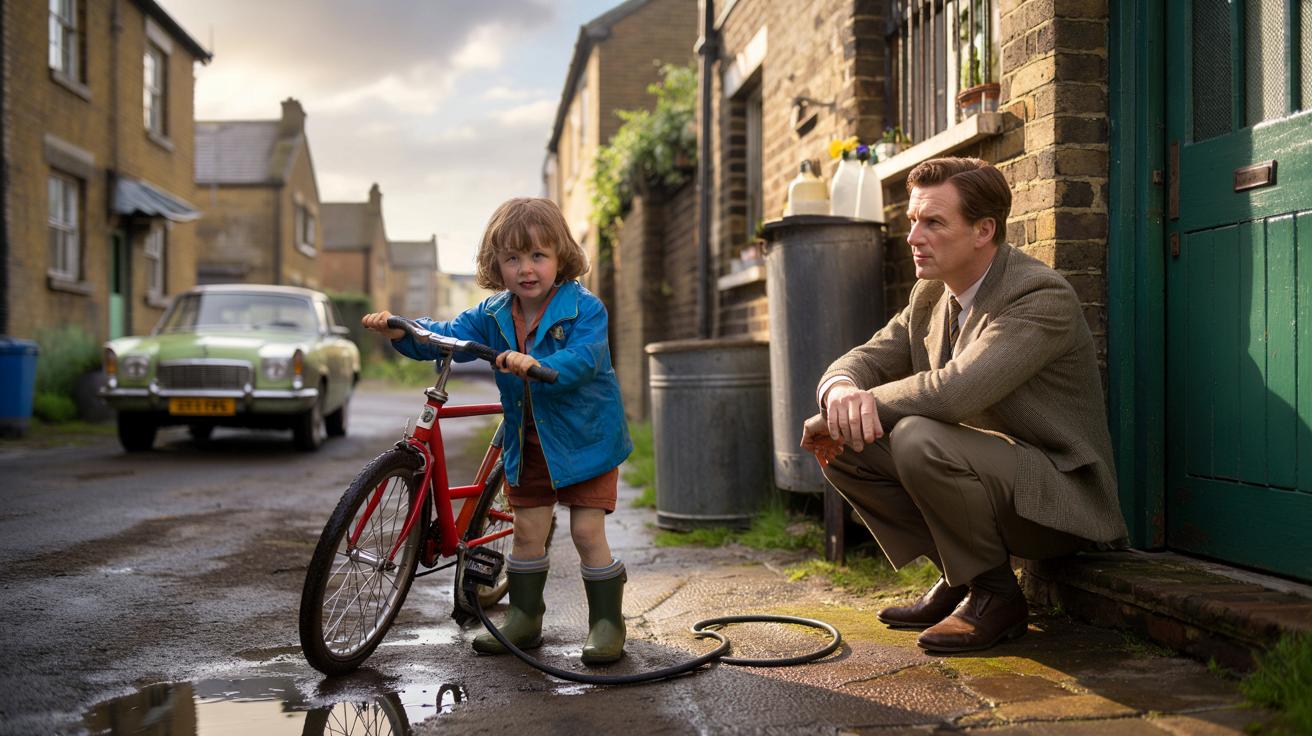
His dad leaned on a wall, arms folded, saying almost nothing. Ten minutes later the tyre hissed back to life, the boy’s grin wider than the alley. No stickers. No speech. Just a little win that would sit in his bones.
We’ve all had that moment when the urge to step in is magnetic. You see the wobble, the falter, the tears about to come. Yet you hold back, and they find their feet. Something changes.
That small decision — the one not to rescue — is the old-school secret in miniature.
The texture of “old school” childhood
Walk into a 1960s kitchen and you’d see chores hung on the fridge with a magnet and a radio murmuring the news. Kids were expected to peel carrots, post a letter, knock for a neighbour, navigate boredom. Parents were not life coaches. They were parents. The rhythm wasn’t chaotic, just less curated. Childhood was allowed to be slightly inconvenient, slightly scruffy, slightly brave.
Ask a grandparent and they’ll tell you the same story with different streets. “Mum said back by tea. We made dens.” In UK surveys across recent decades, children’s independent roaming distance has shrunk to a fraction of what their parents enjoyed. Fewer solo trips, fewer errands, more lifts. Add screens to the mix, and the day fills without any real friction. Quiet comfort wins, but at a cost we feel but don’t name.
Resilience grows where stakes are small and consequences are real. Psychologists talk about “desirable difficulties”: just-hard-enough tasks that stretch without breaking. The 1960s delivered those by default. You cycled in drizzle, you spoke to a shopkeeper, you fixed what you broke. Modern childhood strips these micro-struggles away with admirable care and unintended side effects. Childhood isn’t meant to be a frictionless app.
Borrowing the best bits without time-travelling
Start with micro-freedoms. Give a task with a clear outcome and zero commentary: “Pop to Mrs Khan’s with this note,” or “You’re on pasta and plates tonight.” Keep it age-appropriate, local and repeatable. Build a ritual of “solve-then-show”: they try first, then ask for help. If it’s safe, let natural consequences teach quickly — missing gloves equals cold hands tomorrow. Small discomfort, big lesson.
Watch for the rescue reflex. The shoe lace you can tie blindfolded, the email you could write in two minutes, the squabble you could referee from the doorway. Pause. Count to ten. Ask, “What’s your plan?” or “How will you fix it?” Be warm, not hovering. Let’s be honest: nobody actually does that every day. When you blow it, name it: “I jumped in too fast — your turn.” That humility lands harder than any pep talk.
The point isn’t toughness for its own sake; it’s competence that calms the nervous system. Kids who complete small real tasks bank proof that they can handle life. That bank is resilience. As one retired PE teacher put it:
“My mum didn’t raise me to be fearless. She raised me to be useful. Fear got quieter after that.”
- One errand a week: same route, same shopkeeper, growing confidence.
- Chore ladder: master one job before adding another.
- “Ask three, then me”: try three fixes before calling a parent.
- Open-window boredom: twenty minutes with no screen, every day.
- Rough weather walks: drizzle is a teacher, not a warning sign.
What the 1960s got right — and how to adapt it now
There’s a myth that old-school parenting was all bark and no hug. Plenty of it was warm, just quieter. Affection lived in packed lunches, a wink across the pitch, a blanket left on a sofa. You can keep your bedtime stories and still give space for struggle. Blend clear rules with roomy afternoons. Set anchors — mealtimes, sleep — then let a little chaos in between. The mix builds spine and softness.
Tech is the other elephant. Screens steal the friction that builds resolve. You don’t need to bin them. Use them like a spice, not a sauce. Rotate “make, mend, move” hours into weekends: bake a loaf, patch a sock, cycle to the park. Free-range can mean a block radius or a seat at the front door with a book while they scooter in loops. Safety isn’t the enemy of independence; it’s the guardrail.
Old-school didn’t mean careless — it meant trusted. Trust grows when adults do less and watch more. Start local, start small, start today. If you’re city-bound, trade distance for repetition: the same lift buttons, the same shop queue, the same “good afternoon” to the porter. Those tiny civic acts wire confidence into the body. They also stitch kids into a community that sees them, which is its own kind of safety net.
| Key point | Detail | Interest for the reader |
|---|---|---|
| Micro-freedoms build resilience | Age-appropriate errands, chores and solo problem-solving create safe, repeatable stress that strengthens coping skills. | Simple tweaks to daily routines can reduce anxiety without grand overhauls. |
| Natural consequences teach fast | Let the small discomfort land — late homework means a chat with the teacher, not a midnight rescue. | Fewer battles, more lessons that stick, less emotional load on parents. |
| Blend warmth with watchful distance | Consistent affection plus space to struggle mirrors the best of 1960s homes. | Kids feel loved and capable, not micromanaged or left adrift. |
FAQ :
- Was the 1960s really safer for kids?Different risks, fewer cars in some areas, fewer screens everywhere. Today can be safe too with local routines, known adults and repeated routes.
- How do I start if my child is anxious?Tiny wins. One-minute jobs, clear praise for effort, and the question, “What helped you do that?” Let momentum do the heavy lifting.
- What about busy families with no time?Fold resilience into what already happens: laying the table, calling the dentist, paying at the till. No extra clubs needed.
- Does “old school” mean strict punishments?No. It means real responsibility matched to age. Consequences come from life, not just from parents.
- How do I handle screens without a war?Set screen-free anchors — meals, first hour after school, last hour before bed. Swap scroll time for “make, mend, move” blocks.






Honest question: are we measuring resilience or just nostalgia? Survivorship bias is huge — the kids for whom “micro-freedoms” went wrong aren’t writing about it. How do we balance small risks with today’s traffic and online harms? I like the “solve-then-show” idea, but I’d love data beyond anecdotes.
My dad called everything “character building” — cold showers, flat tyres, burnt toast. Turns out he was running randomized controlled trials on me 🙂 Thanks for the “Ask three, then me” mantra; stealing it.