
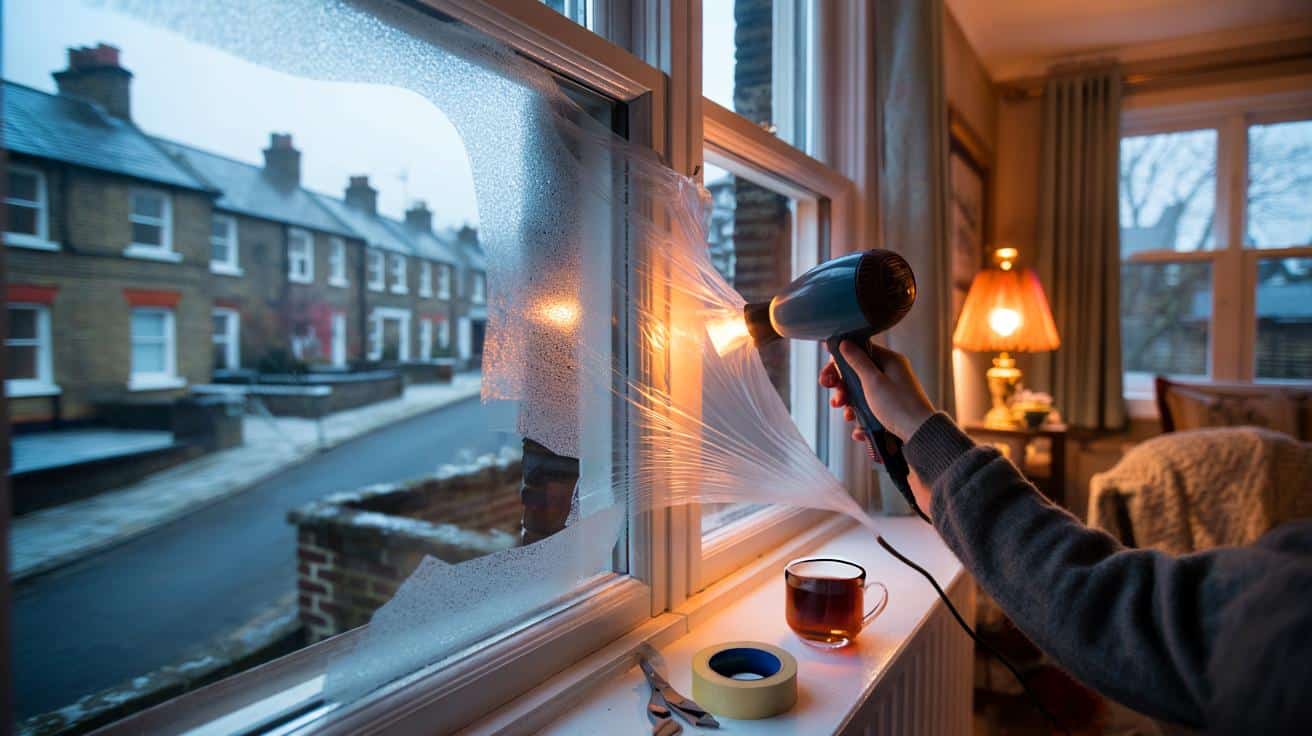
You can feel the draught before you see it: a cold lick under the curtain, the kind that turns a cosy night into a shiver. There’s a quick fix almost nobody talks about — a near-invisible film that costs around 20p a pane when you buy a multipack — and it can lock in warmth like a second skin.
On a raw November evening in Birmingham, I watched a mother tape a clear sheet over her living-room window while her kids stacked Lego forts nearby. The film crinkled, the kettle clicked off, and the radiator stopped its frantic churn. We’ve all had that moment when the room feels warm for once, and you want to freeze time — not your toes. She pulled out a hairdryer, the plastic tightened like drum skin, and the draught vanished as if someone had shut a secret door. Then came the odd part. The room sounded quieter too.
The 20p trick that turns thin glass into a warmer wall
Most British homes leak heat through their windows, even with decent double glazing. Glass is just not great at holding warmth, and tiny gaps around frames act like unseen chimneys. **Stop overpaying for heat.** A lightweight, transparent “secondary glazing” film — the kind you shrink with a hairdryer — can create a still-air pocket that works like an extra pane. It’s renter-friendly, nearly invisible from a distance, and it peels off in spring without drama.
I tried it on a Victorian sash in Manchester that rattled in a stiff breeze. I’d been bleeding cash into the night and blaming the boiler. After fitting the film, my cheap digital thermometer stopped yo-yoing. The room crept from 17.2°C to 19.4°C within an evening, with the thermostat set lower than usual, and the whistling seemed to exit the scene like a bored extra. It felt like putting a lid on a pan.
There’s a simple reason it works. Heat escapes by conduction through glass and by convection through gaps; the film adds a sealed layer of air, slowing both. In an average UK home, around 10–20% of heat loss can be through windows, which means even a small improvement pays back fast. The hairdryer step isn’t just for looks — it shrinks the sheet smooth, cutting ripples that would stir the air and cooling the effect. Think of it as a budget version of triple glazing, without the invoice.
How to do it today (and get actual warmth tonight)
Grab a roll of window insulation film (the kind sold in winter aisles or online), double-sided mounting tape, scissors, and a hairdryer. Wipe the frame dry. Run tape around the inner edge of the frame, press the film gently against it, then trim the excess. Now the satisfying bit: switch the hairdryer to warm and sweep across the film from centre to edges. It tightens, ripples fade, and a clear membrane appears. That’s your heat shield.
Work with patience and cut a piece a little larger than the frame. Start at the top edge so gravity doesn’t fight you. If you’ve got blinds or curtains, mount the film on the frame rather than the glass so you can still draw them. Let’s be honest: nobody really does that every day. If you want to open a window, leave one sash unfilmed or peel and reapply in spring. It’s not surgery. It’s a Saturday job with a cup of tea.
A few common snags are easy to avoid. Don’t tape onto damp paint or dusty wood, or the adhesive will sulk. If you spot wrinkles after shrinking, pass the hairdryer like you’re toasting a marshmallow — slow and steady, not full blast. This is the little hack your future self will thank you for.
“I spent £5 and cut it to size across four windows. The living room stopped feeling like a bus stop, and the boiler ran less. It’s not magic — it’s physics you can feel.” — Maya, Leeds
- Cost: from ~20p per pane when bought in multipacks or by the metre
- Time: 10–15 minutes per window, including a neat trim
- Best for: single glazing, leaky sashes, north-facing rooms
- Bonus: dampens street noise and cuts window condensation drips
- Removal: peels off cleanly when the heating goes off in spring
What to expect once it’s up (and what to do next)
The first thing you notice isn’t a number. It’s the feel. The corner chair no longer sits in a pool of cold, and the curtains don’t shiver when a bus passes. The thermostat stops climbing in tiny guilty nudges, because the room finally holds onto the heat you’ve already paid for. One homeowner told me her nightly “extra half-hour” of heating simply vanished after filming the bay window. That’s real money.
Then there’s the knock-on effect: less condensation crawling down to soak the sill. The warmer inner surface means fewer morning wipe-downs and less chance of sneaky mould. If you rent, this is gold — no drilling, no quibbling with deposits, and the kit looks neat if you take your time. **It’s the closest thing to a reversible upgrade.** And it pairs beautifully with thick curtains, draught excluders, and a tweak to the thermostat schedule so the boiler doesn’t sprint then sag.
Want numbers? Expect a small but meaningful reduction in boiler runtime, especially on windy nights. Even a 1–2°C boost in perceived comfort can let you drop the thermostat a notch, which compounds savings over weeks. **Warmth you can feel, savings you can count.** If you’re the data type, snap a photo of your smart meter at 6 p.m. today and again next week with the film up. Keep the routine the same. The quiet shift in kWh often tells the story better than any advert.
A small sheet, a bigger shift
There’s something quietly defiant about a 20p fix that embarrasses big bills. It’s low effort, high return, and oddly satisfying to do with music on and sleeves rolled. Share it with your street WhatsApp, lend the hairdryer, cut strips for a neighbour who’s had a rough year. This is the sort of home truth that spreads over fences and saves people from choosing between warmth and a hot supper.
Not every window needs it, and not every room benefits the same. Start with the coldest wall, the north-facing glass, the room where you linger after 9 p.m. Try one pane and sit with it for a week. You’ll know if it’s working the moment your shoulders drop and the evening stretches a touch easier. The fix isn’t glamorous. It doesn’t need to be.
Our homes are full of tiny leaks and quiet wins. This one is small enough to do tonight, sturdy enough to matter all winter, and simple enough to pass on without a manual. You don’t need permission, planning, or a loan. You just need a roll of film, a warm blast of air, and the will to stop paying to heat the street.
| Key point | Detail | Interest for the reader |
|---|---|---|
| Ultra-low cost | From around 20p per pane with multipack film | Affordable warmth without upgrades or contractors |
| Quick comfort gain | 10–15 minutes per window, instant draught cut | Feel warmer tonight, not next year |
| Renter-friendly | No drilling, peels off cleanly in spring | Improved comfort without risking your deposit |
FAQ :
- Does window film really make a difference?Yes. By trapping a still layer of air, it slows heat loss and tames draughts. In real rooms, that often means 1–2°C more warmth for the same boiler setting.
- Will it damage paint or PVC frames?Use decent double-sided tape and apply to clean, dry surfaces. Most films peel off without residue in spring if you don’t rush the removal.
- Can I still open my windows?Once a window is filmed, it’s effectively sealed for the season. Leave one window unfilmed for fresh air, or film only the worst offenders.
- What about condensation and mould?The inner surface runs warmer, which usually reduces condensation on cold glass. Vent kitchens and bathrooms briefly to manage moisture.
- How long does it last?Through the winter with ease. Many people reapply each season for best clarity. A single roll often covers several windows with spare to learn on.






I used this last winter in a draughty Victorian flat—£6 multipack covered five panes and the place finally stopped feeling like a bus stop. Heat held better and street noise dropped. Cheers for the reminder to do it early this year.
Isnt this basically plastic wrap with a new label? Any hard numbers on kWh saved vs just lowering the thermostat 1°C?